Here’s a paradox that confuses every new crypto investor: Chainlink is used by Swift, JP Morgan, Mastercard, Euroclear, UBS, Fidelity International, and hundreds of the world’s largest financial institutions. It has secured over $95 billion in value across 1,000 project integrations. It has enabled tens of trillions in transaction value. Eric Schmidt — former Google CEO — calls it “a secret ingredient to unlocking the potential of smart contract platforms.”
And yet LINK trades at $8.67 — down 84% from its all-time high.
This is Chainlink’s defining paradox: extraordinary real-world adoption with stubbornly disappointing price performance. Understanding why requires understanding what Chainlink actually does — and why its value doesn’t flow to LINK holders as directly as you might expect.
Let’s break it all down.
The Quick Answer: What Is Chainlink?
Chainlink is a decentralized oracle network — the infrastructure that connects blockchain smart contracts to real-world data, external APIs, and other blockchains.
Here’s the problem it solves: blockchains are closed systems. A smart contract on Ethereum has no way to know what the price of gold is, whether a flight was cancelled, what the Federal Reserve’s interest rate is, or whether a specific shipment arrived at its destination. Blockchains only know what’s on the blockchain.
Chainlink is the bridge. It takes real-world data, verifies it through a decentralized network of independent nodes, and delivers it to smart contracts in a trustworthy way.
Without oracles like Chainlink, DeFi lending protocols couldn’t know asset prices. Insurance smart contracts couldn’t verify weather events. Tokenized government bonds couldn’t verify their underlying yields. The entire $100+ billion DeFi ecosystem depends on reliable oracle data — and Chainlink provides the majority of it.
LINK is the native token used to:
- Pay node operators for delivering data
- Stake as collateral by node operators to guarantee data accuracy
- Participate in staking for community members earning rewards
- Power the Chainlink Reserve mechanism
Who Created Chainlink?
Chainlink was co-founded in 2017 by Sergey Nazarov and Steve Ellis, with academic contributions from Ari Juels of Cornell University.
Nazarov is one of crypto’s most experienced builders — he has worked in blockchain since 2010, one year after Bitcoin’s creation, making him among the longest-tenured technologists in the industry. He built some of the first smart contracts before Ethereum existed and co-authored the Chainlink whitepaper that introduced the concept of Decentralized Oracle Networks (DONs).
The project raised $32 million in its 2017 ICO, with LINK priced at approximately $0.09. The mainnet launched in 2019.
Notable advisors include Eric Schmidt (former Google CEO/Chairman), Jeff Weiner (former LinkedIn CEO), and Tom Gonser (DocuSign co-founder) — an unusually credentialed advisory board that reflects Chainlink’s institutional ambitions.
How Does Chainlink Actually Work?
The Oracle Problem
The fundamental challenge: blockchains are deterministic systems — the same input always produces the same output. But real-world data is messy, inconsistent, and can be manipulated. If a single source provides price data to a smart contract, that source becomes a point of failure — if it’s wrong (accidentally or maliciously), every smart contract using it makes wrong decisions.
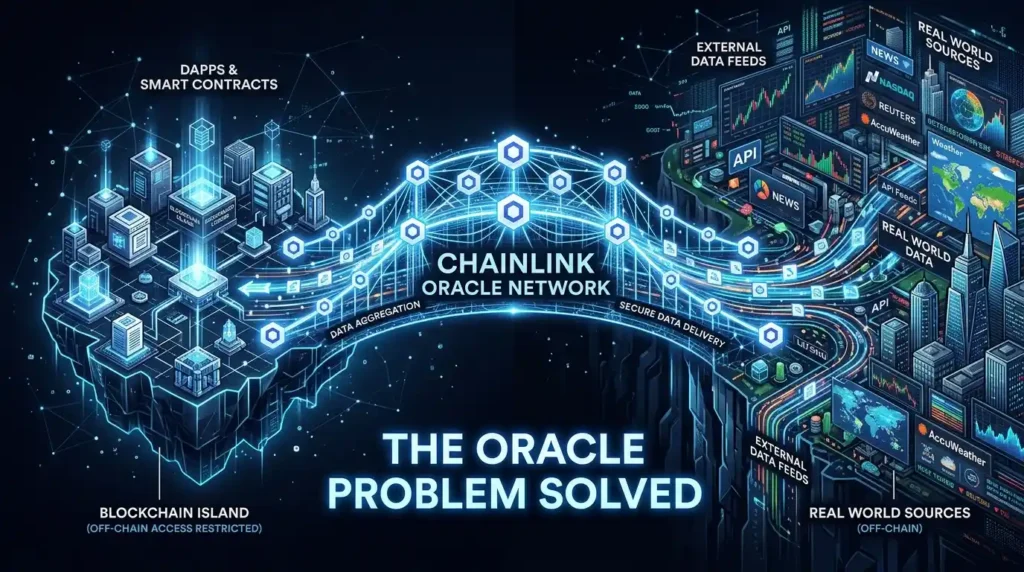
Chainlink’s solution: decentralized oracle networks. Instead of one data source, a network of independent nodes independently fetches the same data, and a consensus mechanism determines the “true” answer. No single node can manipulate the result without controlling a majority of the network — making data manipulation economically and technically prohibitive.
The Full Chainlink Product Stack
Chainlink has evolved far beyond simple price feeds. In 2026, the platform offers:
Data Feeds: Real-time price data for thousands of assets — the foundational product powering DeFi lending, derivatives, and stablecoins.
Data Streams: High-frequency, ultra-low latency data for on-chain derivatives and trading protocols requiring millisecond updates.
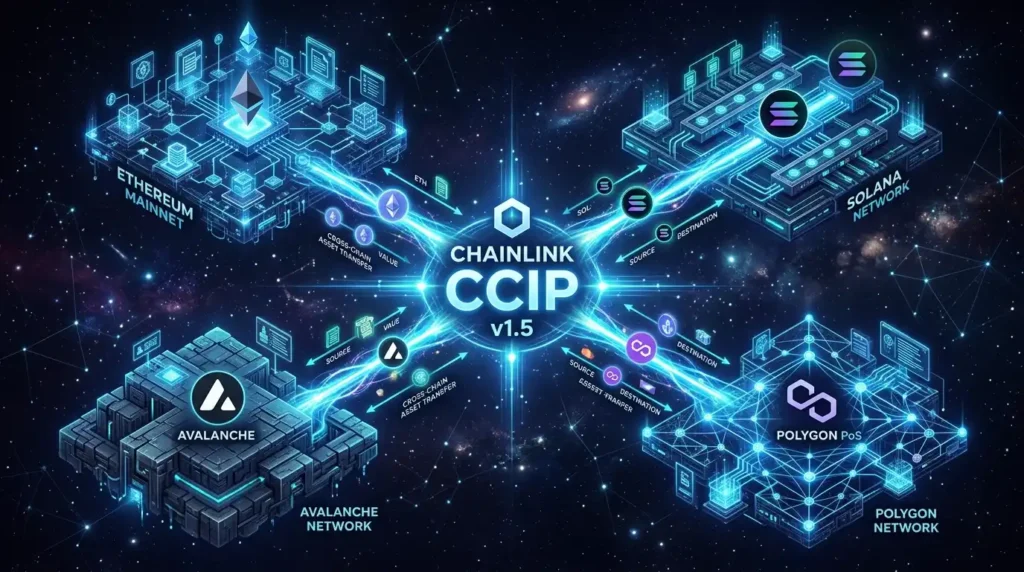
CCIP (Cross-Chain Interoperability Protocol): Chainlink’s solution for secure communication and asset transfer between different blockchains. CCIP v1.5 launched on mainnet in 2026, enabling institutions to move tokenized assets across chains with the same security guarantees as oracle data.
Proof of Reserve: Automated, real-time verification that reserves backing stablecoins and tokenized assets actually exist. Used by major stablecoin issuers to provide on-chain proof of collateral.
Functions: Allows smart contracts to connect to any public API and run custom off-chain computations — enabling arbitrary real-world connectivity.
Automation: Triggers smart contract functions automatically based on time or conditions — like automatically harvesting DeFi yield or triggering insurance payouts.
Automated Compliance Engine (ACE): Extends existing financial compliance infrastructure (KYC, AML, asset restrictions) to blockchain applications — critical for institutional adoption.
Why Institutions Use Chainlink
The institutional pitch is clear: tokenized assets on blockchain need to solve four problems:
- Data problem: What’s the real-world price of this bond? Chainlink provides verified data.
- Liquidity problem: How do we move this tokenized asset across chains? Chainlink CCIP provides the bridge.
- Synchronization problem: How does the on-chain record stay in sync with off-chain systems? Chainlink provides continuous connectivity.
- Compliance problem: How do we enforce KYC/AML on-chain? Chainlink ACE provides the framework.

This comprehensive stack is why Swift, JP Morgan, and Mastercard choose Chainlink over competitors.
LINK Tokenomics: The Numbers That Matter
| Metric | Data |
|---|---|
| Ticker | LINK |
| Current Price | ~$8.67 (April 2026) |
| Market Cap | ~$6.3 billion |
| Rank | ~#15–17 |
| Circulating Supply | ~727 million LINK |
| Maximum Supply | 1 billion LINK (hard cap) |
| % in Circulation | ~73% |
| All-Time High | $52.99 (May 10, 2021) |
| Staking APY | ~4.32% (community staking v0.2) |
| Staking Pool Cap | 45 million LINK |
| Chainlink Reserve | 2.17 million LINK (Feb 2026) |
| Value Secured | $95+ billion |
The Original Token Distribution (Why There’s Selling Pressure)
At launch, 1 billion LINK were distributed as follows:
- 35% (350 million) — Public token sale
- 35% (350 million) — Node operators and ecosystem development
- 30% (300 million) — Company reserve (Chainlink Labs)
The company and ecosystem allocation — 650 million LINK — has been a persistent concern for investors. When Chainlink Labs sells LINK to fund operations, it creates selling pressure in the market. This is the primary reason LINK has historically underperformed relative to network adoption growth.
Chainlink Economics 2.0: The Tokenomics Reset
In 2022, Chainlink introduced Economics 2.0 — a redesign of how the protocol generates and distributes value:
Staking: Node operators and community members stake LINK as security guarantees. Staking reduces circulating supply while rewarding long-term holders.
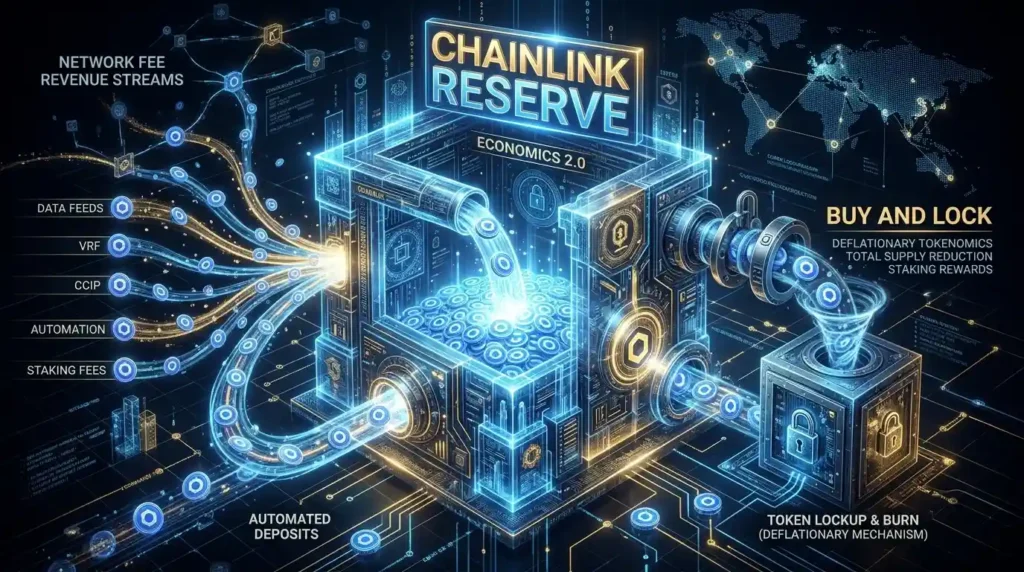
Chainlink Reserve: A strategic on-chain reserve that automatically converts network fees paid in fiat or other cryptocurrencies into LINK and locks them. As of February 2026, the Reserve holds over 2.17 million LINK — creating a systematic buy-and-lock mechanism tied directly to network revenue.
BUILD program: Early-stage projects provide a portion of their token supply to Chainlink in exchange for services. These tokens are distributed to LINK stakers as additional rewards.
SCALE program: Blockchain networks subsidize Chainlink node operating costs, reducing the need for Chainlink Labs to fund operations through LINK sales.
The thesis: as network adoption grows → more revenue → more LINK bought and locked → reduced circulating supply → price appreciation. Whether this flywheel has reached sufficient velocity is the central investment question for LINK in 2026.
2026: Institutional Adoption at Scale
Swift, JP Morgan, and the TradFi Integration
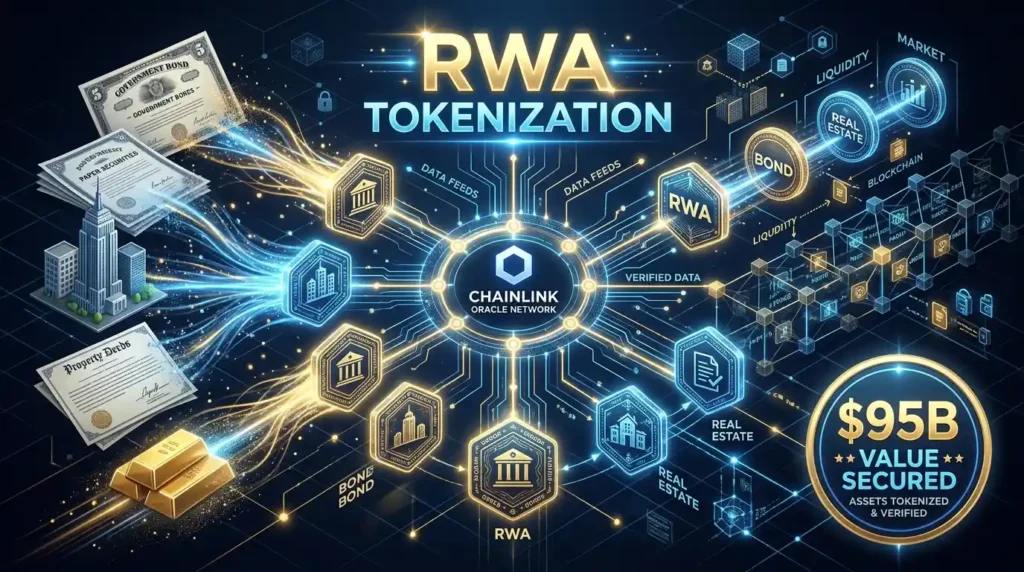
Chainlink’s most impressive 2026 story is the depth of traditional finance integration:
- Swift — the global interbank messaging system — uses Chainlink CCIP to connect its traditional payment infrastructure to blockchain networks
- JP Morgan uses Chainlink for tokenized asset infrastructure
- Mastercard integrates Chainlink for digital asset connectivity
- Euroclear uses Chainlink for securities settlement
- S&P Global Ratings publishes credit ratings on-chain via Chainlink
- Spiko Amundi fund uses Chainlink for RWA data
- OnePay (Walmart’s fintech super-app) added LINK to its crypto offerings in March 2026
SEC Crypto Task Force
Chainlink’s deputy general counsel joined the SEC’s Crypto Task Force in February 2026 — an extraordinary signal of regulatory engagement. This positions Chainlink as a cooperative partner in developing crypto regulations rather than a passive subject of them.
CCIP v1.5 Mainnet Launch
The upgraded Cross-Chain Interoperability Protocol launched on mainnet in 2026 after completing security audits. CCIP v1.5 enables more sophisticated cross-chain messaging and asset transfers — critical infrastructure for the multi-chain RWA tokenization market.
Grayscale Accumulation Signal
Grayscale’s research identified LINK as a compelling accumulation opportunity in early 2026 — a signal that institutional investment firms are positioning in Chainlink at current depressed prices.
The LINK Paradox: Why Great Technology Doesn’t Always Mean Great Price
This deserves a full section because it’s the most important thing to understand about Chainlink as an investment.
The bull case sounds perfect: Chainlink is the standard oracle infrastructure for blockchain. Every major financial institution tokenizing assets needs it. DeFi couldn’t exist without it. Network revenue is growing. The Reserve is accumulating LINK.
The disappointing reality: LINK is -84% from ATH despite all of this. The TVS (Total Value Secured) has grown dramatically — but LINK’s market cap has not kept pace.
Why the disconnect? Several reasons:
Selling pressure from allocations: Chainlink Labs holds 300 million LINK in its company reserve. Every time they sell to fund operations, it creates supply. Even as the Reserve buys and locks LINK, the company allocation can offset it.
B2B infrastructure model: Chainlink’s customers are protocols and institutions — not LINK token holders. Using Chainlink’s services doesn’t require buying LINK on open markets (fees can be paid in fiat and converted off-market). The relationship between “Chainlink is widely used” and “LINK demand increases” is less direct than investors assume.
Competition: Pyth Network (fast, cheap, Solana-native), Band Protocol, API3, and others compete for market share in specific niches.
Accumulation phase: At $8.67, LINK is near multi-year lows. Grayscale and other sophisticated allocators are accumulating. The question is whether the next catalyst comes from Economics 2.0 flywheel, CCIP adoption, or broader market recovery.
Chainlink Risks: The Honest Version
Company reserve selling: The 300 million LINK held by Chainlink Labs represents significant potential selling pressure. Investors must monitor on-chain wallet activity.
Competition: While Chainlink dominates DeFi oracles, Pyth Network has gained significant traction on Solana and newer chains. If DeFi activity migrates to chains where Pyth is dominant, Chainlink’s market share could erode.
Value accrual uncertainty: Despite massive network usage, the mechanism by which network value flows to LINK holders is indirect and depends on Economics 2.0’s Reserve and staking mechanisms working as intended.
Market indifference: Chainlink can do everything right operationally and LINK can still underperform if broader market sentiment favors other narratives (meme coins, AI tokens, etc.).
Concentration risk: The staking pool v0.2 is capped at 45 million LINK and was filled by May 2024. New community stakers can only enter when existing stakers exit — limiting participation.
How to Buy Chainlink (LINK) in the US
Step 1: Choose a regulated exchange
- Coinbase — LINK fully supported, beginner-friendly
- Kraken — strong LINK liquidity, well-regulated
- Gemini — regulated, clean interface
Step 2: Create and verify your account
Standard KYC — government ID required.
Step 3: Deposit funds
ACH bank transfer for lowest fees. Debit card for instant access.
Step 4: Buy LINK
Search for LINK or Chainlink, enter dollar amount, confirm.
Step 5: Staking options
- MetaMask / Ledger — hold LINK in your own wallet
- Chainlink Staking v0.2 — stake LINK directly at staking.chain.link (when pools have space)
- Liquid staking derivatives — various platforms offer liquid staked LINK positions
Key Chainlink Terminology for Beginners
Oracle: A service that brings external, real-world data onto a blockchain for use by smart contracts.
Oracle Problem: The fundamental challenge that blockchains can’t access off-chain data without a trusted intermediary — which Chainlink solves by decentralizing the intermediary.
DON (Decentralized Oracle Network): A network of independent nodes that collaboratively fetch, verify, and deliver data — Chainlink’s core innovation.
CCIP: Cross-Chain Interoperability Protocol — Chainlink’s standard for secure communication between different blockchains.
Proof of Reserve: Chainlink’s service for verifying on-chain that assets backing stablecoins and tokenized securities actually exist.
Chainlink Reserve: The on-chain strategic reserve that automatically buys and locks LINK using network fee revenue.
Economics 2.0: Chainlink’s redesigned tokenomics model featuring staking, the Reserve, BUILD, and SCALE programs to better align network success with LINK value.
Staking v0.2: The current community staking mechanism with a 45 million LINK cap and ~4.32% APY.
ACE (Automated Compliance Engine): Chainlink’s tool bringing KYC/AML compliance on-chain for institutional tokenized assets.
TVS (Total Value Secured): The total value of assets protected by Chainlink’s oracle infrastructure — currently $95+ billion.
Should You Buy Chainlink in 2026?
We are not financial advisors. Here is the most honest framing we can offer.
The bull case: Chainlink is genuinely critical infrastructure for the future of blockchain. The institutional adoption — Swift, JP Morgan, Euroclear — is real and growing. The RWA tokenization market (projected in the trillions) essentially requires oracle infrastructure like Chainlink. The Reserve mechanism creates systematic buying pressure tied to network revenue. At $8.67, LINK is near multi-year lows while fundamentals are at multi-year highs. Grayscale is accumulating. The CCIP launch addresses the cross-chain market.
The honest caution: Chainlink has been “critical infrastructure with disappointing price performance” for three years. The gap between network adoption and token price appreciation is real and persistent. The company reserve creates ongoing supply. Economics 2.0’s Reserve mechanism is promising but holds only 2.17 million LINK against 727 million in circulation — the flywheel is small relative to supply. LINK could remain in this paradox for longer than any investor’s patience allows.
The most accurate summary: Chainlink is one of the few crypto projects with genuine, undeniable, multi-trillion dollar utility. The investment thesis depends on whether Economics 2.0 successfully translates that utility into sustained LINK demand — and whether you have the patience to wait for that flywheel to spin up.
Disclaimer: This article is for informational purposes only and does not constitute financial advice. Cryptocurrency investments carry significant risk, including the potential loss of all invested capital. Always conduct your own research before making any investment decisions.