Most blockchains are general-purpose platforms — they support smart contracts, and developers can build whatever they want on top of them. Injective took a different approach: build a blockchain designed from the ground up specifically for financial applications, with core financial infrastructure baked into the protocol layer rather than bolted on as applications.
The result is a blockchain with a fully decentralized, MEV-resistant on-chain order book as a native primitive, built-in support for derivatives markets, seamless cross-chain interoperability across 23+ networks, and a deflationary tokenomics model that burns tokens weekly based on protocol revenue.
In April 2026, INJ trades at approximately $3.60–3.65 with a market cap around $360–365 million. Its all-time high of $52.94 was reached on March 14, 2024 — making its current price approximately 94% below ATH. The INJ token has one of the most aggressive and unique deflationary mechanisms in crypto — burning tokens every week through auction. Over 1 billion cumulative transactions have now been processed on the network.
The Origin Story: Incubated by Binance
Injective has a distinctive origin that separates it from most blockchain projects: it was originally incubated by Binance — the world’s largest cryptocurrency exchange.
Injective Labs was co-founded by Eric Chen and Albert Chon:
- Eric Chen (CEO) — brings expertise in both blockchain protocols and traditional finance. Previously worked on blockchain research and DeFi protocol design.
- Albert Chon (CTO) — Stanford graduate and former software engineer at Amazon, known for pioneering an Ethereum standard adopted by major projects.
The Binance incubation and subsequent investment from Binance Labs (now YZi Labs) wasn’t just financial — it provided Injective with strategic partnerships, exchange listings, and institutional credibility in Asia and globally that most independent projects spend years trying to build.
Mainnet launch: October 19, 2020 — making Injective one of the older DeFi-focused Layer 1s in the current ecosystem.
What Makes Injective Different: Finance as Infrastructure
The defining characteristic of Injective isn’t its consensus mechanism or VM — it’s the decision to build financial primitives directly into the protocol layer rather than leaving them entirely to application developers.
The Native On-Chain Order Book
Traditional DEXs (like Uniswap) use Automated Market Makers (AMMs) — liquidity pools with mathematical pricing formulas. This works well for spot trading but is fundamentally unsuitable for derivatives, options, and institutional-grade trading.
Injective embedded a fully decentralized, MEV-resistant Central Limit Order Book (CLOB) directly into the blockchain protocol. This means:
- Any application can leverage the order book without building it from scratch
- Spot, perpetual futures, expiry futures, and options markets are all supported natively
- MEV resistance: Injective uses frequent batch auctions to process orders — eliminating the front-running and sandwich attacks that plague Ethereum DEXs
- Zero gas fees for users on most operations — fees are handled at the protocol level
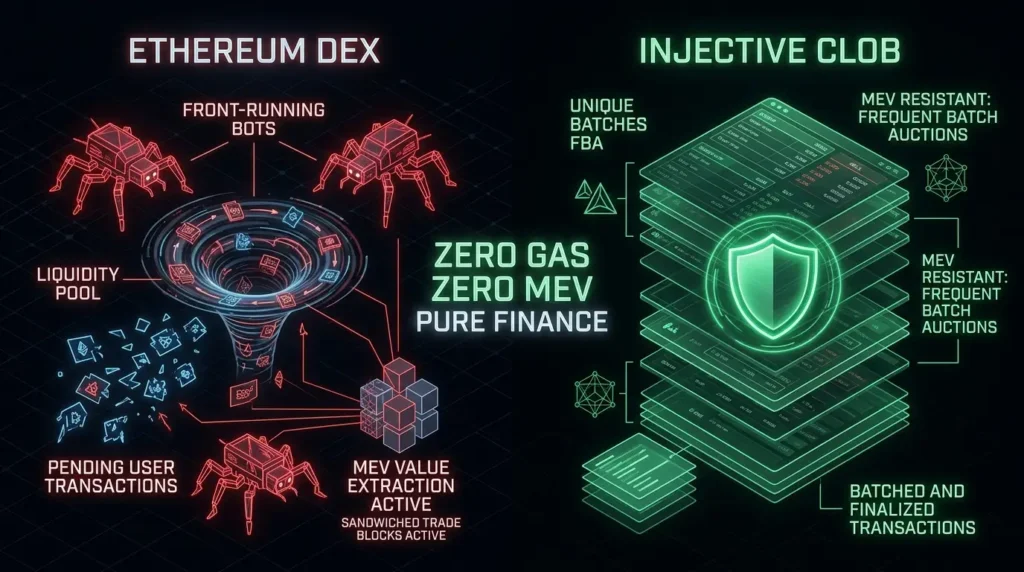
Why MEV resistance matters: On Ethereum, sophisticated bots (and validators) extract billions of dollars annually from traders by front-running their orders — inserting their own trades ahead of user transactions to profit at users’ expense. Injective’s batch auction system eliminates this attack vector structurally.
Plug-and-Play Financial Modules
Injective provides developers with pre-built, customizable modules covering:
- Exchange primitives (order matching, market creation)
- Oracle integrations (price feeds for any asset)
- Token launch modules
- Prediction market infrastructure
- Real World Asset (RWA) modules
A developer building a derivatives exchange on Injective can leverage these modules to go from concept to production in days — a process that would take months on general-purpose blockchains.
The Technical Stack
Consensus: Custom Tendermint Proof-of-Stake implementation — provides instant transaction finality with 1.2-second block times and 25,000+ TPS theoretical throughput.
Smart contracts: CosmWasm (Wasm-based) + new MultiVM initiative to support additional virtual machines. Not EVM-native but EVM-compatible through bridge and wrapping.
Interoperability:
- IBC (Inter-Blockchain Communication) — connects to the entire Cosmos ecosystem
- Ethereum bridge (Peggy) — two-way asset transfers to Ethereum
- Solana bridge
- 23+ total network integrations
AI infrastructure: Injective launched an SDK for on-chain AI agents — autonomous programs operating within DeFi applications, capable of automated trading, predictive analysis, and financial modelling.
The INJ Burn Auction: Injective’s Unique Deflationary Mechanism
This is arguably Injective’s most distinctive tokenomics feature — and one that has no direct equivalent in the broader crypto ecosystem.
How It Works
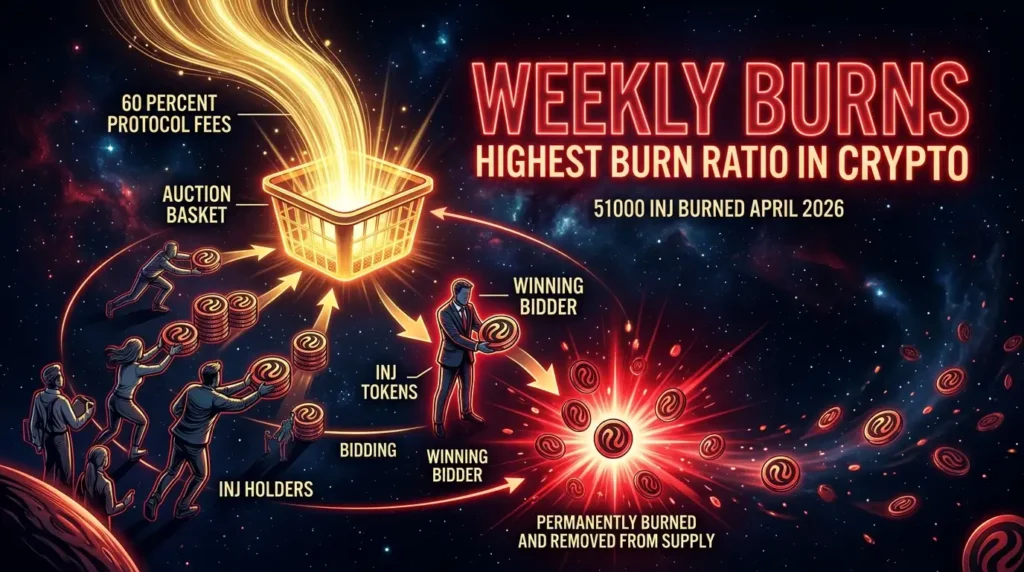
Every week on Injective, the following happens:
- Fee collection: 60% of all fees collected from dApps on Injective are pooled into an auction basket
- Basket auction: The pooled fees (in various tokens — USDT, ETH, other assets) are auctioned off to any INJ holder who wants to bid
- INJ payment: The winning bidder pays INJ tokens for the basket
- Permanent burn: The INJ paid by the winner is permanently burned — removed from the total supply forever
The economic logic:
- As Injective generates more fee revenue, the auction basket becomes more valuable
- More valuable baskets attract higher INJ bids
- Higher bids = more INJ burned per week
- Network usage directly drives token supply reduction
Community BuyBack program (ongoing 2026):
Beyond the weekly burn auction, a separate monthly Community BuyBack program purchases INJ on the open market and burns it. In April 2026, 51,000 INJ were removed from supply through this mechanism in a single month.
Current burn rate and supply:
- Total supply: fixed at 100 million INJ (max supply, fully issued)
- Circulating supply: ~97–100 million INJ (nearly all tokens in circulation)
- Injective claims the highest token burn ratio in the crypto industry
- Cumulative supply has been meaningfully reduced since mainnet launch
This burn mechanism creates a direct link between protocol activity and token value — the more DeFi activity on Injective, the more INJ is permanently destroyed. It’s one of the most structurally deflationary designs in crypto.
The INJ Airdrop and Early Community Distribution
Injective’s early community distribution happened through a combination of mechanisms rather than a single large airdrop event.
Binance IEO (October 2020): INJ was launched through a Binance Launchpad IEO (Initial Exchange Offering) — giving Binance users the ability to purchase INJ tokens at the initial distribution price. This provided broad initial distribution to an existing user base of millions.
Liquidity mining and staking rewards: Early ecosystem participants who staked INJ, provided liquidity, or participated in protocol testing received token rewards during the mainnet development and early mainnet phases.
Ongoing ecosystem incentives: The Injective Foundation has run multiple campaigns, hackathons, and developer grants distributing INJ to ecosystem builders and early users.
The IEO mechanism rather than traditional airdrop is worth noting: Binance’s platform gave INJ immediate global distribution at launch, but through a purchase mechanism (at ~$0.40–0.90 initial sale range) rather than free distribution to qualifying addresses. Early IEO participants who held saw extraordinary returns during the 2021 bull market and the 2024 run to $52.94.
INJ Price History: From IEO to $52.94 ATH and Back
The IEO and Initial Trading (2020–2021)
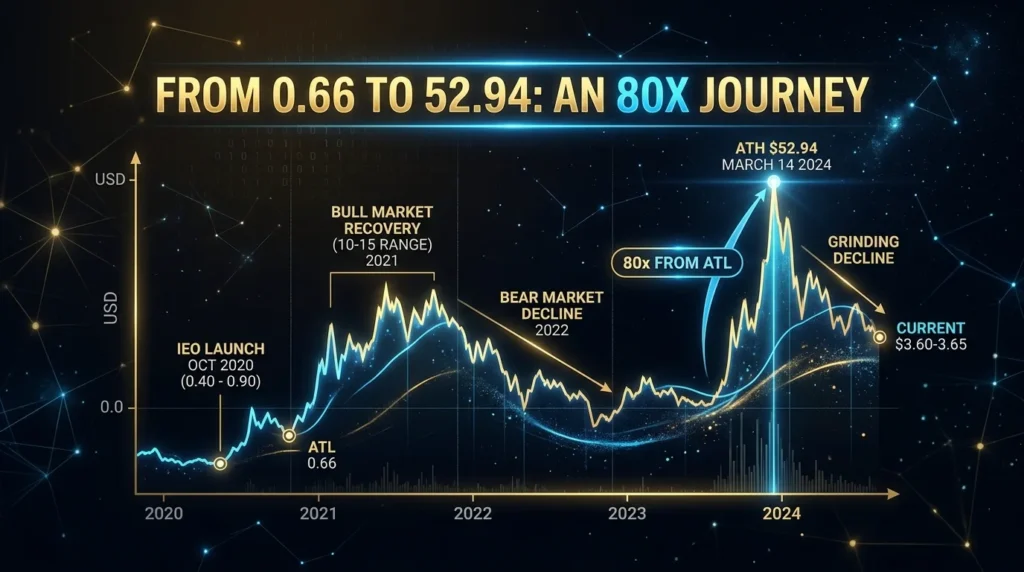
INJ launched through Binance Launchpad in October 2020 at an initial token sale price around $0.40–0.90. The token began trading at modest prices before the broader 2021 bull market lifted all boats.
Early 2021 bull market:
MATIC, DOT, SOL, and other altcoins saw explosive gains in early 2021. INJ participated — rising from early lows to the $10–15 range during the May 2021 altcoin season before the market correction.
All-time low: Recorded at $0.66 — demonstrating the severity of the 2021–2022 bear market correction for INJ.
The 2022 Bear Market
Like virtually every altcoin, INJ was punished in 2022. The bear market driven by Terra/LUNA collapse, Three Arrows Capital bankruptcy, and FTX’s implosion wiped out gains across the sector. INJ found support around the $1–3 range during the worst periods.
What Injective did during the bear market: Rather than retreating, the team continued building aggressively. The mainnet was upgraded, the order book functionality improved, new financial instruments added. The RWA (Real World Assets) narrative was developed. The interoperability architecture was expanded. By the time the bull market returned, Injective had meaningfully better fundamentals than at the 2021 peak.
The Spectacular 2023–2024 Bull Run
INJ’s 2023–2024 performance was genuinely remarkable — one of the standout stories of the cycle:
Late 2023: INJ began recovering as DeFi sentiment improved and the Injective ecosystem metrics — transactions, active addresses, TVL — showed strong growth. The burn mechanism became a significant narrative as investors understood its deflationary implications.
2024 bull market: INJ became one of the outperforming majors. The combination of:
- Unique deflationary burn mechanism (easy to understand value capture)
- Growing DeFi ecosystem with real usage
- Cosmos/IBC interoperability expanding the accessible market
- RWA narrative (Injective positioning as RWA infrastructure)
- Binance backing (continued exchange support and promotion)
…all contributed to strong price momentum.
March 14, 2024: INJ reached its all-time high of $52.94 — an extraordinary journey from the $0.66 all-time low. Those who bought at the ATL and held to ATH saw an 80x return. Even from the Binance IEO price of ~$0.40–0.90, the ATH represented a 60–130x return.
The 2024–2026 Decline
Following the March 2024 ATH, INJ entered a correction characteristic of the broader altcoin market:
The character of the decline: INJ’s fall from $52.94 to the $3–4 range in 2026 has been a sustained grinding decline — not a single dramatic crash. Multiple recovery attempts (30–60% bounces during risk-on crypto periods) were each followed by resumption of the downtrend.
May 2026: INJ trades approximately $3.60–3.65 — roughly 93–94% below its $52.94 ATH.
Contributing factors:
- Fixed supply of 100M INJ fully in circulation — no unlock pressure (unlike many competitors), but also means all selling is from holders, not new issuance
- Burn mechanism positive but insufficient to offset macro altcoin weakness
- Competition from newer DeFi chains and derivatives platforms
- Broader crypto cycle rotation back toward Bitcoin
An important context: INJ’s 93% decline from ATH is not unusual for this crypto cycle — many high-quality projects have seen similar or worse corrections. And critically, INJ’s fixed supply and active burn mechanism mean there’s no structural vesting unlock pressure unlike most other tokens.
Who Backed Injective?
Beyond Binance incubation (Binance Labs, now YZi Labs), Injective attracted backing from prominent crypto-native and mainstream institutional investors:
Pantera Capital — one of the earliest and most respected crypto-focused investment funds globally. Their involvement signals fundamental belief in the project’s market thesis.
Jump Crypto — the crypto arm of Jump Trading, one of the world’s most sophisticated algorithmic trading firms. Jump’s investment in a DeFi derivatives platform carries specific credibility — they understand the derivatives market.
Mark Cuban — the billionaire entrepreneur and Dallas Mavericks owner participated in Injective’s funding rounds. While his involvement is more high-profile than strategic, it indicates broad mainstream interest in the project.
Additional institutional participants included other prominent crypto funds and strategic partners. Total funding raised across multiple rounds reached tens of millions of dollars — modest compared to some Layer 1 raises but sufficient given the more focused, team-efficient development approach.
The Injective Ecosystem in 2026
Scale:
- 1 billion+ cumulative transactions processed
- 100+ active projects in the ecosystem
- 500,000+ community members globally
- Network processes 25,000+ TPS with 1.2-second finality
Key DeFi applications:
- Helix — Injective’s flagship decentralized derivatives exchange. Perpetual futures, options, and spot trading
- Mito — automated yield vaults and trading strategies
- Black Panther — liquid staking protocol for INJ
- Neptune — lending and borrowing protocol
- Realmint — tokenized real-world asset (RWA) platform backed by Injective Foundation
Real World Assets (RWA):
Injective has become a meaningful platform for RWA tokenization — tokenized commodities, bonds, and real assets. The Realmint platform aggregates over 50 commodities across multiple chains with a scoring system for comparison.
AI agents:
Injective launched an SDK for on-chain AI agents — enabling autonomous AI programs to trade, manage positions, and interact with DeFi applications directly on-chain.
MultiVM initiative:
New initiative to support additional virtual machines on Injective — expanding developer accessibility beyond the current CosmWasm smart contract environment.
Key 2026 Developments
Mainnet Upgrade IIP-632 (April 28, 2026): Enhanced trading speed, improved derivatives risk management (new Auto-Deleveraging system), refined INJ burn buyback efficiency. Network upgraded to v1.19.0.
Injective Summit 2026 (July 16, Washington D.C.): Major ecosystem event bringing crypto, traditional finance, and big tech partners — following the precedent of the 2025 summit which featured institutions like Citibank and 21Shares.
Staked INJ ETF Progress (Q3/Q4 2026): Regulatory advancement of a novel ETF product combining spot INJ price and staking rewards — would be one of the first ETF products combining yield with spot exposure for a non-Bitcoin/Ethereum asset.
Monthly Community BuyBack (ongoing): 51,000 INJ burned in April 2026 alone through the monthly buyback and burn program.
INJ Tokenomics (May 2026)
| Metric | Data |
|---|---|
| Price | ~$3.60–3.65 |
| Market cap | ~$360–365 million |
| Circulating supply | ~97–100 million INJ |
| Max supply | 100 million INJ (fixed, all issued) |
| All-time high | $52.94 (March 14, 2024) |
| All-time low | $0.66 |
| CoinMarketCap ranking | ~#123–140 |
| FDV | ~$360–365 million (= market cap, fully diluted) |
| Inflation | 0% (fixed supply, net deflationary via burns) |
The tokenomics advantage: Unlike most tokens that face ongoing sell pressure from vesting unlocks and team/investor distributions, INJ has a fixed max supply that is fully in circulation. All deflationary pressure comes from the burn mechanism. There’s no hidden supply overhang — what you see is what exists.
Distribution (at mainnet launch)
- Ecosystem development: 40%
- Binance Launchpad (public sale): 9.47%
- Team: 20%
- Seed and private rounds: 30.53%
Injective vs. The Competition
Injective occupies a distinctive niche — a finance-specific L1 competing both with general-purpose L1s (Ethereum, Solana) and specialized DeFi chains.
| Injective | Ethereum (DeFi) | dYdX | Hyperliquid | |
|---|---|---|---|---|
| Focus | Finance-native L1 | General purpose | Derivatives DEX (Cosmos chain) | Derivatives L1 |
| Order book | Native CLOB, MEV-resistant | Application layer (limited) | Native CLOB | Native CLOB |
| Market cap (2026) | ~$360M | ~$200B+ | ~$1–2B | ~$3–5B |
| Gas model | Zero gas for users | High and variable | Low | Low |
| Interoperability | 23+ chains (IBC + Ethereum + Solana) | Limited native | Cosmos/IBC | Limited |
| Burn mechanism | Weekly 60% fee burn | EIP-1559 ETH burn | DYDX buyback | HYPE buyback |
| Key advantage | Finance modules, burn mechanism | DeFi ecosystem depth | Derivatives focus | Fast perps, growing |
The competitive challenge: dYdX v4 (built on Cosmos SDK, similar to Injective’s foundation) and Hyperliquid (a new high-performance derivatives chain) have emerged as strong competitors specifically in the derivatives and perpetuals market that is Injective’s core use case. Hyperliquid in particular achieved significant TVL and trading volume in 2024–2025 — directly competing with Injective’s core derivatives narrative.
How to Buy INJ
Available on: Coinbase, Binance, Kraken, Bybit, OKX, Gate.io
INJ is the native token of the Injective blockchain, compatible with Injective’s native wallet and MetaMask (via bridge). Available as both an ERC-20 token on Ethereum and natively on the Injective chain.
Key Terminology
Injective Order Book: Fully decentralized, MEV-resistant Central Limit Order Book built into the Injective protocol layer — supports spot, perpetual, futures, and options markets natively.
Burn Auction: Weekly auction where 60% of Injective protocol fees are auctioned for INJ, which is then permanently burned — Injective’s primary deflationary mechanism.
MEV (Maximal Extractable Value): Value extracted by validators/bots by reordering transactions. Injective’s batch auction system eliminates MEV from its order book.
CosmWasm: Wasm-based smart contract platform used by Injective and other Cosmos-ecosystem chains.
IBC (Inter-Blockchain Communication): Cosmos protocol for trustless cross-chain asset and message transfers — gives Injective access to the entire Cosmos ecosystem.
Tendermint PoS: Byzantine Fault Tolerant consensus mechanism providing instant finality — used by Injective and many Cosmos chains.
Peggy: Injective’s bidirectional Ethereum bridge, secured by Injective validators.
MultiVM: Injective’s initiative to support multiple virtual machines — expanding developer access beyond CosmWasm.
Disclaimer: This article is for informational and educational purposes only and does not constitute financial advice. Cryptocurrency investments carry significant risk, including the potential loss of all invested capital. Always conduct your own research before making any investment decisions.