If Bitcoin is digital gold, then Ethereum is the digital world’s operating system. It’s the platform where most of the interesting things in crypto actually happen — decentralized finance, NFTs, stablecoins, and applications that run without anyone being in charge.
Bitcoin answered one question: can we create digital money without a bank? Ethereum asked a much bigger one: can we rebuild the entire internet’s financial infrastructure without any central authority at all?
Spoiler: it’s still working on it. But it’s come further than almost anyone expected.
As of April 2026, Ethereum sits at #2 by market cap, trading around $2,100 per coin with a total market capitalization of approximately $254 billion. It’s not Bitcoin — nothing is — but it’s the backbone of a financial ecosystem that processes billions of dollars in transactions every day.
Let’s break down exactly what it is, how it works, and why it matters.
The Quick Answer: What Is Ethereum?
Ethereum is a decentralized blockchain platform that allows developers to build and run applications without relying on a central server or company. The native currency of the Ethereum network is called Ether (ETH) — that’s what you actually buy on an exchange when you “buy Ethereum.”
Here’s the key distinction that trips everyone up:
- Ethereum = the network (like the internet)
- Ether (ETH) = the currency (like the dollar you use online)
When people say “I bought Ethereum,” they mean they bought Ether. The network itself isn’t for sale — it’s decentralized and owned by no one.
Who Created Ethereum? The Teenager Who Changed Finance
Unlike Bitcoin’s mysterious Satoshi Nakamoto, Ethereum’s creator is very much known — and very much still involved.
Vitalik Buterin published the Ethereum whitepaper in November 2013. He was 19 years old. A Russian-Canadian programmer who had been writing for Bitcoin Magazine as a teenager, Buterin recognized that Bitcoin’s blockchain could do more than just record transactions. His insight: if you add a programming language to a blockchain, you can build basically anything on top of it.
Ethereum was officially proposed in 2013, crowdfunded in 2014 (raising over $18 million in one of the first major ICOs), and launched on July 30, 2015. That launch date is now celebrated annually by the Ethereum community — because apparently crypto people celebrate blockchain birthdays, which is exactly as nerdy as it sounds.
Buterin didn’t work alone. Co-founders include Gavin Wood (who wrote the technical specification and later founded Polkadot), Charles Hoskinson (who later founded Cardano), and several others who have since gone on to build their own competing blockchain projects. The Ethereum founding team has arguably produced more blockchain entrepreneurs than any other single project in history.
How Does Ethereum Actually Work?
Smart Contracts: The Game Changer
The concept that makes Ethereum fundamentally different from Bitcoin is the smart contract.
A smart contract is a program stored on the blockchain that automatically executes when predefined conditions are met. No lawyer, no bank, no middleman required.
Example: imagine you want to bet a friend $100 that Bitcoin will be above $80,000 by the end of the month. Normally, someone has to hold the money and pay out when the result is known. With a smart contract, you both deposit $100 into the contract code, which automatically checks the Bitcoin price on the specified date and sends the entire $200 to whoever wins. No trust required — the code handles everything.

Scale this concept up and you get: decentralized exchanges, lending protocols, stablecoins, NFT marketplaces, prediction markets, insurance products, and hundreds of other financial applications running autonomously without any company controlling them.
Gas: Paying for Computation
Every operation on the Ethereum network — every transaction, every smart contract execution — requires computational resources. Users pay for these resources in gas, denominated in Gwei (one Gwei = 0.000000001 ETH).
Gas fees fluctuate based on network demand. When Ethereum is busy — during an NFT mint frenzy, a major DeFi launch, or a market panic — gas fees can spike dramatically. During quiet periods, fees are minimal.
This fee mechanism was significantly improved by the EIP-1559 upgrade in August 2021, which introduced a “base fee” that is automatically burned (destroyed) rather than paid to miners. More on why this matters in the tokenomics section.
The Merge: From Mining to Staking
In September 2022, Ethereum underwent one of the most significant upgrades in blockchain history: The Merge.
Before The Merge, Ethereum used Proof of Work — the same energy-intensive mining process as Bitcoin. After The Merge, Ethereum switched to Proof of Stake, reducing its energy consumption by approximately 99.95%. Overnight, Ethereum went from being criticized for its environmental impact to being one of the most energy-efficient major blockchains.

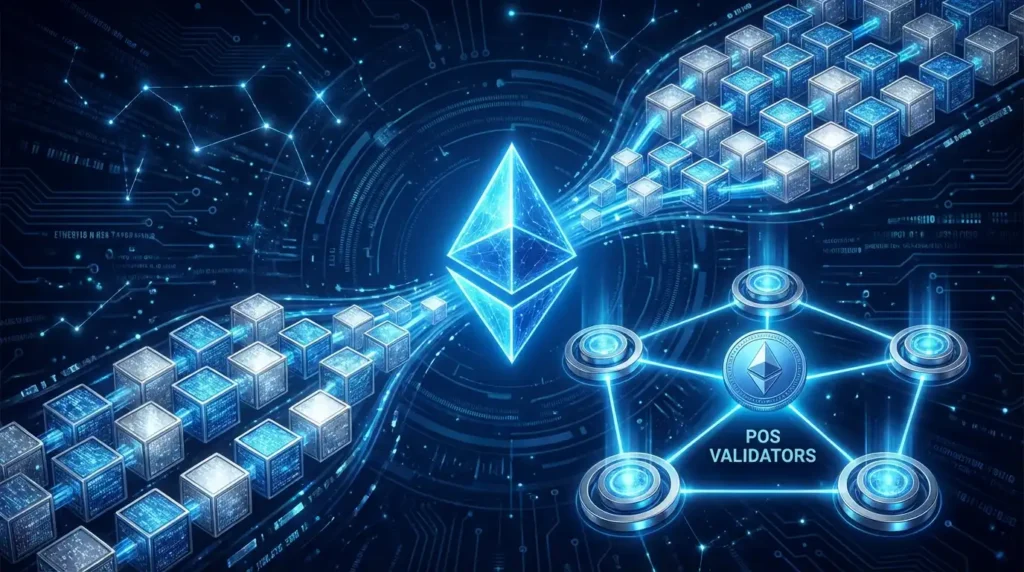
Under Proof of Stake, network security is maintained by validators — participants who lock up (stake) 32 ETH as collateral. In exchange for securing the network, they earn staking rewards. As of 2026, over 35 million ETH is staked — nearly 30% of the total supply — by more than 1 million active validators.
Ethereum Tokenomics: The Numbers That Matter
| Metric | Data |
|---|---|
| Ticker | ETH |
| Current Price | ~$2,100 (April 2026) |
| Market Cap | ~$254 billion |
| Rank | #2 |
| Circulating Supply | ~120.7 million ETH |
| Maximum Supply | No hard cap |
| All-Time High | $4,950 (August 2025) |
| ETH Staked | ~35.8 million ETH (~29% of supply) |
| Staking APY | ~3.3% average |
| Total ETH Burned (since EIP-1559) | 4.6+ million ETH |
No Hard Cap: Is That a Problem?
The first question every Bitcoin maximalist asks about Ethereum: “But there’s no 21 million limit — isn’t ETH just inflationary garbage?”
Fair question. The honest answer: Ethereum’s supply dynamics are more complex and more interesting than a simple hard cap.
Before The Merge, Ethereum was significantly inflationary — new ETH was constantly being created and paid to miners. After The Merge and EIP-1559, the picture changed dramatically:
ETH issuance: New ETH is issued to validators as staking rewards — currently at a low annual rate.
ETH burning: Every transaction on Ethereum burns a portion of the fee (the base fee). When the network is busy enough, the amount burned exceeds the amount issued.
Net result: During periods of high network activity, Ethereum becomes deflationary — there’s less ETH at the end of the day than at the beginning. During quiet periods, it’s mildly inflationary.

Since EIP-1559 launched, over 4.6 million ETH has been permanently burned. That’s billions of dollars worth of ETH removed from circulation forever. Not bad for a network without a hard cap.
Staking: ETH That Earns Yield
Unlike Bitcoin, Ethereum holders can stake their ETH to earn rewards — essentially earning interest on their holdings by helping secure the network.
Options for staking in 2026:
- Solo staking: Run your own validator node (requires 32 ETH minimum, technical knowledge)
- Liquid staking: Platforms like Lido allow staking with any amount and provide a liquid token (stETH) in return
- Exchange staking: Coinbase, Kraken, and others offer simplified staking services
Average yields hover around 3–5% annually — not dramatic, but reliable, and better than most traditional savings accounts. For institutional investors, this transforms ETH from a speculative asset into a yield-bearing position, more like a bond than a typical cryptocurrency.
Ethereum’s Price History: The Sequel That Keeps Delivering
2015: Ethereum launches at around $0.30 per ETH. Early buyers who are still holding have done well. Very well.
2017: The ICO boom. Every new blockchain project raises money by issuing tokens on Ethereum, driving massive demand for ETH. Price surges from under $10 to nearly $1,400 by January 2018. Then the entire crypto market collapses and ETH spends most of 2018-2019 falling back toward $100.
2020: DeFi Summer. Decentralized finance explodes in popularity, with billions flowing into Ethereum-based protocols. ETH rises from around $130 to nearly $750 by year end.
2021: The NFT boom meets institutional interest. ETH hits its then-all-time high of roughly $4,800 in November 2021. Then the 2022 bear market arrives and ETH drops below $900 — an 80%+ decline from its peak.
2022: The Merge happens in September. Despite being one of the most technically impressive achievements in blockchain history, the price doesn’t immediately reflect this — the broader crypto market is still in bear mode.
2024–2025: Ethereum spot ETFs launch in the US, joining Bitcoin ETFs in providing regulated institutional exposure. The bull market resumes. ETH reaches its all-time high of $4,950 in August 2025.
Early 2026: ETH is trading around $2,100 — down roughly 57% from its ATH but still significantly higher than where most long-term holders bought. Institutional staking through ETFs is becoming mainstream, with BlackRock and Fidelity among the players seeking staking-enabled ETH products.
What Is Ethereum Used For?
Decentralized Finance (DeFi)
Ethereum is the undisputed home of DeFi. Protocols built on Ethereum allow users to lend, borrow, trade, and earn yield — all without a bank.
As of 2026, Ethereum’s Total Value Locked (TVL) in DeFi stands at approximately $68 billion — roughly 8 times larger than its nearest competitor. The major protocols — Aave, Uniswap, MakerDAO, Compound — process billions in volume daily.
Stablecoins
The majority of the world’s stablecoins run on Ethereum. USDT (Tether), USDC (Circle), and DAI are all primarily Ethereum-based assets. When businesses and individuals want to use dollar-denominated digital money, they’re usually using Ethereum under the hood.
NFTs
During the 2021–2022 NFT boom, Ethereum was the primary platform for buying and selling digital art, collectibles, and gaming assets. While NFT trading has cooled significantly from its peak, Ethereum remains the most trusted platform for high-value digital ownership.
Tokenized Real-World Assets
Perhaps the most significant emerging use case: traditional financial assets — stocks, bonds, real estate — being tokenized and represented on the Ethereum blockchain. BlackRock, Franklin Templeton, and other major institutions are actively building in this space. This could eventually be bigger than DeFi, NFTs, and stablecoins combined.
The App Store Analogy
The best way to think about Ethereum’s role: it’s like Apple’s App Store or Google’s Play Store — a platform that other developers build on. Just as developers pay Apple a cut when apps run on iOS, application users pay ETH gas fees when apps run on Ethereum. The more apps and users, the more valuable the underlying platform.
Layer 2: Ethereum’s Speed Solution
Ethereum’s base layer can process approximately 15–30 transactions per second. That’s not enough for global scale. The solution: Layer 2 networks — separate blockchains that process transactions at high speed and low cost, then periodically settle those transactions back to Ethereum.
The major Layer 2 networks in 2026:
- Arbitrum — largest by TVL, popular for DeFi
- Optimism — strong ecosystem, used by Coinbase’s Base
- Base — Coinbase’s own L2, growing rapidly
- zkSync, Starknet — zero-knowledge proof-based L2s, cutting-edge technology
With Layer 2s, transactions that would cost dollars on Ethereum mainnet can cost fractions of a cent and settle in seconds. This is where most everyday Ethereum activity is moving.
Ethereum Risks: The Honest Version
No hard cap: Some investors prefer the certainty of Bitcoin’s 21 million limit. Ethereum’s deflationary mechanism works well during high activity, but requires continued network usage.
Competition: Solana, Avalanche, and other blockchains offer faster and cheaper transactions. While Ethereum maintains dominant market share, competition is real.
Complexity: Smart contracts contain bugs. Several high-profile hacks have exploited vulnerabilities in Ethereum-based protocols, resulting in hundreds of millions in losses.
Regulatory uncertainty: Staking, DeFi, and tokenized assets are all areas where regulators are still developing frameworks. Changes could significantly impact Ethereum’s ecosystem.
Gas fees: Despite Layer 2 improvements, Ethereum mainnet fees remain high during peak periods. New users sometimes find the fee experience frustrating.
Vitalik risk: Unlike Bitcoin, Ethereum’s development is significantly influenced by its founder. While this has been largely positive, it represents a concentration of influence unusual for a “decentralized” network.
How to Buy Ethereum in the US: Step by Step
Step 1: Choose a regulated exchange
- Coinbase — most beginner-friendly, US-regulated, direct access to ETH staking
- Kraken — excellent security, competitive fees, good staking options
- Gemini — strong compliance, New York-based, clean interface
Step 2: Create and verify your account
All regulated US exchanges require identity verification (KYC). Prepare a government-issued ID. Verification typically takes minutes to 24 hours.
Step 3: Deposit funds
Bank transfer (ACH) is the cheapest option but takes 1–3 business days. Debit card is instant but carries higher fees. Wire transfer is fastest for large amounts.
Step 4: Buy ETH
Search for ETH or Ethereum, enter your dollar amount, review the fee, confirm. You can buy as little as $1 worth — no need to buy a whole ETH.
Step 5: Consider staking
If you’re buying ETH as a long-term hold, staking through Coinbase, Kraken, or directly through Lido can earn you 3–5% annually on your holdings. It’s one of the few ways to earn passive income in crypto with a relatively established track record.
Step 6: Storage
For amounts above $1,000–2,000, consider a hardware wallet (Ledger, Trezor) for maximum security. For casual amounts, a reputable exchange is fine.
Ethereum vs. Bitcoin: What’s the Difference?
| Feature | Bitcoin (BTC) | Ethereum (ETH) |
|---|---|---|
| Primary purpose | Store of value / digital gold | Programmable blockchain platform |
| Smart contracts | Limited | Native, extensive |
| Supply cap | 21 million hard cap | No hard cap (deflationary mechanism) |
| Consensus | Proof of Work (mining) | Proof of Stake (staking) |
| Staking yield | None | ~3–5% annually |
| Transaction speed | ~7 TPS | ~15–30 TPS (much faster with L2) |
| Energy usage | High | ~99.95% less than pre-Merge |
| Main use cases | Store of value, payments | DeFi, stablecoins, NFTs, tokenization |
The short version: Bitcoin is the most trusted store of value. Ethereum is the most active programmable platform. They serve different purposes and many investors hold both.
Ethereum’s 2026 Roadmap: What’s Coming
Ethereum’s development never stops. Key upcoming upgrades:
Glamsterdam (H1 2026): Targets a gas limit beyond 100 million, significantly increasing network capacity and reducing fees.
Hegotá (H2 2026): Focuses on faster single-slot finality (targeting ~2-second block times) and quantum-resistant security foundations.
Danksharding: A multi-phase upgrade that will dramatically increase Ethereum’s data capacity, making Layer 2 transactions even cheaper.
If these upgrades execute successfully, Ethereum’s scalability will improve substantially, potentially bringing more users and applications — and consequently more ETH burning — into the ecosystem.
Key Ethereum Terminology for Beginners
Ether (ETH): The native cryptocurrency of the Ethereum network, used to pay transaction fees and as a store of value.
Gas: The fee paid for computing operations on Ethereum, measured in Gwei.
Smart contract: Self-executing code stored on the blockchain that runs automatically when conditions are met.
The Merge: Ethereum’s September 2022 transition from Proof of Work to Proof of Stake.
Staking: Locking ETH as collateral to help validate transactions and earn rewards.
DeFi: Decentralized Finance — financial applications built on Ethereum that operate without central intermediaries.
Layer 2: Blockchain networks built on top of Ethereum to increase transaction speed and reduce costs.
EIP-1559: The 2021 upgrade that introduced ETH burning, fundamentally changing Ethereum’s supply dynamics.
Validator: A participant who stakes 32 ETH and runs software to help secure the Ethereum network.
Lido/stETH: The largest liquid staking protocol on Ethereum, allowing users to stake any amount of ETH and receive stETH tokens in return.
Should You Buy Ethereum in 2026?
We are not financial advisors, and this is not financial advice. If we were and it were, we’d probably be charging more for this article.
What we can say: Ethereum is the most active smart contract platform in the world, with the largest developer ecosystem, the most DeFi TVL, the most stablecoins, and growing institutional adoption through spot ETFs. Its tokenomics have improved significantly since The Merge, with deflationary pressure during high-activity periods. Staking provides a native yield mechanism that Bitcoin doesn’t offer.
It is also volatile, faces real competition, and carries technical complexity that Bitcoin doesn’t. The lack of a hard supply cap makes some investors uncomfortable, though the burning mechanism provides a meaningful counterbalance.
The question isn’t really “is Ethereum good?” The question is whether it fits your investment timeline, risk tolerance, and understanding. A well-informed decision made with money you can afford to risk is always better than a panicked buy at the peak because someone at work won’t stop talking about it.
Do your research. Start small if you invest. And if you decide to stake — enjoy watching those staking rewards accumulate, even when the price is doing things that make your stomach hurt. It helps. Slightly.
Disclaimer: This article is for informational purposes only and does not constitute financial advice. Cryptocurrency investments carry significant risk, including the potential loss of all invested capital. Always conduct your own research before making any investment decisions.