In 1992, sci-fi author Neal Stephenson wrote a novel called Snow Crash. In it, he described a virtual world called the Metaverse — a persistent, immersive digital universe where people lived parallel lives as avatars, owned digital real estate, attended events, and conducted business. You accessed it through goggles and earphones, and it was as real as real life.
Thirty years later, Mark Zuckerberg renamed Facebook to “Meta” and spent over $40 billion trying to build it.
The results have been… mixed.
Understanding the metaverse — what it actually is, what the crypto connection is, what’s genuinely working, and what’s still science fiction — matters for anyone trying to understand where the internet might be going.
The Quick Answer: What Is the Metaverse?
The metaverse is a persistent, immersive, interconnected digital world where people can interact with each other and with digital environments in real-time using avatars — and where digital ownership is verifiable and meaningful.
The key properties that separate a “metaverse” from just a video game or 3D app:
- Persistent: It keeps running whether you’re logged in or not. The world doesn’t pause.
- Shared: Many people exist in it simultaneously and interact with each other in real-time.
- Immersive: You experience it from within, as an avatar, rather than looking at a flat screen.
- Interoperable (ideally): Your assets, identity, and items work across different platforms and worlds.
- Economy: Real digital ownership, real transactions, real value.
No fully realized metaverse meeting all these criteria exists yet. But different pieces of it are being built — by tech giants, crypto projects, gaming companies, and independent developers — each taking different approaches.
The Crypto Connection: Why Blockchain Matters for the Metaverse
Here’s the critical question: why does the metaverse need blockchain?
The answer connects directly to everything you’ve learned about Web3.
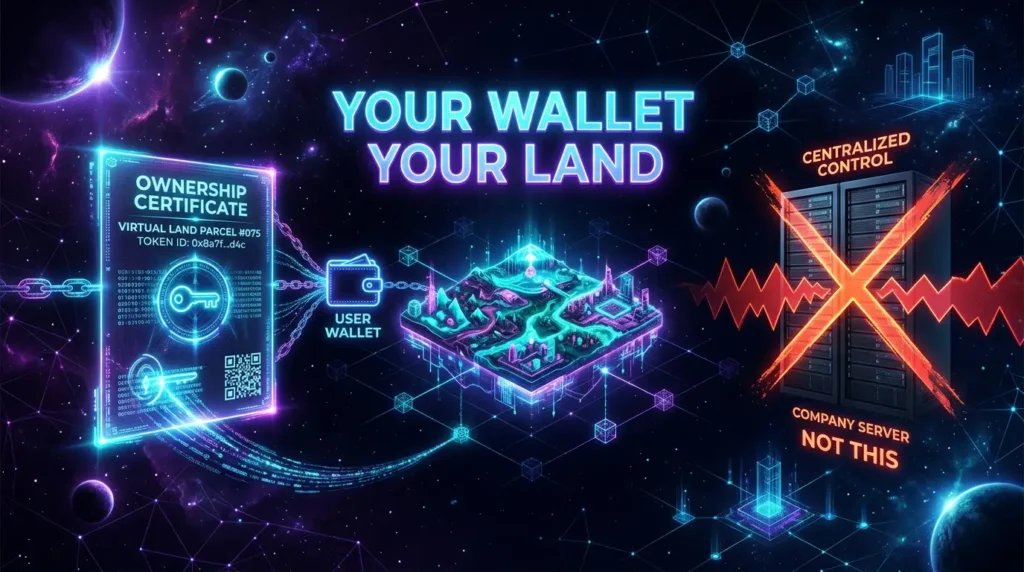
The problem without blockchain: In a traditional game or virtual world, everything is owned by the company. Your in-game items, your character, your land, your achievements — they live on company servers and disappear if the company shuts down, decides to change the rules, or bans your account. You never truly owned anything.
The blockchain solution: With NFTs and smart contracts, digital ownership becomes verifiable and transferable without the company’s permission. Your virtual land in a blockchain-based metaverse is an NFT — it belongs to your wallet, not to the company. You can sell it peer-to-peer. You can verify its scarcity. It persists on-chain even if the platform changes.
Cryptocurrencies serve as the native money of these virtual economies — purchasing land, paying for experiences, compensating creators, and enabling decentralized governance.
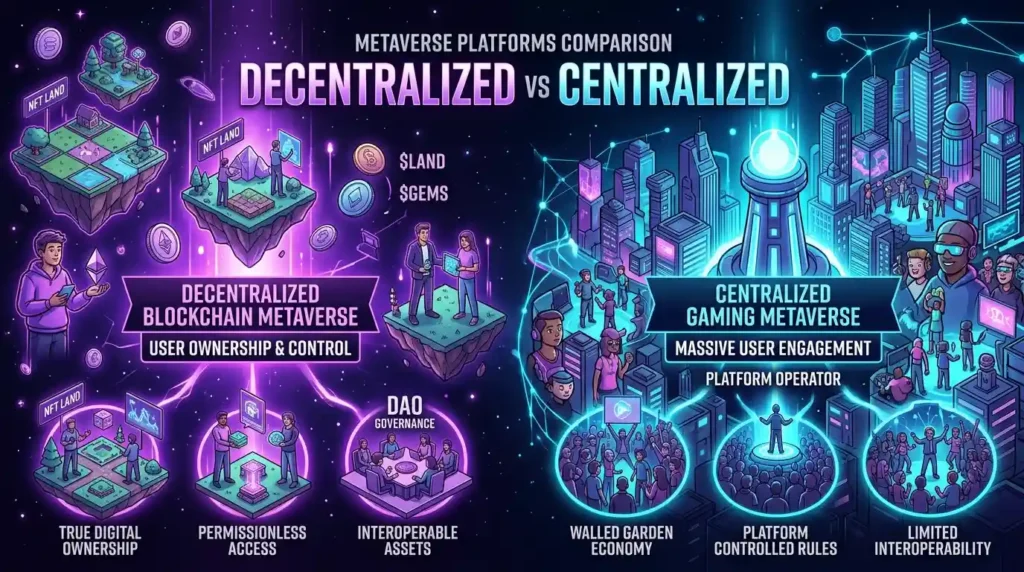
The Main Metaverse Platforms: Centralized vs Decentralized
The metaverse landscape splits clearly into two camps:
Blockchain-Based (Decentralized) Metaverses
Decentraland (MANA)
One of the earliest blockchain metaverses, built on Ethereum. Virtual land is divided into parcels called LAND, each an NFT. Users buy LAND, build experiences on it, and monetize those experiences. MANA is the native cryptocurrency for purchasing land and goods.
Decentraland hosts virtual art galleries, live music events, casino-style games, and brand activations. Nike, Samsung, and JPMorgan have built presences there. However, concurrent user numbers have often been modest — critics point to an underwhelming user experience compared to traditional games.
The Sandbox (SAND)
A voxel-based virtual world (think Minecraft-style aesthetics) where users can build, own, and monetize game experiences. LAND NFTs represent plots of the virtual map. SAND is the native utility token. Major brands including Gucci, Adidas, and Snoop Dogg have purchased virtual real estate.
The Sandbox targets game creators — its ASSET system lets anyone create NFT game objects and monetize them without coding experience.
Key advantage of blockchain metaverses: True digital ownership. If Decentraland or The Sandbox shuts down tomorrow, your NFTs still exist on Ethereum. You own the record.
Key challenge: User experience that can feel primitive compared to modern games. Adoption numbers haven’t matched the hype. Many virtual land purchases were speculative.
Centralized Metaverses (The Big Tech Version)
Meta’s Horizon Worlds
Mark Zuckerberg’s $40+ billion bet. After the 2021 rebrand from Facebook to Meta, the company poured extraordinary resources into building a VR metaverse. The results have been disappointing by most accounts — cartoon-like avatars (infamously without legs until 2022), limited user engagement, and a struggle to explain the product’s core value. Meta has laid off thousands from its Reality Labs division in 2025-2026, signaling a strategic retreat.
Roblox
Not a crypto platform but arguably the most successful “proto-metaverse” by user engagement — particularly among younger audiences. Roblox is a platform where users create and share games. It has a persistent economy (Robux currency), avatar customization, and massive concurrent users. It lacks blockchain-based ownership but has proven that the “online world where you live and play” concept has massive market appeal.
Fortnite and Epic Games
Epic Games has positioned Fortnite as a social space beyond just a battle royale game — hosting virtual concerts by Travis Scott, Ariana Grande, and others attended by millions simultaneously. Their Unreal Engine powers many AAA games and increasingly metaverse experiences. Not blockchain-based, but demonstrating the concert and social event possibilities.
Apple Vision Pro (Spatial Computing)
Apple’s $3,499 headset launched in 2024 introduced a different vision — “spatial computing” rather than “metaverse.” The focus is blending digital elements into real-world environments rather than full VR immersion. More productivity tool than virtual world, but establishes Apple in the hardware space.
What Actually Happens in the Metaverse?
The use cases spanning both centralized and decentralized platforms:
Virtual Real Estate
Purchasing, developing, and renting digital land. At peak 2021-2022 hype, single plots in Decentraland sold for over $900,000. Prices have since fallen dramatically — a cautionary tale about speculative digital land markets.
Virtual Events and Concerts
Live music in virtual spaces attended simultaneously by thousands. Travis Scott’s Fortnite concert drew 27 million attendees. Virtual concerts in Decentraland and The Sandbox have featured real DJs and musicians.
Digital Fashion and Avatars
Dressing your avatar in virtual clothing. Gucci, Balenciaga, Nike, and other luxury brands sell digital-only items. Some sell for more than their physical counterparts.
Virtual Commerce and Brand Experiences
Companies building branded virtual spaces — showrooms, interactive experiences, product launches. Nike has created “Nikeland” in Roblox. Samsung built a virtual store in Decentraland.
Gaming with Real Ownership
Games where in-game items are NFTs — tradeable, sellable, and owned by players rather than publishers. Axie Infinity (now less prominent) pioneered play-to-earn models, though most early implementations had unsustainable economics.
Virtual Work and Meetings
Companies experimenting with VR meeting spaces. Microsoft’s Mesh platform enables mixed-reality meetings. Some remote-first companies use virtual offices as a way to create social presence.
Education and Training
Medical students practicing surgery in VR. Military training simulations. Architecture visualization. These use cases are growing and show genuine utility independent of hype cycles.
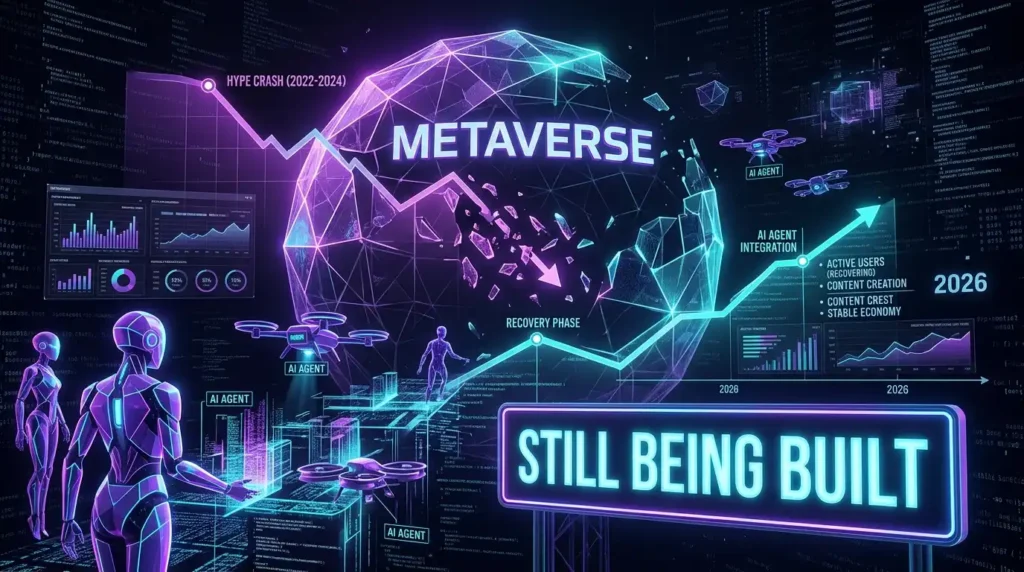
Where Is the Metaverse in 2026? Honest Assessment
The 2021-2022 metaverse hype was extraordinary — and largely unjustified at the time. Companies like Meta spent tens of billions with limited results. Virtual land speculation created and destroyed fortunes. The “metaverse” became a byword for overpromising.
What remains and is growing:
- Gaming companies (Roblox, Epic) continue building genuinely immersive platforms with massive engagement
- Enterprise VR for training and collaboration is growing steadily
- Apple Vision Pro has opened spatial computing to a premium audience
- AI is increasingly powering more dynamic, intelligent virtual worlds
What hasn’t delivered:
- True interoperability between platforms (you can’t take your Fortnite skin into Roblox or your Decentraland land into The Sandbox)
- Blockchain metaverse user numbers have remained modest compared to traditional gaming
- The “killer app” that makes VR/AR headsets as essential as smartphones hasn’t materialized yet
A new direction — AI-driven metaverse:
In 2026, the most interesting development is AI agents inhabiting virtual worlds. Instead of scripted NPCs, AI characters can have conversations, adapt to users, and create dynamic experiences. The metaverse is evolving from “observe and click” to genuinely interactive digital environments.
The honest summary: a fully realized metaverse remains years away. But the infrastructure, economies, and use cases being built now are the foundations it will rest on.
Key Metaverse Terminology
Metaverse: A persistent, shared, immersive digital universe where people interact via avatars, own digital assets, and participate in a virtual economy.
Avatar: Your digital representation in a virtual world — your body in the metaverse.
Virtual Real Estate / Digital Land: NFT-based ownership of virtual plots of land in blockchain metaverses like Decentraland and The Sandbox.
Decentraland (MANA): An Ethereum-based virtual world where land (LAND NFTs) and goods are purchased with MANA token.
The Sandbox (SAND): A voxel-based virtual world where creators build experiences and own assets using SAND token.
Interoperability: The ability to use assets, avatars, and identities across different virtual platforms — a core vision of Web3 metaverses, largely unrealized so far.
Spatial Computing: Apple’s term for technology that blends digital elements with real-world physical space, distinct from full virtual reality immersion.
VR (Virtual Reality): Technology that immerses you completely in a digital environment via headsets like Meta Quest or Apple Vision Pro.
AR (Augmented Reality): Technology that overlays digital elements onto the real world through devices like AR glasses or smartphone cameras.
Play-to-Earn: A gaming model where players earn crypto rewards for gameplay activity — pioneered by Axie Infinity, with mixed results.
The Bottom Line
The metaverse is simultaneously an idea, an emerging technology, a speculative market, and a genuine prediction about the future of how humans spend time online.
The idea: a persistent, immersive digital universe where your identity, assets, and relationships are yours — not a corporation’s.
The current reality: fragmented platforms, early-stage technology, hype cycles that have crashed and recovered, and genuine use cases that are quietly building.
The crypto connection is real and important: blockchain provides the ownership layer that separates a true metaverse from just a fancy video game. When digital land is an NFT, when virtual items are provably scarce, when economies run on public blockchains — ownership means something.
Whether the metaverse becomes the next internet or remains a niche — one of the most important open questions in technology today.
Neal Stephenson would recognize the pieces. The assembly is still in progress. 🌐🕶️
Disclaimer: This article is for informational purposes only and does not constitute financial advice. Cryptocurrency investments carry significant risk, including the potential loss of all invested capital. Always conduct your own research before making any investment decisions.