Bitcoin and Ethereum are both blockchains. Both process transactions. Both are decentralized. But they use completely different methods to decide who gets to add the next block of transactions — and that difference has massive consequences for energy, speed, security, and how you can earn rewards.
These two methods are called Proof of Work and Proof of Stake.
Understanding them isn’t just academic. It explains why Bitcoin mining consumes as much energy as a small country, why Ethereum slashed its energy use by 99.9% in 2022, and why billions of dollars are locked in staking pools right now.
Let’s break it down simply.
The Core Question Both Solve
Before getting into the differences, it’s important to understand what problem both mechanisms are solving.
A blockchain is a shared record book maintained by thousands of computers. Nobody owns it. Nobody’s in charge. So when someone wants to add new transactions — like “Alice sent 1 BTC to Bob” — how does the network decide which computer gets to write the next page?
And crucially: how does it prevent someone from cheating?
This is the consensus problem, and both Proof of Work and Proof of Stake are answers to it. Different answers, with different tradeoffs.
Proof of Work: Earn the Right Through Competition
Proof of Work (PoW) is the original blockchain consensus mechanism, invented by Satoshi Nakamoto and used by Bitcoin since 2009.
The core idea: to add a block, you must prove you’ve done real computational work.
Here’s the analogy that makes it click: imagine a room full of people all trying to solve a Sudoku puzzle as fast as possible. Whoever solves it first gets to write the next page in the shared record book and earns a cash prize. Everyone else’s work is discarded. Then a new puzzle starts.

In Bitcoin’s case, the “puzzle” is a cryptographic challenge involving billions of hash calculations. The first miner to find a valid solution broadcasts their block to the network. Other nodes verify the solution in milliseconds (easy to check, hard to find), accept the block, and the winner earns the block reward — currently 3.125 BTC.
Why this works as security:
To cheat the system — say, to rewrite history and spend Bitcoin twice — you’d need to redo all the computational work for every block you want to change, and do it faster than the entire honest network is adding new blocks. At Bitcoin’s scale in 2026, this would require more computing power than currently exists on Earth. The cost of the attack exceeds any possible benefit.
The security is anchored in the physical world: real electricity, real hardware, real cost. You cannot fake it.
Proof of Work blockchains: Bitcoin (BTC), Litecoin (LTC), Dogecoin (DOGE), Monero (XMR), Ethereum Classic (ETC), Kaspa (KAS)
Proof of Stake: Earn the Right Through Ownership
Proof of Stake (PoS) was developed as an alternative to PoW, addressing its energy consumption and scalability limitations. Ethereum completed its historic switch from PoW to PoS in September 2022 — an event called “The Merge.”
The core idea: instead of doing computational work, you lock up (stake) cryptocurrency as collateral to earn the right to validate blocks.
Here’s how to think about it: instead of a Sudoku competition, imagine a lottery. To buy a lottery ticket, you must deposit some money that stays locked until the lottery is over. The more tickets you buy (the more you stake), the higher your chance of being selected to write the next page. If you try to cheat — write false information — your deposit is destroyed.

In Ethereum’s case, validators must stake a minimum of 32 ETH (worth roughly $64,000 at current prices) to participate directly. The network randomly selects a validator to propose the next block, weighted by their stake. Other validators then “attest” to the block’s validity. When enough attestations accumulate, the block is finalized.
Validators who behave honestly earn staking rewards (currently around 3–4% annually on Ethereum). Validators who try to cheat, go offline, or act maliciously have their stake partially or fully slashed — burned forever as punishment.
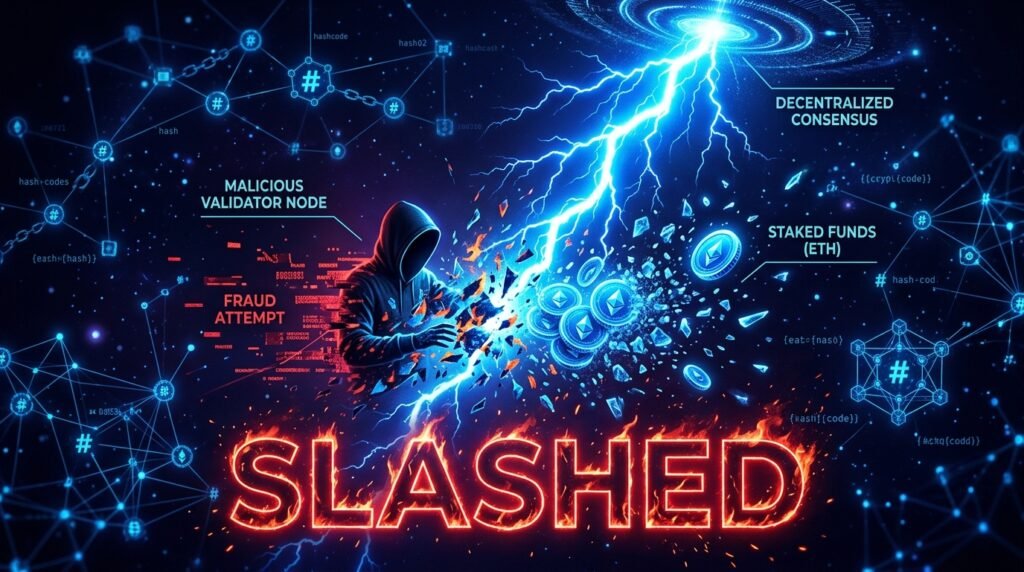
The security mechanism is financial: cheating destroys your own investment. The more you have at stake, the more you have to lose.
Proof of Stake blockchains: Ethereum (ETH), Cardano (ADA), Solana (SOL), Polkadot (DOT), Avalanche (AVAX), Tezos (XTZ), and most modern blockchains
The Key Differences: Side by Side
| Feature | Proof of Work | Proof of Stake |
|---|---|---|
| How is the validator chosen? | Wins a computational race | Selected by weighted lottery |
| What’s required to participate? | Powerful hardware + electricity | Cryptocurrency stake |
| Energy consumption | Very high | 99%+ lower |
| Transaction speed | Slower (Bitcoin: ~10 min/block) | Faster (Ethereum: ~12 seconds/block) |
| Main security mechanism | Cost of computation | Cost of stake (slashing) |
| Who earns rewards? | Miners who win the race | Validators who are selected |
| Used by | Bitcoin, Litecoin, Monero | Ethereum, Cardano, Solana |
| Vulnerability | 51% attack (control hash rate) | 33%+ attack (control stake) |
| Environmental impact | High (especially PoW with fossil fuels) | Low |
| Barrier to entry | ASIC hardware ($2,000–$10,000+) | Minimum stake (32 ETH for Ethereum) |
The Energy Question: Why It Actually Matters
This is where the debate gets heated — and where the facts sometimes get lost.
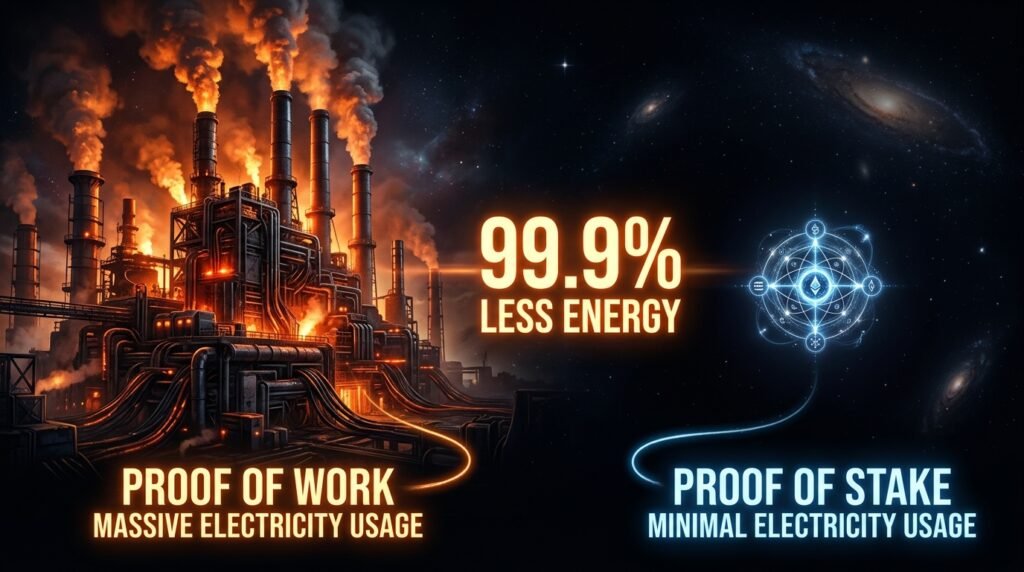
Proof of Work requires continuous, massive energy expenditure. Bitcoin’s annual electricity consumption is estimated at 95–162 TWh — comparable to countries like Poland or Argentina. This energy is not “wasted” from the protocol’s perspective: it IS the security. The cost of attacking Bitcoin is the cost of overpowering all that energy.
Proof of Stake uses vastly less energy because validators don’t need to run power-hungry hardware 24/7. Ethereum’s energy consumption dropped by over 99.9% after The Merge. Instead of running warehouse-scale mining operations, validators run relatively modest computer nodes.
The honest debate:
- PoW supporters argue the energy consumption is justified because it creates security anchored in physical reality that can’t be faked or bought with cryptocurrency alone
- PoS supporters argue that slashing mechanisms create equally strong deterrents with a fraction of the environmental cost
- Both sides have legitimate points, and neither consensus is fully settled in academic literature
The Security Debate: Which Is Actually Safer?
PoW security in practice: Bitcoin has never been successfully attacked in 15+ years of operation. The sheer scale of its hash rate makes an attack economically irrational. However, smaller PoW chains with lower hash rates are vulnerable — Ethereum Classic suffered multiple 51% attacks because its hash rate was low enough to be overpowered.
PoS security in practice: Ethereum’s PoS has been running since September 2022 without a successful attack. The economic incentives (slashing) appear to work. However, PoS is newer and less battle-tested than Bitcoin’s PoW. Critics point out theoretical vulnerabilities:
- Nothing-at-stake problem: In some PoS designs, validators could theoretically vote on multiple competing chains simultaneously at no cost. Modern implementations address this through slashing.
- Wealth concentration: The rich get richer — larger stakers earn more rewards and gain more influence. This could lead to centralization over time.
- Long-range attacks: In theory, someone with access to old private keys could try to rewrite very old history. Modern PoS implementations use checkpointing to prevent this.
The consensus among researchers: Both mechanisms are sufficiently secure for their intended use cases. PoW provides arguably more battle-tested, physics-based security. PoS provides comparable economic security with dramatically lower energy costs.
How You Earn Rewards in Each System
In Proof of Work: You earn by mining — running hardware that solves cryptographic puzzles. As discussed in our mining guide, this requires significant hardware investment and access to cheap electricity to be profitable.
In Proof of Stake: You earn by staking — locking up cryptocurrency and either running a validator node or delegating your stake to someone who does.
Staking options for regular users:
Direct staking: Run your own validator node. On Ethereum, this requires 32 ETH (roughly $64,000+) and technical knowledge to maintain. Rewards: ~3–4% annually.
Liquid staking: Use a service like Lido or Rocket Pool to stake any amount of ETH. You receive stETH (liquid staking tokens) in return — representing your staked ETH plus accruing rewards — which you can still use in DeFi. Lower minimum, but adds smart contract risk.
Exchange staking: Stake through Coinbase, Kraken, or Binance. Simplest option, but you’re trusting the exchange (custodial risk). Lower rewards due to fees.
Delegated staking: On Solana, Cardano, and many other PoS chains, you can delegate your stake to a validator without running a node, earning proportional rewards minus a small fee.
Staking rewards vary by network and market conditions, but typically range from 3–8% annually for major PoS blockchains.
The Ethereum Story: Why the Switch Mattered
Ethereum’s transition from PoW to PoS in September 2022 was one of the most significant technical events in blockchain history.

Before The Merge: Ethereum had thousands of GPU miners worldwide. Mining ETH was a viable business for individuals with GPU rigs. Energy consumption was enormous.
After The Merge: Mining ETH became instantly impossible. GPU miners had to redirect their hardware to other coins or sell it. Ethereum’s energy consumption dropped by over 99.9%. Over 800,000 validators now secure the network through staking.
Why did Ethereum switch?
- Scalability: PoS enables higher transaction throughput and is a prerequisite for Ethereum’s Layer 2 scaling roadmap
- Energy: The environmental criticism of PoW was a reputational problem for Ethereum’s developer community
- Economics: Staking rewards are funded by newly issued ETH and transaction fees — lower issuance means less inflation
The Merge proved that a major blockchain could switch consensus mechanisms without losing functionality or security — something many considered impossible beforehand.
Other Consensus Mechanisms Worth Knowing
PoW and PoS are the two dominant mechanisms, but the space has evolved:
Delegated Proof of Stake (DPoS): Token holders vote for a small set of “delegates” who validate blocks. More efficient but more centralized. Used by EOS, TRON.
Nominated Proof of Stake (NPoS): Used by Polkadot — token holders nominate validators, who are selected by an algorithm optimizing for network security.
Proof of History (PoH): Solana’s innovation — a cryptographic clock that timestamps transactions before they’re processed, enabling much higher throughput alongside PoS.
Proof of Authority (PoA): A small, known set of approved validators. Very fast and efficient, but highly centralized. Used for private/enterprise blockchains.
Key Terminology
Consensus Mechanism: The rules a blockchain uses to decide which computer gets to add the next block of transactions.
Proof of Work (PoW): A consensus mechanism where participants compete to solve computational puzzles to earn the right to add blocks.
Proof of Stake (PoS): A consensus mechanism where participants lock up cryptocurrency as collateral, with validators selected by weighted lottery.
Miner: A PoW participant who uses hardware to solve puzzles and earn block rewards.
Validator: A PoS participant who stakes cryptocurrency and is selected to propose or attest to blocks.
Staking: Locking up cryptocurrency as collateral to participate in PoS validation and earn rewards.
Slashing: A PoS punishment mechanism that destroys part of a validator’s staked funds for dishonest behavior or extended downtime.
51% Attack: An attack where a single entity controls more than half of a PoW network’s hash rate — enough to potentially rewrite recent history.
The Merge: Ethereum’s September 2022 transition from Proof of Work to Proof of Stake.
Hash Rate: The total computational power being applied to a PoW blockchain — a measure of its security.
The Bottom Line
Neither mechanism is objectively “better” — they make different tradeoffs.
Proof of Work offers security anchored in physical reality — you can’t fake the electricity and hardware required. Bitcoin has operated flawlessly for 15+ years on this model. Its critics argue the energy cost is too high and its supporters argue that cost is precisely what makes it secure.
Proof of Stake offers comparable security at a fraction of the energy cost. Ethereum has operated successfully on PoS since 2022. Its critics argue that wealth-based security is less robust than work-based security, and that PoS is less battle-tested.
The real world has voted with capital: Bitcoin and Ethereum together represent the vast majority of crypto’s market cap, one on each side of the debate. Both are working, securing trillions of dollars, and will likely coexist for years to come.
Mining burns electricity to create trust. Staking locks capital to create trust. Different fuel, same destination. ⚡
Disclaimer: This article is for informational purposes only and does not constitute financial advice. Cryptocurrency investments carry significant risk, including the potential loss of all invested capital. Always conduct your own research before making any investment decisions.