Here’s something that surprises almost every new crypto investor: the IRS knows.
When you sell Bitcoin on Coinbase, Coinbase reports it to the IRS. When you swap ETH for USDC on a centralized exchange, that’s reported too. As of 2026, all major US crypto exchanges are required to send Form 1099-DA — a new tax form for digital assets — to both you and the IRS automatically.
The era of crypto being a gray area for taxes is over. The rules are clear, enforcement is increasing, and not understanding how crypto is taxed is one of the most expensive mistakes a new investor can make.
The good news: the rules are actually straightforward once you understand the framework.
The Foundation: Crypto Is Property, Not Currency
The single most important thing to understand about crypto taxes:
The IRS treats cryptocurrency as property — not as currency.
This is established by IRS Notice 2014-21 and has been in effect for over a decade. It means crypto is taxed like stocks, bonds, or real estate — not like dollars in a bank account.
The practical implication: every time you dispose of crypto, you trigger a taxable event. Selling it. Trading it. Spending it. Converting it to another coin. Each of these is a taxable “disposal” of property.
Holding crypto — no matter how much it appreciates — is not a taxable event. You owe nothing to the IRS until you sell, trade, spend, or otherwise dispose of it.
The Two Types of Crypto Tax
All crypto taxation falls into two categories:
1. Capital Gains Tax (when you dispose of crypto you bought as an investment)
When you sell or trade crypto for more than you paid for it, you have a capital gain. When you sell for less, you have a capital loss.
The tax rate depends on how long you held the crypto:
Short-term capital gains (held 1 year or less):
Taxed at your ordinary income rate — the same bracket as your salary, wages, or freelance income. Federal rates range from 10% to 37% depending on your total income.
Long-term capital gains (held more than 1 year):
Taxed at preferential long-term capital gains rates: 0%, 15%, or 20% depending on your total taxable income.
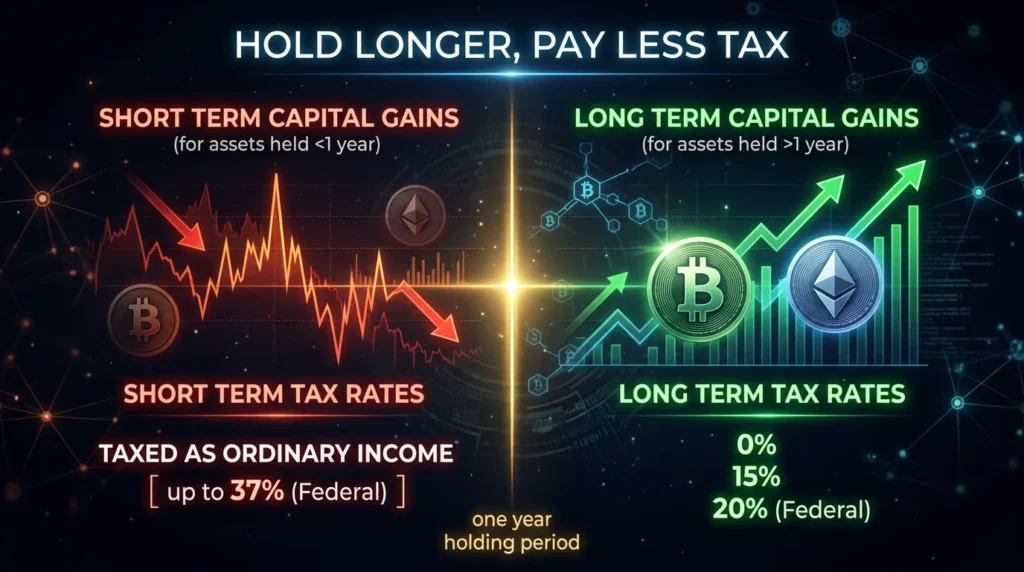
This difference is massive and represents one of the most powerful legal tools for reducing your crypto tax bill.
2026 Long-Term Capital Gains Tax Rates (Federal):
| Filing Status | 0% Rate | 15% Rate | 20% Rate |
|---|---|---|---|
| Single | Up to $47,025 | $47,025–$518,900 | Over $518,900 |
| Married filing jointly | Up to $94,050 | $94,050–$583,750 | Over $583,750 |
Real example:
You buy 0.1 BTC for $6,000 in January 2024. You sell it for $10,000 in March 2025 (15 months later).
- Capital gain: $4,000
- Held more than 1 year → long-term rate applies
- If you’re in the 15% bracket: tax owed = $600
Had you sold after only 10 months (short-term), the same $4,000 gain could be taxed at 22–32%+ depending on your income bracket.
2. Ordinary Income Tax (when you earn crypto)
Some crypto transactions generate income rather than capital gains. These are taxed at your ordinary income rate (10–37%), just like a paycheck.
Crypto income includes:
- Mining rewards: The fair market value of crypto received when you successfully mine a block
- Staking rewards: Per IRS Revenue Ruling 2023-14, staking rewards are taxable income when you receive them (when you gain the ability to sell or transfer them)
- Airdrops: Free tokens received are income at their fair market value on the date received
- Getting paid in crypto: If your employer or a client pays you in Bitcoin, it’s ordinary income at the USD value on the date received
- DeFi yield and interest: Income from lending protocols, liquidity provision, etc.
What Are Taxable Events? The Complete List

Taxable events (you owe taxes on gains):
- ✅ Selling crypto for US dollars or other fiat currency
- ✅ Trading one cryptocurrency for another (BTC → ETH is a taxable disposal of BTC)
- ✅ Spending crypto to buy goods or services (buying a laptop with Bitcoin is a taxable event)
- ✅ Converting crypto to stablecoins (BTC → USDC triggers a taxable event)
- ✅ Receiving mining rewards (income)
- ✅ Receiving staking rewards (income)
- ✅ Receiving airdropped tokens (income)
- ✅ Receiving crypto as payment for work (income)
NOT taxable events (no tax owed):
- ✅ Buying crypto with US dollars and holding it
- ✅ Transferring crypto between your own wallets
- ✅ Receiving crypto as a gift (the recipient doesn’t owe tax until they sell)
- ✅ HODLing — no matter how much the value increases
The 2026 Changes: Form 1099-DA
Starting with the 2025 tax year (forms you receive in early 2026), all centralized crypto exchanges — Coinbase, Kraken, Binance US, etc. — are required to issue Form 1099-DA to both you and the IRS.
Phase 1 (2025 transactions, received in 2026): Exchanges report gross proceeds from your crypto sales and exchanges.
Phase 2 (2026 transactions, received in 2027): Exchanges must also report your cost basis — what you originally paid for the crypto.
This matters because previously, crypto users could potentially underreport transactions with lower detection risk. Now, if your 1099-DA shows $50,000 in proceeds and you don’t report it on your tax return, the IRS gets an automatic mismatch notice.
Important caveat: 1099-DA forms can contain errors — especially for users who move crypto between exchanges or use multiple wallets. They may show gross proceeds without accurate cost basis, potentially making your tax liability appear higher than it is. Always verify against your own records.
Calculating Your Gain: Cost Basis Methods
Your cost basis is what you paid for the crypto (including fees). Your taxable gain = proceeds – cost basis.
When you’ve bought the same crypto multiple times at different prices, you need to specify which “lot” you’re selling. The IRS allows several methods:
FIFO (First In, First Out): Assumes you sell your oldest holdings first. This is the IRS default if you don’t specify otherwise.
HIFO (Highest In, First Out): Sells your highest-cost lots first, minimizing your taxable gain. Generally most tax-efficient during bull markets.
Specific Identification: You manually specify exactly which lot you’re selling. Requires detailed records but gives maximum control.
Important 2026 change: The IRS now requires cost basis tracking at the wallet/exchange level — you can no longer mix lots across different exchanges as if they were one universal pool.
Tax-Loss Harvesting: The Legal Way to Reduce Your Bill
Tax-loss harvesting means intentionally selling crypto at a loss to offset gains elsewhere — reducing your total taxable income.
How it works:
- You have $10,000 in gains from selling Bitcoin
- You also hold Ethereum that’s down $4,000 from your purchase price
- You sell the ETH, realizing the $4,000 loss
- Your net taxable gain is now $6,000 instead of $10,000

The crypto advantage: Unlike stocks, crypto is NOT subject to the wash sale rule (as of 2026). Under wash sale rules, you can’t sell a stock at a loss and immediately buy it back — you must wait 30 days. Crypto doesn’t have this restriction yet.
This means you can sell ETH at a loss, immediately buy ETH back, and still claim the full loss. This is a powerful and currently legal strategy.
Caution: Legislation to apply wash sale rules to crypto has been discussed in Congress and may be enacted. Consult a tax professional for the current status when filing.
Capital loss limits: You can offset unlimited capital gains with capital losses. If losses exceed gains, you can deduct up to $3,000 of losses against ordinary income per year, carrying remaining losses forward to future years.
Smart Legal Strategies to Reduce Crypto Taxes
1. Hold for 12+ months
The simplest and most powerful strategy. Moving from short-term (up to 37% federal) to long-term rates (0–20%) can cut your tax bill dramatically. If you believe in an asset, patience is literally profitable.
2. Harvest losses strategically
Before year-end, review your portfolio for unrealized losses. Selling before December 31 locks in those losses for the current tax year.
3. Donate appreciated crypto to charity
Donating crypto you’ve held long-term to a qualified 501(c)(3) charity gives you a deduction for the full fair market value without triggering capital gains. A $10,000 BTC donation that cost you $1,000 avoids $9,000 of taxable gain while still giving you the full $10,000 deduction.
4. Crypto IRAs
Self-directed IRAs can hold cryptocurrency and allow tax-deferred or tax-free growth (depending on whether it’s a Traditional or Roth IRA). Disposals within the IRA are not taxable events.
5. Gift crypto
You can gift up to $19,000 per recipient in 2026 without gift tax implications. The recipient inherits your cost basis, so this works best for recipients in lower tax brackets.
Reporting: Where Crypto Goes on Your Tax Return
Form 1040: Every US taxpayer must answer the digital assets question: “At any time during the tax year, did you receive, sell, exchange, or otherwise dispose of any digital asset?” Answer truthfully.
Form 8949: Report each taxable crypto transaction — date acquired, date sold, proceeds, cost basis, and gain/loss.
Schedule D: Summarizes your total capital gains and losses from Form 8949.
Schedule 1: Report crypto income (staking, mining, airdrops) as “Other Income.”
Schedule C: If crypto activities rise to the level of a trade or business (professional mining, trading as a business), report here.
Crypto Tax Software: Don’t Do This Manually
Given that active crypto users may have thousands of transactions across multiple exchanges and wallets, manual record-keeping is impractical. Crypto tax software automates most of this:
- Koinly: Connects to exchanges and wallets via API, calculates gains/losses, generates tax reports
- CoinLedger (formerly CryptoTrader.Tax): Popular option, integrates with TurboTax
- TaxBit: Used by institutions, strong DeFi support
- CoinTracker: Clean interface, good exchange coverage
These tools typically cost $50–$200/year depending on transaction volume. For anyone with more than a handful of trades, this cost pays for itself in accuracy and time saved.
Key Tax Terminology
Cost Basis: What you originally paid for crypto (including fees). Used to calculate your gain or loss.
Capital Gain: Profit from selling crypto for more than your cost basis.
Capital Loss: Loss from selling crypto for less than your cost basis.
Short-Term Capital Gain: Gain from crypto held 1 year or less — taxed at ordinary income rates (10–37%).
Long-Term Capital Gain: Gain from crypto held more than 1 year — taxed at preferential rates (0%, 15%, or 20%).
Taxable Event: Any transaction that triggers a tax obligation — selling, trading, spending, or earning crypto.
Form 1099-DA: New IRS form (2025+) that centralized exchanges use to report your crypto transactions to you and the IRS.
Tax-Loss Harvesting: Selling crypto at a loss to offset gains elsewhere, reducing total taxable income.
Wash Sale Rule: Currently does NOT apply to crypto — you can sell and immediately repurchase to claim a loss.
FIFO/HIFO: Methods for determining which crypto “lot” was sold when you’ve made multiple purchases at different prices.
The Bottom Line
Crypto taxes aren’t complicated once you understand the framework:
- IRS treats crypto as property — every disposal is a taxable event
- Short-term gains (under 1 year) = income tax rates — up to 37%
- Long-term gains (over 1 year) = capital gains rates — 0%, 15%, or 20%
- Earning crypto = ordinary income at fair market value when received
- Exchanges now report to the IRS via Form 1099-DA — there’s no hiding
- Tax-loss harvesting is legal and powerful — use it before year-end
- Software makes compliance manageable — track everything automatically
The single most common crypto tax mistake: treating disposals as non-taxable because it “wasn’t real money.” It is. The IRS knows. Report accurately, use the legal strategies available to you, and consider consulting a CPA who specializes in crypto for anything complex.
Taxes are part of investing. Understanding them is part of being a serious crypto investor. 🧾
Disclaimer: This article is for informational and educational purposes only and does not constitute tax advice. Tax laws are complex and change frequently. Always consult a qualified tax professional (CPA or tax attorney) before making tax-related decisions. The information here reflects general IRS guidance as of 2026 and may not apply to your specific situation.