It started as a joke. Two software engineers created it in two hours, named it after a dog meme, and expected it to disappear in weeks. Instead, Dogecoin became one of the most recognizable cryptocurrencies on the planet, briefly touched a market cap of $90 billion, attracted the world’s richest person as its most vocal advocate, and in March 2026 received official SEC commodity classification alongside Bitcoin and Ethereum.
Not bad for a joke.
Dogecoin (DOGE) currently trades around $0.09–0.10, maintains a market cap of approximately $20 billion, and remains firmly in the top 10 cryptocurrencies by market cap. It is also — and this is genuinely unique in crypto — the only major asset whose price moves can be directly attributed to a single person’s Twitter activity.
That person is Elon Musk. And in 2026, he’s about to give Dogecoin the biggest real-world use case it’s ever had.
Let’s break it all down.
The Quick Answer: What Is Dogecoin?
Dogecoin (DOGE) is an open-source, peer-to-peer cryptocurrency launched in December 2013. It was created as a lighthearted, community-driven alternative to Bitcoin — designed to be accessible, fun, and useful for tipping, donations, and small payments.
Unlike most cryptocurrencies which position themselves as revolutionary financial technology, Dogecoin has always been honest about its nature: it’s a meme coin with a real community behind it. The Shiba Inu dog from the “Doge” internet meme is its logo. Its community motto is “Much wow.” Its founders created it partly as a joke. And yet here we are, 13 years later, discussing its potential integration into a platform with 600 million users.
Who Created Dogecoin? The Accidental Success Story
Dogecoin was created by Billy Markus (a software engineer from Portland, Oregon) and Jackson Palmer (a marketer from Sydney, Australia) in December 2013.
The story goes that Palmer bought the domain dogecoin.com as a joke, posted a picture of the Shiba Inu meme with a “Dogecoin” logo, and went to sleep. By morning, hundreds of people had messaged him asking how to buy it. He teamed up with Markus, who built the actual software by forking Litecoin’s codebase, and launched it on December 6, 2013.
Their goal was explicitly not to build serious financial infrastructure. They wanted to create something fun and approachable — a cryptocurrency that felt welcoming rather than intimidating, designed for tipping content creators and making small donations rather than replacing the global financial system.
Neither Palmer nor Markus became crypto billionaires from Dogecoin. Palmer has been largely critical of the crypto industry in recent years. Markus, known online as “Shibetoshi Nakamoto,” remains active in the Dogecoin community.
The Dogecoin Foundation — a non-profit supporting the ecosystem — was originally founded in 2014, dissolved, and relaunched in 2021 with an advisory board that includes Ethereum co-founder Vitalik Buterin and a representative of Elon Musk.
How Does Dogecoin Actually Work?
Technical Foundation
Dogecoin is built on the Litecoin codebase, which itself was forked from Bitcoin. It uses a Proof of Work consensus mechanism — meaning miners compete to solve mathematical problems and are rewarded with new DOGE for each block they validate.
Key technical specs:
- Block time: ~1 minute (much faster than Bitcoin’s 10 minutes)
- Transaction fees: Very low — fractions of a cent
- Mining algorithm: Scrypt (same as Litecoin — allows merged mining)
- New DOGE per block: 10,000 DOGE
- New DOGE per year: ~5 billion
Merged Mining with Litecoin
An important technical feature: Dogecoin can be merged mined with Litecoin. This means Litecoin miners can simultaneously mine DOGE with no extra computational effort. This has massively increased Dogecoin’s hashrate and security — making it far more resistant to 51% attacks than its market position might suggest.
No Maximum Supply: The Inflation Reality
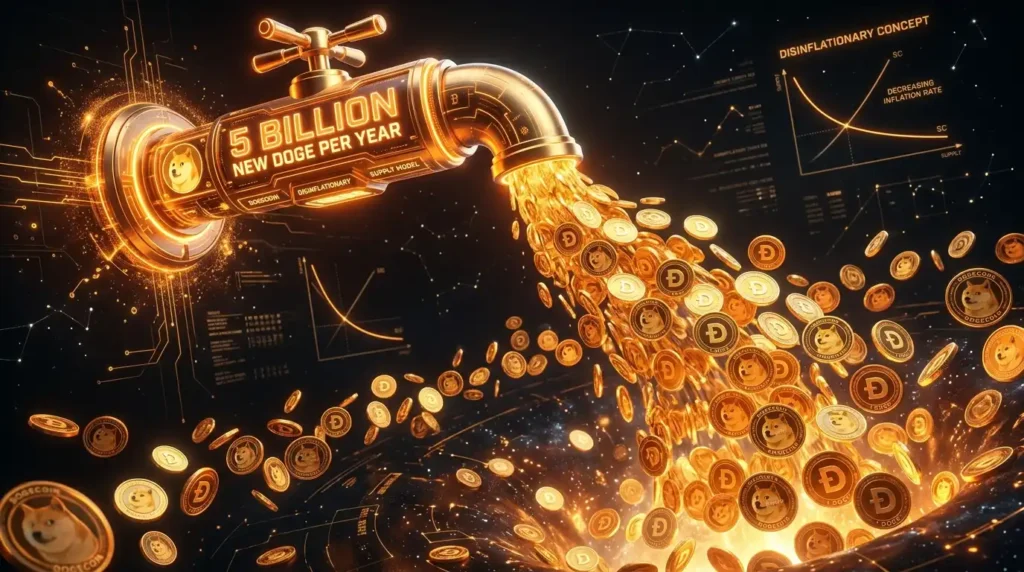
Here’s the biggest tokenomics fact about Dogecoin: there is no maximum supply. Unlike Bitcoin (21 million cap) or even Ethereum (no cap but declining issuance), Dogecoin permanently adds approximately 5 billion new DOGE per year, every year, forever.
At first glance, this sounds terrible. Infinite supply = infinite inflation = price goes to zero. In practice, the math is more nuanced:
- When Dogecoin had 100 billion DOGE in circulation, 5 billion new per year = 5% annual inflation
- With 167 billion in circulation today, 5 billion per year = ~3% annual inflation
- As supply grows, the inflation rate falls — creating a “disinflationary” effect
- At 500 billion DOGE (decades away), the inflation rate falls to 1%
This disinflationary model is actually similar in structure to traditional currency systems — the US dollar inflates at 2-3% annually and has been doing so for a century. The key difference: DOGE has no central bank adjusting rates.
Dogecoin Tokenomics: The Numbers That Matter
| Metric | Data |
|---|---|
| Ticker | DOGE |
| Current Price | ~$0.09–0.10 (April 2026) |
| Market Cap | ~$20 billion |
| Rank | #9–10 |
| Circulating Supply | ~167.9 billion DOGE |
| Maximum Supply | None — ~5 billion new DOGE per year |
| Block Reward | 10,000 DOGE per block |
| Block Time | ~1 minute |
| All-Time High | ~$0.74 (May 2021) |
| SEC Classification | Digital Commodity (March 2026) |
| Spot DOGE ETF | 21Shares TDOG on Nasdaq (2026) |
The Elon Musk Effect: The Most Powerful Force in DOGE
No article about Dogecoin can avoid Elon Musk. He is, without exaggeration, the single most important external factor in DOGE’s price history.
The timeline:
- April 2019: Musk calls Dogecoin “my favorite cryptocurrency” in a tweet. Price jumps modestly.
- July 2020: Musk tweets “Dogecoin is the people’s crypto.” Price surges 20% in a day.
- January 2021: Musk changes his Twitter bio to “#Dogecoin CEO.” Price spikes 80% in hours.
- February 2021: Musk tweets a Lion King meme featuring DOGE. Price goes parabolic.
- May 2021: Musk appears on Saturday Night Live as the “Dogefather.” DOGE is at $0.73 — its all-time high. He makes jokes about DOGE being a “hustle.” Price crashes 30% live on air.
- 2022–2024: Musk acquires Twitter, renames it X, hints repeatedly at DOGE payment integration. Price remains volatile around his statements.
- 2025: Musk leads the Department of Government Efficiency — nicknamed “DOGE” by the media. The coincidence is not lost on anyone.
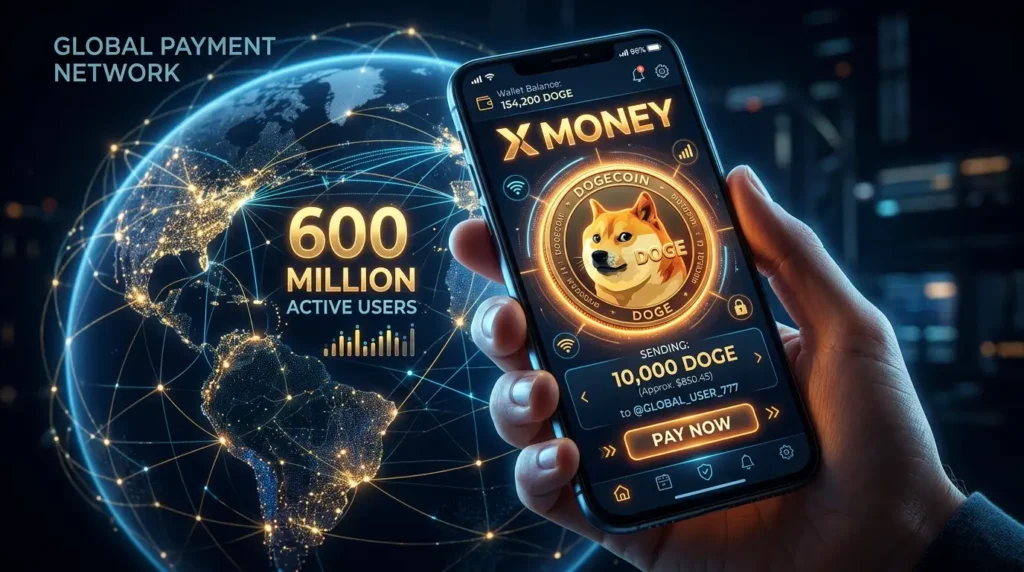
- March 2026: Musk confirms X Money will launch its public beta in April 2026, with DOGE as a potential native payment layer for the platform’s 600 million users.
The relationship between Musk and Dogecoin is unlike anything else in crypto. A single tweet has moved DOGE’s price by double digits within hours. This is a feature for traders. It’s a significant risk for long-term investors.
2026: Dogecoin’s Most Important Year?
Several developments in early 2026 have given Dogecoin more genuine catalysts than at any point since 2021.
SEC Commodity Classification (March 20, 2026)
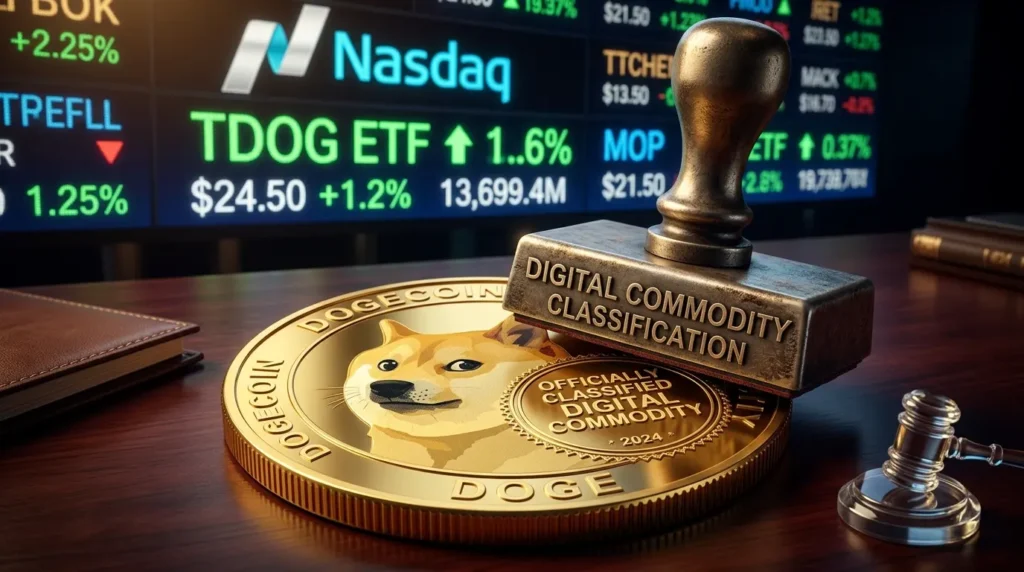
On March 20, 2026, the SEC officially classified Dogecoin as a digital commodity — the same status as Bitcoin and Ethereum. This ruling eliminates the risk of DOGE being classified as a security, which had been a concern that kept some institutions cautious. It also opened the door for regulated financial products.
21Shares Dogecoin ETF on Nasdaq (TDOG)
Following the SEC classification, the 21Shares Dogecoin ETF (TDOG) began trading on the Nasdaq — the first physically-backed Dogecoin ETP allowing institutional capital to flow into DOGE without managing wallets directly.

X Money Integration (April 2026)
Elon Musk confirmed that X Money — the financial services arm of X (formerly Twitter) — will launch its public beta in April 2026. The platform already features integrated Visa debit cards and payment rails.
The critical detail: DOGE is expected to serve as the native clearing layer for micro-transactions and global payments within X Money’s ecosystem. If implemented, this would give DOGE real utility on a platform with 600 million active users — the largest potential payment integration in crypto history.
This remains partially speculative — integration details haven’t been fully confirmed — but the potential is enormous.
DogeOS: Smart Contracts for Dogecoin
The MyDoge Wallet team, which raised $6.9 million in 2025, is developing DogeOS — an application layer that would bring smart contracts to Dogecoin. If successful, this would transform DOGE from a simple payment coin into a programmable blockchain — potentially unlocking DeFi and broader ecosystem development.
Dogecoin Price History: The Meme Made Real
2013: Dogecoin launches at a fraction of a cent. Early community forms around tipping and charitable causes.
2014: Price nearly doubles to $0.0018. Community raises funds to send Jamaican bobsled team to the Winter Olympics. The “Doge4Water” campaign raises $30,000 worth of DOGE for clean water in Kenya. This community-driven charity work sets Dogecoin apart from other early cryptocurrencies.
2015–2020: Dogecoin largely forgotten. Trades between $0.001–0.005. True believers keep the community alive.
2021: The year that changed everything. DOGE begins 2021 at $0.004. By May, it reaches $0.74 — an almost unimaginable 18,400% gain driven entirely by Musk tweets, Reddit communities, and retail mania. Peak market cap exceeds $90 billion.
2021 (SNL): Musk’s SNL appearance is the top. DOGE crashes 30% during the broadcast and continues falling. Many retail investors who bought near the top lose significant amounts.
2022: Crypto winter. DOGE falls below $0.06, wiping out most 2021 gains.
2024: Recovery. DOGE reaches approximately $0.50 during the bull market cycle — its peak for the cycle, driven by Musk’s X payment hints and broader crypto momentum.
2025: Pullback. DOGE retreats from 2024 highs.
Early 2026: DOGE trades around $0.09–0.10, down 87% from its all-time high but maintaining top-10 market cap status. SEC commodity classification, the 21Shares ETF, and X Money beta launch are the catalysts the community has been waiting for.
What Is Dogecoin Used For?
Tipping and Donations
This is Dogecoin’s original use case and where its community culture still shines. DOGE has been used to tip content creators on Reddit, fund charitable causes, and support community projects. The low transaction cost makes micro-tipping economically viable in a way that Bitcoin never was.
Payments
Several companies accept Dogecoin as payment — AMC Theatres, Newegg (electronics), the Dallas Mavericks, and various online merchants. Low fees and fast 1-minute block times make it practical for small purchases.
Speculation
Let’s be honest — the majority of DOGE trading volume is speculative. People buy DOGE because they expect the price to go up, often correlating with Musk’s social media activity or broader crypto market movements.
Potential: X Money / Global Payments
The X Money integration, if fully realized, could transform DOGE into a practical payment layer for hundreds of millions of users. Musk has described X as an “everything app” similar to WeChat in China. Integrating DOGE as a native payment method would be the most significant real-world adoption event in the coin’s history.
Dogecoin Risks: The Honest Version
Infinite supply: Dogecoin adds 5 billion new DOGE every year with no end date. While the inflation rate falls over time, persistent new supply creates ongoing selling pressure that other capped-supply assets don’t face.
Musk dependency: Dogecoin’s price is dangerously correlated with one person’s Twitter behavior. This creates extreme volatility and makes long-term price prediction nearly impossible. What happens to DOGE if Musk loses interest?
Limited technology: Dogecoin has no smart contracts, no DeFi, no NFTs, and limited programmability compared to Ethereum, Solana, or even BNB Chain. It’s essentially Bitcoin from 2013 with a dog meme — which is either charming or limiting depending on your perspective.
X Money uncertainty: The DOGE integration into X Money is not officially confirmed in detail. If it doesn’t happen, or happens in a limited way, the catalyst that has driven much of 2026’s optimism disappears.
Community-driven development: Dogecoin’s development relies largely on volunteers and community contributions. Progress is slower and less predictable than projects with dedicated development teams and VC funding.
Whale concentration: Several very large wallets hold enormous amounts of DOGE. These “whales” can move markets significantly when they buy or sell.
How to Buy Dogecoin in the US: Step by Step
Step 1: Choose a regulated exchange
- Coinbase — DOGE fully available, beginner-friendly
- Kraken — excellent DOGE liquidity, strong security
- Gemini — regulated, clean interface, supports DOGE
Step 2: Create and verify your account
Standard KYC — government ID required on all regulated US exchanges.
Step 3: Deposit funds
ACH bank transfer for lowest fees. Debit card for instant access.
Step 4: Buy DOGE
Search for DOGE or Dogecoin, enter dollar amount, confirm. Because DOGE trades at fractions of a dollar, $100 buys over 1,000 DOGE — which feels psychologically satisfying to many beginners.
Step 5: Storage options
- Exchange storage: Fine for smaller amounts
- Dogecoin Core wallet: The official wallet, fully decentralized
- MyDoge wallet: Leading mobile wallet for DOGE, built by the team developing DogeOS
- Hardware wallets: Ledger and Trezor both support DOGE for maximum security
Dogecoin vs Other Meme Coins
| Feature | Dogecoin (DOGE) | Shiba Inu (SHIB) | Pepe (PEPE) |
|---|---|---|---|
| Founded | 2013 | 2020 | 2023 |
| Market Cap | ~$20 billion | ~$8 billion | ~$3 billion |
| Max Supply | No cap | 1 quadrillion | 420 trillion |
| Technology | Scrypt PoW | Ethereum ERC-20 | Ethereum ERC-20 |
| Celebrity backing | Elon Musk | None significant | None |
| Real payments | Yes (merchants) | Limited | Very limited |
| ETF | Yes (21Shares TDOG) | No | No |
Dogecoin’s advantages over newer meme coins: longevity, brand recognition, actual payment adoption, SEC commodity status, and ETF availability. Its disadvantage: less upside potential given its already large market cap.
Key Dogecoin Terminology for Beginners
Much wow: The community’s catch-all expression of excitement, derived from the Doge meme format.
Shibetoshi Nakamoto: Billy Markus’s online alias — a playful reference to Bitcoin’s pseudonymous creator.
Dogefather: Elon Musk’s community nickname, reflecting his outsized influence on DOGE.
Merged mining: The ability to mine DOGE simultaneously with Litecoin, sharing computational work.
DogeOS: An upcoming application layer that would bring smart contract capabilities to Dogecoin.
X Money: Elon Musk’s financial services platform within X (formerly Twitter), with potential DOGE integration.
TDOG: The ticker for 21Shares’ Dogecoin ETF on Nasdaq — the first institutional DOGE product.
House of Doge: The commercial arm of the Dogecoin Foundation, building the “Such” App for merchant payments.
1 Doge = 1 Doge: Community philosophy — focus on the absolute value of your DOGE holdings rather than the fiat price.
Should You Buy Dogecoin in 2026?
We are not financial advisors. And with Dogecoin specifically, we feel compelled to be particularly clear: this is one of the most speculative assets in crypto.
The case for DOGE: SEC commodity status brings institutional clarity. The 21Shares ETF brings regulated access. X Money integration could provide the largest real-world use case in the coin’s history. The community is genuinely passionate. Brand recognition is unmatched in the meme coin space.
The case for extreme caution: DOGE’s price is fundamentally driven by sentiment, memes, and one person’s tweets rather than revenue, technology, or fundamentals. The infinite supply creates permanent inflation. The all-time high is $0.74 — from which the price has fallen 87%. X Money integration remains partially speculative. Dogecoin has made believers very wealthy and also caused real financial pain for people who bought near the top expecting “to the moon.”
If you decide to invest in Dogecoin — only invest money you can genuinely afford to lose entirely. This is not hyperbole. Dogecoin can lose 80% of its value in a matter of months. It has done so multiple times. It can also 10x in weeks. The volatility cuts both ways.
Much wow. Very risk. Such disclaimer.
Disclaimer: This article is for informational purposes only and does not constitute financial advice. Cryptocurrency investments carry significant risk, including the potential loss of all invested capital. Always conduct your own research before making any investment decisions.