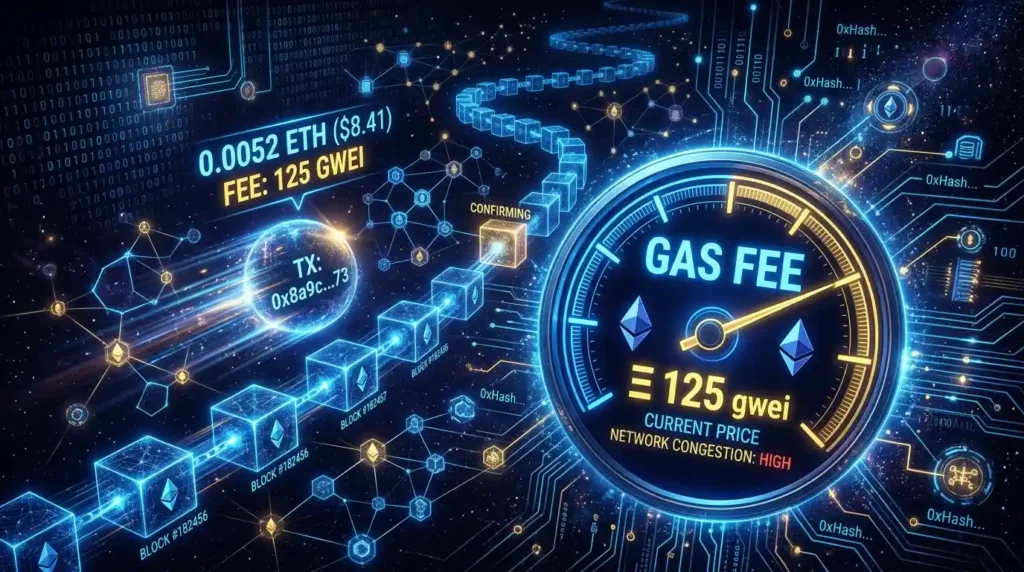
You’ve found a token you want to buy. You’ve connected your MetaMask wallet. You’ve entered the amount. You hit “Swap” — and your wallet shows you’ll pay $23 in fees for a $50 trade.
You close the app and wonder what just happened.
That $23 is a gas fee — one of the most confusing and frustrating parts of crypto for beginners. It’s also completely unavoidable if you use Ethereum and most DeFi protocols. Understanding what gas fees are, why they exist, and how to minimize them can save you real money.
The Quick Answer: What Is a Gas Fee?
A gas fee is the cost you pay to perform any action on a blockchain. Every transaction — sending ETH to a friend, swapping tokens on Uniswap, minting an NFT, interacting with a smart contract — requires computational work from the network’s validators. Gas fees compensate them for that work.
The name comes from a simple analogy: just like a car needs gasoline to run, blockchain transactions need “gas” to execute. More complex operations require more gas — just like a bigger car consumes more fuel.
Gas fees are not charged by the apps you use (MetaMask, Uniswap, Coinbase Wallet). They’re charged by the underlying blockchain itself and go directly to the validators securing the network.
Why Do Gas Fees Exist?
Gas fees serve three critical functions:
1. Compensating validators
Someone has to run the computers that process your transaction, verify it’s legitimate, and record it permanently on the blockchain. Gas fees are the economic incentive that makes this worth doing.
2. Preventing spam
If transactions were free, anyone could flood the network with millions of worthless transactions, grinding it to a halt. By requiring a fee for every operation, the network makes spam economically costly.
3. Preventing infinite loops
Smart contracts are code — and code can have bugs that create infinite loops. Gas fees solve this elegantly: every computation costs gas, and every transaction has a gas limit. When the gas runs out, the transaction stops. No fee, no computation — so buggy code can’t loop forever and paralyze the network.
How Are Gas Fees Calculated? (Ethereum)
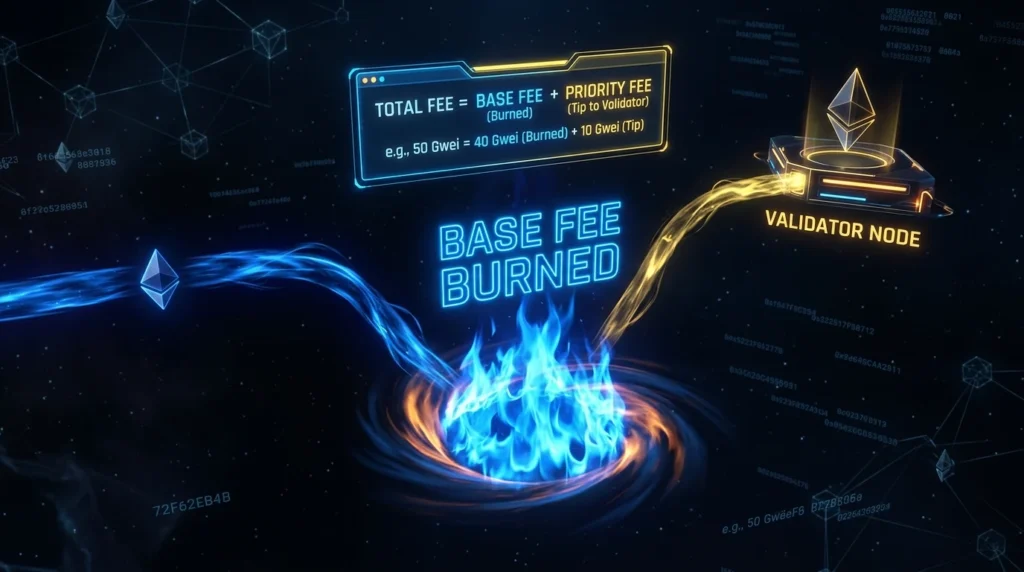
Ethereum’s fee structure was significantly redesigned in August 2021 with EIP-1559. Here’s how it works today:
Total Fee = (Base Fee + Priority Fee) × Gas Used
Base Fee: Set automatically by the network based on demand. When Ethereum’s blocks are more than 50% full, the base fee increases. When they’re less than 50% full, it decreases. You can’t negotiate the base fee — it’s determined by the network at the moment your transaction is processed. Crucially, the base fee is burned (destroyed forever), reducing ETH’s circulating supply.
Priority Fee (Tip): An optional extra you add to incentivize validators to include your transaction sooner. Think of it as tipping for faster service. During periods of low congestion, a tiny tip is sufficient. During “gas wars” (high demand events), a larger tip may be needed.
Gas Used: The amount of computational work your specific transaction requires. Measured in units of gas.
| Transaction Type | Gas Units Used |
|---|---|
| Simple ETH transfer | 21,000 gas |
| ERC-20 token transfer | 45,000–65,000 gas |
| Uniswap token swap | 100,000–150,000 gas |
| NFT mint | 150,000–300,000 gas |
| Complex DeFi interaction | 200,000–500,000+ gas |
What Is Gwei?
Gas prices are quoted in gwei — a tiny denomination of ETH.
- 1 ETH = 1,000,000,000 gwei (1 billion gwei)
- 1 gwei = 0.000000001 ETH
Gas prices are quoted in gwei because the numbers are more readable. “25 gwei” is easier than “0.000000025 ETH.”
A real example:
On April 14, 2026, Ethereum’s gas tracker showed standard gas at approximately 0.1 gwei. That means:
- A simple ETH transfer: 21,000 × 0.1 gwei = 2,100 gwei = 0.0000021 ETH ≈ $0.005
- A Uniswap swap: ~130,000 × 0.1 gwei = 13,000 gwei = 0.000013 ETH ≈ $0.03
These are extremely low fees by historical standards — the result of Ethereum’s Layer 2 ecosystem dramatically reducing pressure on the mainnet. During peak periods in 2021, that same swap cost $50–$200.
Why Do Gas Fees Spike?
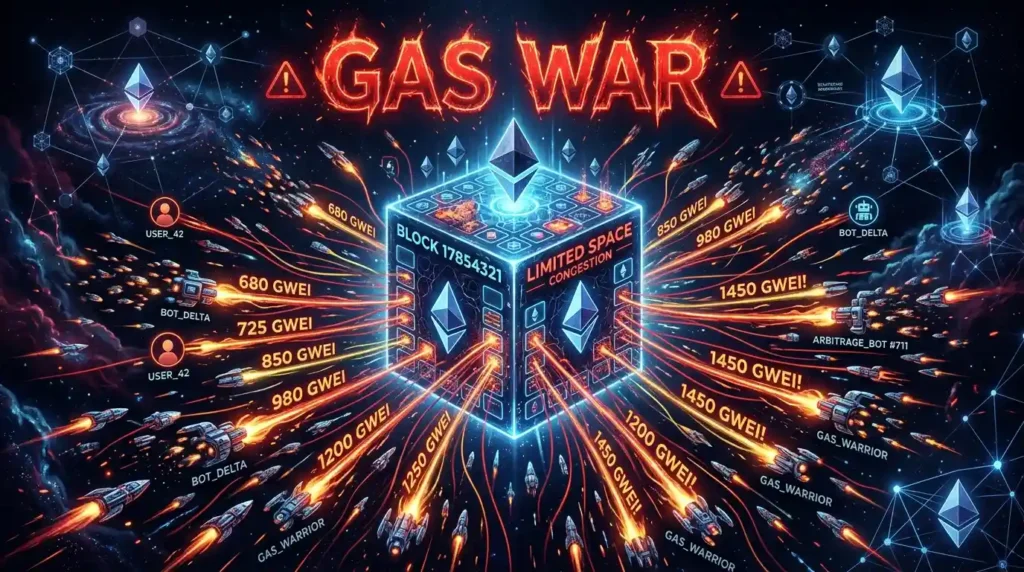
Gas fees are driven by supply and demand for block space — the limited amount of transactions that can fit into each Ethereum block (processed every ~12 seconds).
When demand for block space exceeds supply, users compete by raising their priority fees. The highest bidders get their transactions included first. Everyone else waits — or pays more.
Events that cause gas spikes:
- High-profile NFT collection launches (thousands of people minting simultaneously)
- Major token airdrops (everyone claiming at the same time)
- Viral DeFi opportunities (arbitrage bots competing)
- Sharp market movements (everyone rushing to trade at once)
- Popular token launches
During the 2021 NFT boom, average Ethereum gas regularly exceeded 200–500 gwei, making simple transfers cost $50+ and complex DeFi interactions cost hundreds of dollars.
Gas Fees Across Different Blockchains
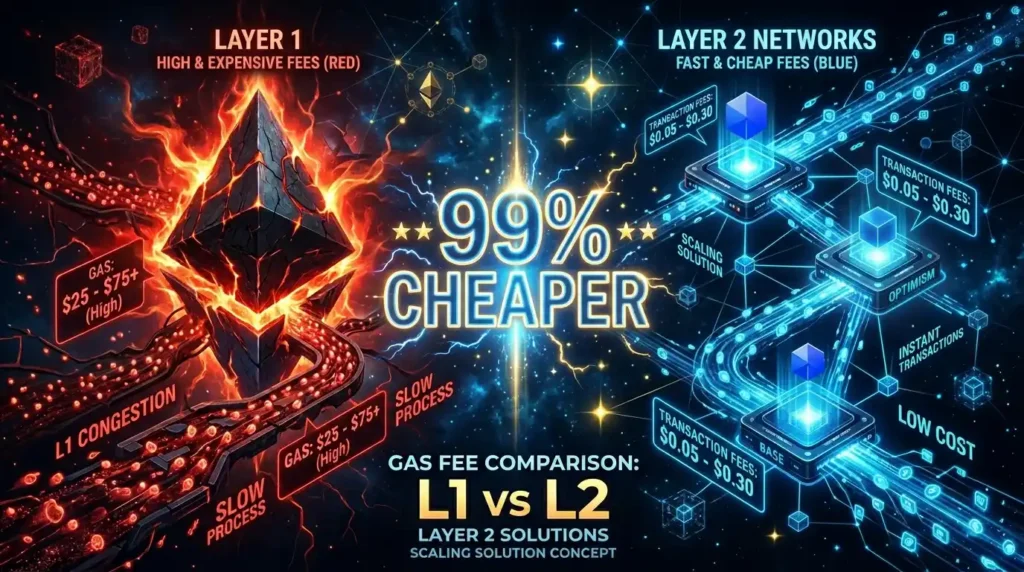
Ethereum mainnet is not the only option — and in 2026, most users have much cheaper alternatives:
| Network | Typical Swap Fee | Speed |
|---|---|---|
| Ethereum Mainnet | $0.02–$5 (varies with demand) | ~12 seconds |
| Arbitrum (L2) | $0.01–$0.20 | ~1–2 seconds |
| Optimism (L2) | $0.01–$0.20 | ~1–2 seconds |
| Base (L2, Coinbase) | $0.01–$0.10 | ~1–2 seconds |
| Solana | $0.001–$0.01 | ~0.4 seconds |
| BNB Chain | $0.05–$0.30 | ~3 seconds |
| Polygon | $0.01–$0.10 | ~2 seconds |
Layer 2 networks (Arbitrum, Optimism, Base) are built on top of Ethereum — they inherit Ethereum’s security but process transactions off the main chain and bundle them together, dramatically reducing per-transaction costs. In 2026, Layer 2s process more transactions than Ethereum mainnet itself, and fees of under $0.01 per swap are common.
Solana was designed from the ground up for high throughput and ultra-low fees. Most Solana transactions cost fractions of a cent.
Gas Limit vs Gas Price: What’s the Difference?
When sending a transaction in MetaMask or any wallet, you may see both a gas limit and a gas price:
Gas Limit: The maximum amount of gas you’re willing to let the transaction use. For a simple ETH transfer, the limit is always 21,000 (that’s all it needs). For a complex smart contract interaction, your wallet estimates a higher limit. If you set the limit too low, your transaction fails with an “out of gas” error — and you still pay for the gas that was consumed before failure.
Gas Price: How much you’re willing to pay per unit of gas. Higher gas price = faster inclusion. Lower gas price = might wait a long time or get dropped during congestion.
Modern wallets (MetaMask, Rainbow, Coinbase Wallet) calculate these automatically. You rarely need to adjust them manually unless you’re trying to save money by using a very low gas price during off-peak hours.
How to Reduce Gas Fees: Practical Tips
1. Use Layer 2 networks
The single most effective strategy. Arbitrum, Optimism, and Base offer Ethereum-compatible DeFi at 1–10 cent fees instead of dollars. Bridge your ETH to an L2 once, then use it there for everything.
2. Time your transactions
Ethereum gas fees follow predictable patterns. Fees are typically lowest between 2 AM – 8 AM UTC (overnight in the US, early morning in Asia) when network activity is low. Fees are highest during US and European business hours.
Use Etherscan’s Gas Tracker (etherscan.io/gastracker) to see current fees before transacting.
3. Use Solana for low-fee DeFi
If you’re doing frequent small trades, Solana’s Jupiter DEX offers nearly identical DeFi functionality to Ethereum at near-zero fees.
4. Batch transactions
Some protocols allow combining multiple actions into one transaction, paying gas only once. For example, claiming rewards and reinvesting in a single transaction rather than two.
5. Avoid “gas wars”
If you see a viral NFT launch or a hot new token dropping — that’s when fees spike most. If the transaction isn’t time-critical, wait an hour until the frenzy settles.
6. Set a custom gas limit
If you’re doing routine transactions on quiet periods, you can set a lower priority fee (tip) in MetaMask to save a few cents. Your transaction might take longer but it’ll still confirm.
What Happens If You Don’t Have Enough Gas?
Not enough ETH for gas: The transaction simply won’t submit. You need ETH in your wallet to pay gas fees — even if you’re swapping another token. Always keep a small ETH balance for gas.
Gas limit too low: The transaction attempts to execute, runs out of gas partway through, and fails. You still pay the gas consumed up to the failure point. No refund.
Gas price too low: During high congestion, your transaction may sit in the mempool (waiting area) indefinitely or be dropped. Not consumed, just ignored.
Key Gas Fee Terminology
Gas: The unit measuring computational work required for a blockchain operation.
Gas Fee: The total amount paid for a transaction: (Base Fee + Priority Fee) × Gas Used.
Base Fee: The minimum fee required by the network — burned (destroyed) upon transaction completion on Ethereum. Set algorithmically based on demand.
Priority Fee (Tip): An optional extra payment to validators for faster transaction inclusion.
Gas Limit: The maximum gas a transaction can consume. Set by the user; unused gas is refunded.
Gwei: A tiny denomination of ETH used to quote gas prices. 1 ETH = 1,000,000,000 gwei.
Gas War: A period of extreme demand where users outbid each other with high priority fees for scarce block space — causing fees to spike dramatically.
EIP-1559: The August 2021 Ethereum upgrade that replaced the chaotic fee auction with a base fee + tip model and introduced ETH burning.
Out of Gas: When a transaction fails because it consumed the entire gas limit before completing.
Layer 2 (L2): Networks built on top of Ethereum that process transactions more cheaply by batching them before settling to mainnet.
The Bottom Line
Gas fees are the price of using a decentralized network. They’re not a scam, not a bug, and not optional — they’re the economic mechanism that keeps the blockchain running, honest, and spam-free.
The good news: in 2026, you have options. Ethereum mainnet fees are near historic lows. Layer 2 networks have made complex DeFi interactions available for cents. Solana handles millions of transactions daily at near-zero cost.
If you’re new to crypto, the practical takeaway is simple: keep some ETH in your wallet for fees, use Layer 2 networks when possible, and check a gas tracker before large transactions during volatile market periods.
The network charges. You choose when and where to pay. ⛽
Disclaimer: This article is for informational purposes only and does not constitute financial advice. Cryptocurrency investments carry significant risk, including the potential loss of all invested capital. Always conduct your own research before making any investment decisions.