XRP has one of the most dramatic stories in all of crypto. A five-year legal battle with the SEC. Exchange delistings across the United States. Price swings that would make a cardiologist nervous. And through all of it — a core thesis that never changed: international money transfers are broken, and XRP can fix them.
As of April 2026, that thesis has finally found its footing. The SEC lawsuit that defined XRP’s narrative for half a decade is resolved. Spot XRP ETFs are live with over $1.4 billion in inflows. Over 300 banks and financial institutions use XRP for cross-border settlements. And the SEC has formally classified XRP as a digital commodity alongside Bitcoin.
XRP currently trades around $1.34, sits at #3–5 by market cap, and remains one of the most polarizing assets in crypto — loved by its community, misunderstood by critics, and increasingly accepted by the institutions it was always designed to serve.
Let’s cut through the noise.
The Quick Answer: What Is XRP?
XRP is the native digital asset of the XRP Ledger (XRPL) — a blockchain launched in 2012 specifically for fast, cheap, global payments. Unlike Bitcoin (designed as digital cash) or Ethereum (designed as a programmable computer), XRP was designed from day one for one purpose: to move money across borders instantly and cheaply.
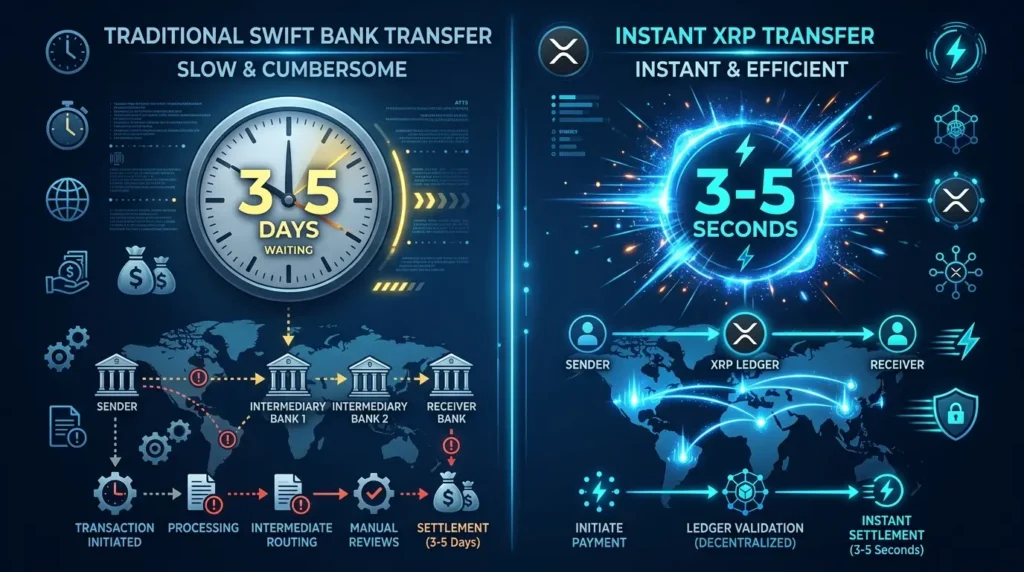
Think of XRP as a universal bridge currency. When a bank in Japan wants to send money to a bank in Brazil, they normally need pre-funded accounts in both currencies, wait 3–5 days through the SWIFT system, and pay significant fees. With XRP, the transaction settles in 3–5 seconds at a cost of fractions of a cent.
Important distinction — XRP and Ripple are not the same thing:
- XRP = the cryptocurrency / digital asset
- Ripple = the private company (Ripple Labs) that uses XRP in its products
Ripple uses XRP, but XRP exists independently on the XRP Ledger, which anyone can use.
Who Created XRP?
XRP was created in 2012 by David Schwartz, Jed McCaleb, and Arthur Britto — who built the XRP Ledger as a faster, more energy-efficient alternative to Bitcoin. Later that year, along with Chris Larsen, they founded the company that became Ripple Labs.
The original vision: create a payment protocol for the internet age. SWIFT — the system banks use for international transfers — was built in 1973. XRP’s creators believed they could build something dramatically better.
The XRP Ledger architects created 100 billion XRP at launch — a fixed supply with no mining. They gifted 80 billion to Ripple Labs to fund the company’s growth and build use cases around the technology.
One early member, Jed McCaleb, later left Ripple and founded Stellar (XLM) — a competing payment blockchain. His departure and subsequent sales of his XRP holdings created years of market uncertainty. By 2021, McCaleb’s XRP holdings were fully sold off, removing that source of selling pressure.
How Does XRP Actually Work?
The XRP Ledger
The XRP Ledger uses a unique consensus mechanism called Federated Consensus — significantly different from Bitcoin’s Proof of Work or Ethereum’s Proof of Stake.
Instead of miners or stakers competing to validate blocks, the XRPL relies on a network of designated validators — independent servers operated by universities, exchanges, businesses, and individuals. These validators communicate and reach agreement on transaction ordering and validity.
Key specs:
- Settlement time: 3–5 seconds
- Transaction cost: ~0.00001 XRP (fractions of a cent)
- Throughput: 1,500 transactions per second
- Validators: 150+ independent worldwide
- Energy: Extremely low — no mining required
On-Demand Liquidity (ODL): XRP’s Main Use Case
Ripple’s flagship product, On-Demand Liquidity (ODL), uses XRP as a bridge currency for cross-border payments:
- A bank in the US wants to send $1 million to a bank in Mexico
- Instead of pre-funding a peso account, they convert dollars to XRP instantly
- XRP transfers across the XRP Ledger in 3–5 seconds
- XRP converts to pesos on the other end
- Total time: seconds. Total cost: minimal
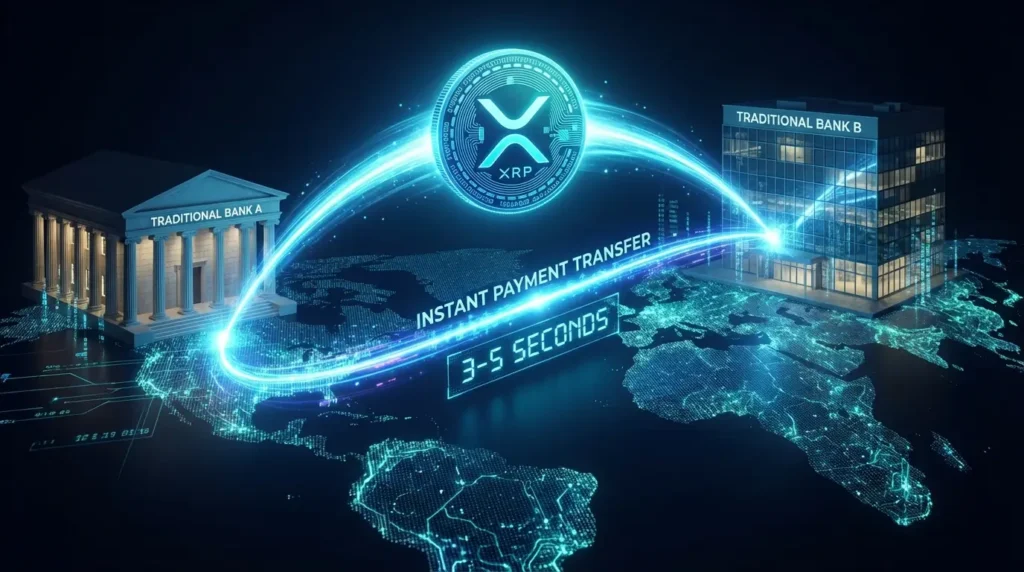
This eliminates the need for pre-funded accounts in every currency — currently banks lock up trillions in “nostro/vostro” accounts just to facilitate international transfers. XRP could free up that capital.
RLUSD: Ripple’s Stablecoin
In 2024, Ripple launched RLUSD — a US dollar stablecoin that works alongside XRP on the XRP Ledger. RLUSD provides stability for transactions requiring dollar certainty, while XRP handles the bridging function. Together they create a more complete payment infrastructure.
The SEC Lawsuit: The Story That Defined XRP
No discussion of XRP is complete without the SEC lawsuit — arguably the most important legal case in crypto history.
How It Started
In December 2020, the SEC filed a lawsuit against Ripple Labs, CEO Brad Garlinghouse, and co-founder Chris Larsen, alleging they raised over $1.3 billion through unregistered securities sales of XRP. The impact was immediate: Coinbase, Kraken, Bitstamp, and dozens of exchanges delisted XRP. The price crashed. Institutional investors fled.
The Key Ruling: July 2023
US District Judge Analisa Torres issued a landmark split ruling:
- XRP sold on public exchanges = NOT a security
- XRP sold directly to institutional investors = securities transactions
This was a major win for Ripple and the broader crypto industry — establishing that a token can be a security in some contexts but not others.
Resolution: August 2025
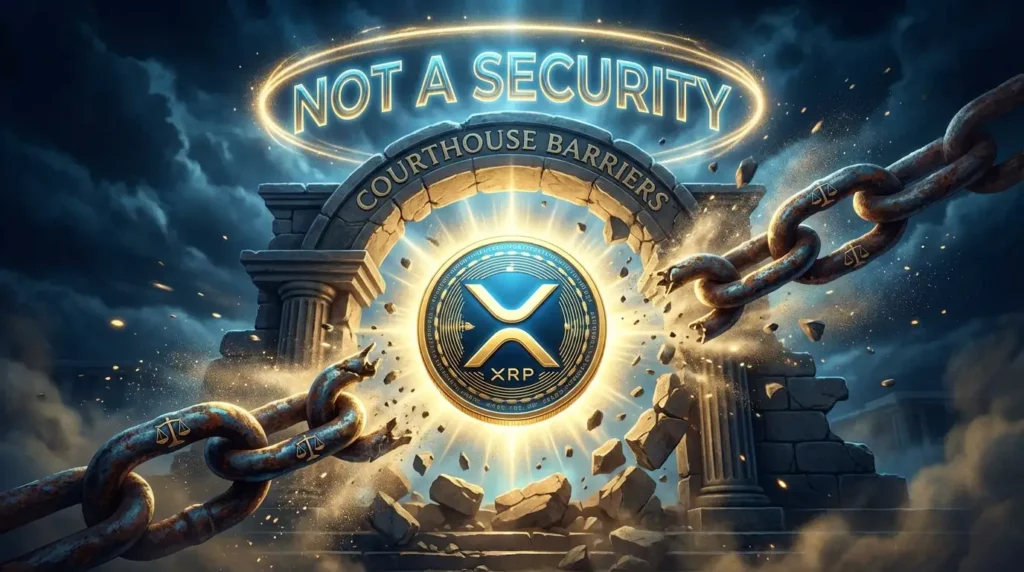
Both the SEC and Ripple filed a joint motion to dismiss their appeals, ending the nearly five-year legal battle. Ripple paid $125 million to resolve the institutional sales portion. XRP is not a security when traded on public exchanges. The cloud is lifted.
2026: Commodity Classification
In March 2026, the SEC formally classified XRP as a digital commodity alongside Bitcoin — removing any remaining legal ambiguity for US institutions. Seven spot XRP ETFs launched, bringing in $1.44 billion in Q1 2026 inflows alone.
XRP Tokenomics: The Numbers That Matter
| Metric | Data |
|---|---|
| Ticker | XRP |
| Current Price | ~$1.34 (April 2026) |
| Market Cap | ~$77 billion |
| Rank | #3–5 |
| Circulating Supply | ~57.8 billion XRP |
| Maximum Supply | 100 billion XRP (fixed) |
| Ripple Escrow Holdings | ~37–40 billion XRP |
| All-Time High | $3.84 (January 2018) |
| Transaction Speed | 3–5 seconds |
| Transaction Cost | ~$0.0001 |
| Spot ETF inflows (Q1 2026) | $1.44 billion |
The Escrow System
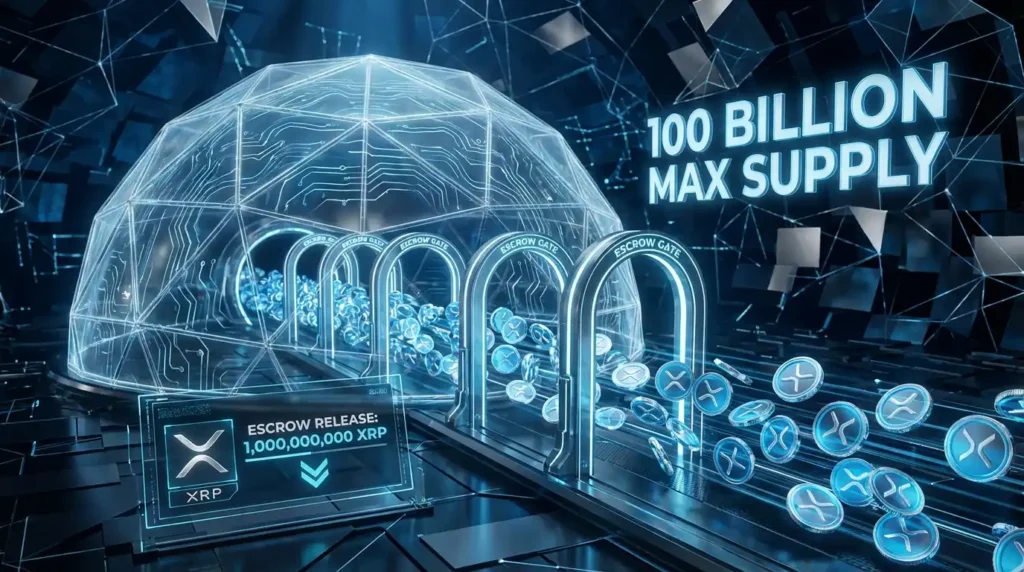
When the XRP Ledger launched, 100 billion XRP were created at once. To prevent Ripple from flooding the market, in 2017 Ripple locked 55 billion XRP into cryptographic escrow — smart contracts releasing a maximum of 1 billion XRP per month. Any unused XRP returns to escrow, extending the timeline.
This makes Ripple’s releases predictable and transparent — a key improvement over the early opacity that fueled criticism.
Fixed Supply: XRP’s Scarcity Feature
XRP has a fixed maximum supply of 100 billion tokens — no new XRP can ever be created. Additionally, a small amount is permanently burned with every transaction. Over 14 years, billions have been destroyed through transaction fees. XRP’s supply is technically deflationary over time.
XRP Price History: From Launch to Legal Victory
2012–2016: XRP trades at fractions of a cent. Ripple quietly builds its banking network.
2017: XRP rises from under $0.01 to $2.65 — a gain of over 36,000% in one year. Banking partnership narrative drives enormous retail interest.
January 4, 2018: XRP hits its all-time high of $3.84 — briefly overtaking Ethereum for the #2 spot by market cap. Then the crash begins.
December 2020: The SEC lawsuit. XRP falls from $0.65 to $0.17 within days as US exchanges delist it en masse.
July 2023: Judge Torres’ landmark ruling. XRP surges 75% within 24 hours — one of the largest single-day moves in any major cryptocurrency’s history.
August 2025: Lawsuit fully resolved. Spot ETFs launch. XRP reaches post-lawsuit highs.
Early 2026: XRP trades around $1.34. Standard Chartered projects $8 by year-end. Ripple CEO projects capturing 14% of SWIFT’s volume within five years.
What Is XRP Used For?
Cross-Border Payments (The Core Use Case)
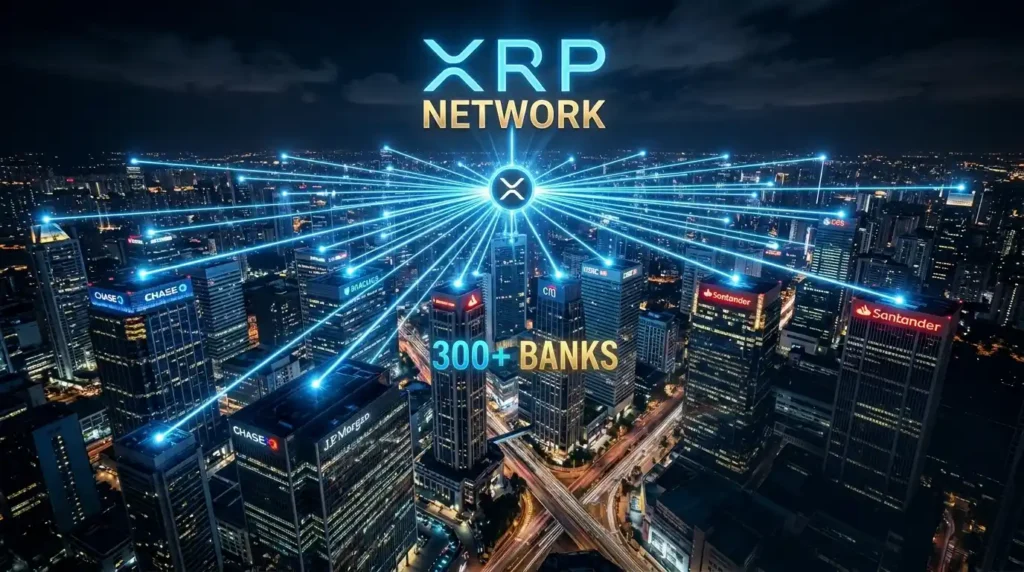
Over 300 banks and financial institutions use XRP through RippleNet for international settlements. The value proposition vs SWIFT is clear: 3–5 seconds vs 3–5 days, minimal fees vs significant costs, no pre-funded accounts needed.
Spot XRP ETFs
Seven US spot XRP ETFs launched between September–December 2025 including one from Franklin Templeton. These products allow pension funds and institutions to access XRP without crypto wallet complexity.
XRP Ledger DeFi
The XRP Ledger now supports DeFi applications, NFT minting, token issuance, and a built-in decentralized exchange. This diversifies XRP beyond pure payments.
CBDC Infrastructure
Ripple has won contracts helping multiple countries develop Central Bank Digital Currency infrastructure — using the XRP Ledger’s proven payment technology.
XRP Risks: The Honest Version
Centralization concerns: Ripple Labs holds ~37–40 billion XRP in escrow — a massive portion of total supply giving them enormous market influence.
Stablecoin competition: Why use volatile XRP as a bridge when USDT or USDC work directly? Ripple’s own RLUSD partially addresses this but the competitive question remains.
SWIFT modernization: SWIFT’s “SWIFT gpi” system has significantly sped up traditional transfers. If banking infrastructure improves enough, XRP’s advantage shrinks.
Validator centralization: The Federated Consensus uses relatively few validators compared to Bitcoin or Ethereum, raising decentralization concerns.
Monthly escrow releases: Up to 1 billion XRP can be released monthly from escrow, creating ongoing supply pressure on the price.
How to Buy XRP in the US: Step by Step
Following the SEC resolution and commodity classification, XRP is freely available on all major US exchanges.
Step 1: Choose a regulated exchange
- Coinbase — relisted XRP after 2023 ruling, fully regulated
- Kraken — maintained XRP trading throughout the lawsuit, excellent liquidity
- Gemini — strong compliance, clean interface
Step 2: Create and verify your account
Standard KYC — government ID required.
Step 3: Deposit funds
ACH for lowest fees, debit card for instant access.
Step 4: Buy XRP
Search XRP, enter dollar amount, confirm.
Step 5: Storage
For significant holdings, Ledger hardware wallet supports XRP. XUMM is the leading XRP Ledger native mobile wallet.
XRP vs Other Payment Cryptos
| Feature | XRP | Bitcoin | Stellar (XLM) |
|---|---|---|---|
| Settlement time | 3–5 seconds | 10+ minutes | 3–5 seconds |
| Transaction fee | ~$0.0001 | $1–50+ | ~$0.00001 |
| Max supply | 100 billion | 21 million | No hard cap |
| Primary use | Cross-border payments | Store of value | Payments/DeFi |
| Institutional adoption | 300+ banks | Growing | Limited |
| Founded | 2012 | 2009 | 2014 |
Key XRP Terminology for Beginners
XRP Ledger (XRPL): The blockchain XRP runs on — fast, cheap, purpose-built for payments.
Ripple Labs: The private company using XRP in its products and holding significant XRP reserves.
On-Demand Liquidity (ODL): Ripple’s product using XRP as a bridge currency for instant cross-border payments.
RippleNet: Ripple’s network of 300+ financial institution partners.
Federated Consensus: XRP’s consensus using trusted validators instead of mining or staking.
Escrow: System locking Ripple’s XRP, releasing maximum 1 billion per month.
RLUSD: Ripple’s USD-pegged stablecoin working alongside XRP on the XRPL.
SWIFT: The traditional interbank messaging system XRP aims to improve upon — built in 1973.
Howey Test: Legal standard for determining if an asset is a security — central to the SEC lawsuit.
Should You Buy XRP in 2026?
We are not financial advisors. But we are people who watched XRP survive a five-year regulatory war that would have killed most cryptocurrencies.
The case for XRP: legal uncertainty resolved, 300+ banking partners, $1.44 billion in ETF inflows, commodity classification, fixed supply with slow deflation, and Standard Chartered projecting $8 by year-end.
The case for caution: XRP hasn’t returned to its 2018 ATH despite everything going right. Escrow releases create supply pressure. Stablecoin competition is real. SWIFT is improving.
XRP is the most institutionally-oriented cryptocurrency outside of Bitcoin. If you believe blockchain infrastructure will reshape global payments, and you believe Ripple has the partnerships to win that market — XRP deserves serious consideration. Do your research, start small, and never invest more than you can afford to lose.
Disclaimer: This article is for informational purposes only and does not constitute financial advice. Cryptocurrency investments carry significant risk, including the potential loss of all invested capital. Always conduct your own research before making any investment decisions.