Here’s a simple thought experiment. Open any Bitcoin block explorer. Type in any Bitcoin address — anyone’s — and you can see every transaction ever made from that wallet. Every amount sent. Every address received. The entire financial history, visible to anyone with a browser.
Now try that with Monero.
You can’t. There’s nothing to see. The sender is hidden. The recipient is hidden. The amount is hidden. By design, by default, by mathematical certainty.
That’s the core idea behind Monero (XMR) — the largest and most technically sophisticated privacy cryptocurrency in the world. It’s also one of the most controversial, one of the most misunderstood, and one of the most fascinating stories in all of crypto.
Let’s get into it.
The Quick Answer: What Is Monero?
Monero is a decentralized, open-source cryptocurrency designed from the ground up for complete financial privacy. Every transaction is private by default — not as an optional setting, not as an extra feature you can toggle on, but as the fundamental behavior of the network.
Its native token is XMR. The name “Monero” comes from Esperanto, meaning simply “coin” — reflecting the project’s vision of being universal, accessible digital money for anyone, anywhere, without surveillance.
As of April 2026, XMR trades around $339–$345 and holds approximately the #15 spot on CoinMarketCap with a market cap of roughly $6.2–$6.3 billion. There are approximately 18.45 million XMR in circulation — a number that grows slowly via “tail emission” (more on that below).
Monero has the third-largest developer community of any cryptocurrency, behind only Bitcoin and Ethereum. It has never been hacked or compromised. And it remains, after more than a decade, the gold standard for on-chain financial privacy.
Who Created Monero? The Most Anonymous Origin Story in Crypto
Monero’s origin is fittingly mysterious for a privacy coin.
It all traces back to a 2013 whitepaper written by someone using the pseudonym “Nicolas van Saberhagen,” who described a protocol called CryptoNote — an entirely new approach to cryptocurrency privacy. The whitepaper argued that Bitcoin’s public blockchain was a “critical flaw” and proposed ring signatures and stealth addresses as solutions. The real identity of Nicolas van Saberhagen remains unknown to this day.
In April 2014, a Bitcointalk forum user known as “thankful_for_today” implemented CryptoNote into a coin called Bitmonero. But the community quickly disagreed with the direction thankful_for_today was taking the project. After a dispute, the community forked the project away from the original creator — keeping the code, changing the leadership, and renaming it Monero.

Both Nicolas van Saberhagen and thankful_for_today remain anonymous. To this day, nobody knows who they are.
This makes Monero one of the only major cryptocurrencies with no identifiable founder — similar in that respect to Bitcoin itself.
Key facts about Monero’s launch:
- No pre-mine: Zero coins were allocated to developers, founders, or investors before launch
- No ICO: No initial coin offering, no fundraising from venture capital
- No developer tax: Zero percent of block rewards go to any development fund
- Fair launch: All XMR were generated through open mining from day one
This is relatively rare in crypto, where many projects quietly pre-allocate tokens to insiders. Monero launched as cleanly as possible — every coin earned through computation.
The project is now maintained by a decentralized community of volunteer developers, funded through the Community Crowdfunding System (CCS) where anyone can propose and fund development work transparently.
How Does Monero Actually Work? The Privacy Technology Explained
Monero achieves privacy through a combination of four distinct cryptographic technologies working simultaneously on every transaction. Here’s what each one does in plain English:
1. Ring Signatures
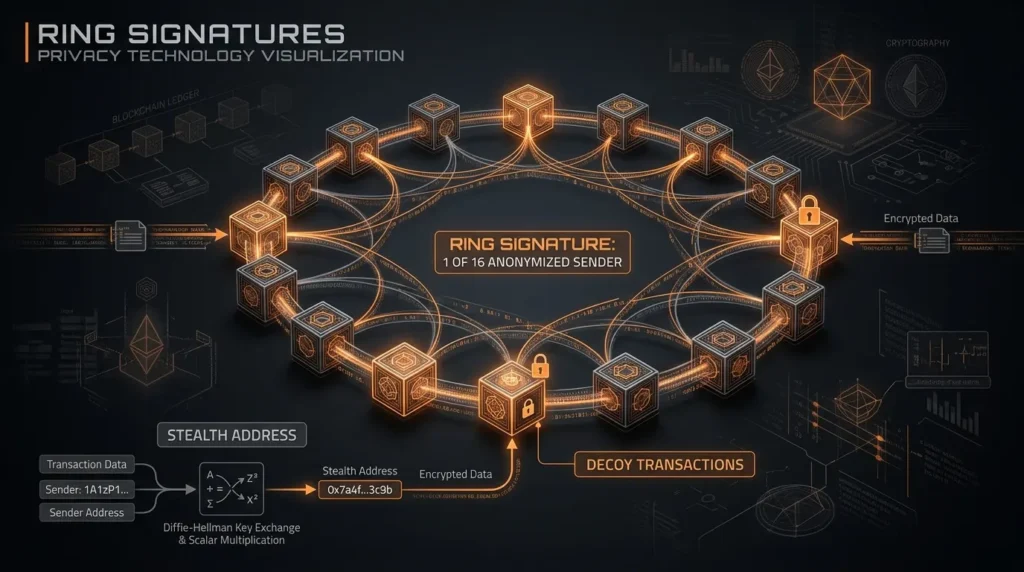
When you send XMR, your transaction is automatically mixed with multiple other past transaction outputs from the blockchain — called “decoys.” These decoys come from real, historical Monero transactions, not fake ones. An outside observer can see that one of the 16 (or more) ring members signed the transaction, but cannot determine which one was the actual sender.
Think of it like signing a document as part of a group: the signature proves someone in the group signed it, but not who specifically.
2. Stealth Addresses
Every time someone sends you Monero, your wallet automatically generates a brand-new, one-time destination address for that specific transaction. This address is derived from your public wallet address but is completely unlinked from it on the blockchain. The sender uses your public address to generate this one-time address, but only you (with your private key) can detect and spend the funds.
The result: your public Monero address never appears on the blockchain. Nobody can look up your address and see your transaction history — because there is no transaction history associated with your address.
3. RingCT (Ring Confidential Transactions)
Ring signatures hide who sent the transaction. Stealth addresses hide who received it. RingCT hides the amount. Using a cryptographic technique called Pedersen commitments, the transaction proves that the inputs equal the outputs (no coins were created from thin air) without revealing the actual values involved.
4. Dandelion++
Even if transaction contents are hidden, the IP address of the node that first broadcast the transaction to the network could potentially be logged. Dandelion++ solves this by first routing the transaction through a random “stem” phase — a series of nodes that pass it along privately — before it “fluffs” out to the broader network. This makes it extremely difficult to trace which IP address originated a transaction.
The 2026 FCMP++ Upgrade:
In 2026, Monero is rolling out its most significant privacy upgrade in history: Full-Chain Membership Proofs (FCMP++). This replaces traditional ring signatures entirely, expanding the anonymity set from 16 decoys to the entire Monero blockchain — approximately 150+ million outputs. The upgrade makes chain analysis computationally implausible even for state-level adversaries, and includes forward secrecy that protects past transactions even if private keys are compromised in the future.

Monero Tokenomics: The Numbers
| Metric | Details |
|---|---|
| Current Price (April 2026) | ~$339–$345 USD |
| Market Cap | ~$6.2–$6.3 billion |
| CoinMarketCap Ranking | ~#15 |
| Circulating Supply | ~18.45 million XMR |
| Maximum Supply | No hard cap (tail emission) |
| Consensus Mechanism | Proof of Work (RandomX) |
| Block Time | ~2 minutes |
| Transaction Fee | ~$0.01–$0.05 |
| All-Time High | ~$799 (January 14, 2026) |
| Launch Date | April 18, 2014 |
| Annual Inflation (tail) | ~0.8%, trending toward 0% |
Key Tokenomics Details:
Monero’s supply model is deliberately different from Bitcoin’s. The main emission curve issued approximately 18.132 million XMR by May 2022. After that, tail emission kicked in: a permanent reward of 0.6 XMR per 2-minute block — forever.
This decision was philosophically intentional. Bitcoin’s capped supply means that eventually, after the last halving, miners will only be compensated by transaction fees. Many researchers argue this creates long-term security risks if transaction fee revenue isn’t sufficient to incentivize miners. Monero’s tail emission guarantees miners are always compensated, maintaining network security in perpetuity — at the cost of perpetual (but very low) inflation under 1% annually.
RandomX Mining:
Monero uses a Proof of Work algorithm called RandomX, designed specifically to be ASIC-resistant and CPU-friendly. Regular consumer processors can mine XMR efficiently — you don’t need specialized mining hardware. This reflects Monero’s core commitment to decentralization: if anyone with a laptop can meaningfully contribute to mining, no single entity can dominate the network.
The Exchange Delisting Problem: The Elephant in the Room
This is the most important practical issue for anyone considering Monero.
Starting in 2023–2024, major centralized exchanges began delisting XMR under regulatory pressure:
- Binance delisted Monero on February 20, 2024, citing regulatory compliance
- Kraken delisted XMR in 2024 for European users
- Bitfinex restricted XMR in certain jurisdictions
- South Korean and Australian exchanges delisted privacy coins broadly
As of 2026, Monero is NOT available on Coinbase — the most popular US exchange — and is unavailable on several other major platforms.
The reason is regulatory: governments and financial regulators argue that the untraceable nature of Monero makes it difficult to enforce Anti-Money Laundering (AML) and Know Your Customer (KYC) requirements. The EU’s MiCA regulation classifies privacy tokens as “high-risk.” The US Treasury has historically taken a tough stance on privacy-enhancing tools.
However — and this is important for US context:
The US Treasury Department recently acknowledged that privacy tools like mixers can serve legitimate purposes. Monero itself has not been banned in the US. Owning and using XMR is legal in the United States. The challenge is simply buying it on mainstream exchanges.
Where you can still buy XMR:
- Kraken — still available for US users (check current status)
- TradeOgre — privacy-focused exchange
- Bisq — decentralized, peer-to-peer exchange
- Atomic Swaps — swap BTC or ETH directly for XMR without an exchange
- Cake Wallet — mobile wallet with built-in XMR swap functionality
The community has adapted remarkably. Atomic swaps between BTC and XMR now allow users to acquire XMR directly from their Bitcoin wallets without any centralized intermediary — maintaining privacy throughout the process.
Monero Price History: Digital Cash with Dramatic Cycles
2014–2016 — The Quiet Years: XMR launched at fractions of a cent and traded below $1 for its first two years. The community was small but technically dedicated, focused on building the protocol rather than speculating on price.
2016–2017 — The Silk Road Legacy: Reports emerged that darknet markets were adopting Monero as an alternative to Bitcoin, whose transactions had become increasingly traceable. This drove significant attention — and price appreciation — from both privacy advocates and speculators. XMR rose from under $1 to over $400 by late 2017.
2018 — The Crash: Like every other cryptocurrency, XMR fell dramatically in 2018. From its late-2017 highs near $400–$500, it collapsed to around $40 by year-end.
2019–2020 — The RandomX Era: The November 2019 launch of RandomX re-energized the mining community, making XMR more accessible to CPU miners. Price stabilized in the $50–$90 range.
2021 — The Bull Run: XMR participated in the 2021 crypto bull market, rising to approximately $517 in May 2021 — still below its 2018 highs despite being a more mature, technically superior product. This persistent discount to 2018 levels reflects the ongoing exchange delisting pressure.
2024 — Binance Delisting: Binance’s February 2024 delisting initially caused a sharp drop. But XMR recovered strongly — demonstrating what the community calls “delisting resilience.” Volume simply migrated to decentralized and peer-to-peer channels.
January 2026 — New All-Time High: XMR reached a new all-time high of approximately $799 on January 14, 2026 — finally surpassing its 2018 peak — during a broader crypto bull run amplified by growing demand for privacy tools amid increasing on-chain surveillance and CBDC rollouts.
April 2026 — Current: After the January ATH, XMR has consolidated around $325–$345, representing a ~57% pullback from its peak. The FCMP++ upgrade remains a near-term catalyst.
What Is Monero Actually Used For?
Financial Privacy: The most obvious use case. Anyone who values keeping their financial transactions private — journalists, activists, businesses protecting competitive information, individuals in authoritarian countries, or simply people who believe their spending is nobody else’s business — uses Monero for the same reason people use cash: because privacy is a legitimate need, not inherently suspicious.
Fungibility: In Bitcoin, every coin has a public transaction history. Coins that have touched darknet markets, gambling sites, or sanctioned addresses can theoretically be “tainted” and refused by exchanges or merchants. Every XMR is identical, indistinguishable, and equally valid — exactly as physical cash works. This is the property of fungibility, and it’s essential for money to function properly.
CPU Mining: Monero is one of the last major cryptocurrencies where an ordinary person can mine meaningfully on a home computer. The RandomX algorithm’s ASIC resistance keeps mining accessible and decentralized.
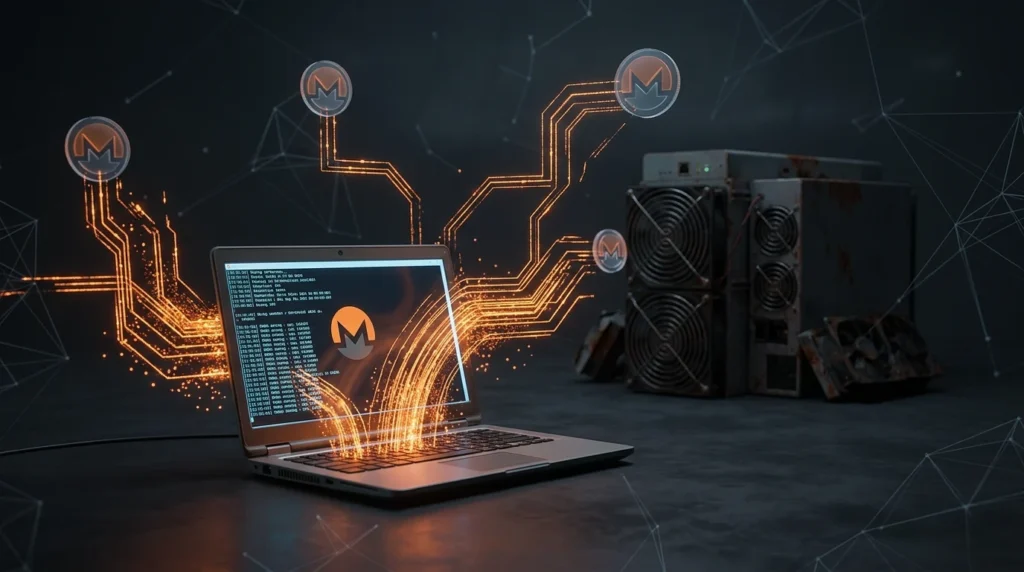
Peer-to-Peer Commerce: Merchants who accept Monero through platforms like NOWPayments can receive payments without exposing their business transaction history to competitors, hackers, or government surveillance.
Remittances: Particularly in regions with aggressive currency controls or financial surveillance, Monero enables people to move value across borders privately.
Atomic Swaps: The Monero ecosystem has built sophisticated atomic swap infrastructure allowing BTC/ETH/XMR swaps without any centralized intermediary — enabling privacy even for users who primarily hold other cryptocurrencies.
Monero Risks: The Honest Assessment
The Regulatory Threat is Real: This is Monero’s biggest risk. As more jurisdictions implement stricter AML/KYC requirements, exchanges face pressure to delist privacy coins. If XMR becomes unavailable on most major exchanges globally, liquidity suffers and adoption becomes harder for mainstream users. The EU’s 2027 planned ban on exchange listings for privacy coins is a significant near-term risk.

The Darknet Association: Monero is extensively used on darknet markets for illegal commerce. This association is real, documented, and regularly cited by regulators to justify restrictions. While privacy itself is not illegal and has countless legitimate uses, the reputational overhang is impossible to ignore.
No ETF, No Institutional Path: Unlike Bitcoin, Ethereum, or even XLM and HBAR, Monero has no ETF filing, no SEC commodity classification, and no visible institutional adoption path. The privacy features that make it valuable to individual users make it incompatible with regulatory frameworks that institutions must comply with.
No Named Founders: While Monero’s anonymous founding is philosophically consistent with its ethos, it means there’s no accountable leadership, no corporate structure, and no institutional relationships that could help navigate regulatory challenges.
Quantum Computing Risk: Long-term, quantum computers could theoretically crack the elliptic curve cryptography underlying Monero’s ring signatures. The FCMP++ upgrade moves toward quantum resistance, but this remains a structural watch item for long-term holders.
How to Buy Monero (XMR) in the US
Given the exchange delistings, buying XMR in the US requires more steps than most cryptocurrencies. Here are the main options:
Option 1 — Kraken (Verify Current Availability)
Kraken has historically been one of the more XMR-friendly exchanges in the US. Verify current XMR availability before creating an account, as policies can change.
Option 2 — TradeOgre
A smaller, privacy-focused exchange that has consistently supported XMR. Less regulated, meaning simpler access but less investor protection.
Option 3 — Bisq (Decentralized)
Bisq is a peer-to-peer decentralized exchange where you can buy XMR with fiat currency directly from other users. No KYC required. More complex for beginners but the most privacy-preserving option.
Option 4 — Atomic Swaps
If you already own Bitcoin, you can use atomic swap software to directly exchange BTC for XMR without any centralized intermediary. Cake Wallet makes this process relatively simple via its built-in swap functionality.
Step-by-step for Kraken:
- Create a Kraken account and verify identity
- Fund with USD via bank transfer
- Search for XMR and place a buy order
- For self-custody, download Cake Wallet (mobile) or the official Monero GUI wallet
- Withdraw XMR from Kraken to your wallet
Note on taxes: In the US, every XMR sale or exchange is a taxable event. CoinTracker and Koinly both support Monero tracking.
Key Monero Terminology for Beginners
Ring Signatures: A cryptographic method where a transaction is signed by one member of a group, but observers can only verify that someone in the group signed it — not who specifically.
Stealth Addresses: One-time destination addresses generated automatically for each transaction, preventing any link between the sender’s payment and the recipient’s public wallet address.
RingCT (Ring Confidential Transactions): A cryptographic technique that hides transaction amounts while proving that inputs equal outputs (no new coins were created).
Dandelion++: A network-level privacy protocol that obfuscates which IP address originated a transaction.
RandomX: Monero’s ASIC-resistant Proof of Work mining algorithm, designed to be efficient for CPUs and prevent specialized hardware from dominating the network.
Tail Emission: A permanent, fixed mining reward of 0.6 XMR per block that activates after the main emission curve, ensuring miners always have an incentive to secure the network.
FCMP++ (Full-Chain Membership Proofs): Monero’s 2026 upgrade that replaces ring signatures with proofs using the entire blockchain as an anonymity set — expanding privacy by approximately 10 million times.
Fungibility: The property where every unit of a currency is interchangeable and equal in value. Monero is fungible by design; Bitcoin is not (due to traceable transaction history).
Atomic Swap: A direct, trustless exchange of one cryptocurrency for another without any centralized intermediary — enabling BTC-to-XMR swaps with no exchange account required.
Should You Buy Monero in 2026?
The honest truth: Monero is the most technically sophisticated privacy tool in crypto and simultaneously one of the hardest assets to hold comfortably in a regulated environment.
The bull case: Financial privacy is a fundamental human right. As on-chain surveillance intensifies, CBDC rollouts accelerate globally, and financial monitoring expands, the demand for genuinely private digital cash will grow. Monero is the only cryptocurrency that provides this at a mathematically proven level. The FCMP++ upgrade makes it even more powerful. It hit a new all-time high in January 2026 — after years of exchange delistings — demonstrating remarkable resilience. At $6.2B market cap, it’s arguably undervalued relative to the scale of the privacy problem it solves.
The bear case: The regulatory trajectory is hostile. The EU ban on exchange listings is coming. US exchanges avoid it. No ETF pathway exists. Every major jurisdiction is moving toward more financial transparency, not less. Holding XMR means accepting that your on-ramp and off-ramp options may continue to shrink.
The honest bottom line: Monero is not for passive investors seeking easy access through traditional brokerages. It’s for people who understand the privacy thesis deeply, can navigate decentralized exchanges and atomic swaps, and are comfortable with the regulatory uncertainty. If you believe financial privacy is worth fighting for — and can handle the complexity — Monero remains the best tool that exists for that purpose.
Privacy by default. Untraceable by design. Anonymous since 2014. 🔒
Disclaimer: This article is for informational purposes only and does not constitute financial advice. Cryptocurrency investments carry significant risk, including the potential loss of all invested capital. Always conduct your own research before making any investment decisions.