Here’s a fun party trick: name a crypto founder who built a P2P file-sharing network in the early 2000s, then created the once-largest Bitcoin exchange in the world, then co-founded one of the top-5 cryptocurrencies by market cap, then left to build another top-20 cryptocurrency.
That person is Jed McCaleb. And his second act in crypto — Stellar — is arguably his most interesting.
Stellar (XLM) is a blockchain network that has quietly built some of the most impressive real-world financial infrastructure in all of crypto. While Bitcoin debates store-of-value vs. payments, and Ethereum battles gas fees, Stellar has been busy convincing Franklin Templeton to tokenize over $650 million of a US-registered money market fund on its chain. PayPal launched its stablecoin on it. MoneyGram uses it. The US government posts economic data on it.
And yet most retail investors have barely heard of it.
That’s exactly the kind of story worth understanding. Let’s get into it.
The Quick Answer: What Is Stellar?
Stellar is an open-source, decentralized blockchain network built specifically for cross-border payments and the tokenization of real-world assets. It was launched in 2014 and is operated by the Stellar Development Foundation (SDF), a nonprofit organization based in San Francisco.
Its native token is called XLM — or “Lumens” — which serves two main purposes: paying tiny transaction fees on the network (we’re talking fractions of a cent), and acting as a bridge currency that enables seamless conversion between different currencies in a single transaction.
In plain English: Stellar lets you send money from one country to another, in any currency, fast, cheaply, and with minimal friction. And it lets institutions tokenize real-world financial assets — bonds, money market funds, equities — and trade them on blockchain rails instead of legacy banking infrastructure.
As of April 2026, XLM trades around $0.15–$0.17 and holds the #20 spot on CoinMarketCap with a market cap of approximately $5.1 billion. There are roughly 33 billion XLM in circulation, out of a maximum supply of 50 billion.
Who Created Stellar? The Legend of Jed McCaleb
To understand Stellar, you need to understand its founder — because few people in crypto have shaped the industry from as many directions simultaneously.
Jed McCaleb was born in 1975 in Fayetteville, Arkansas. He dropped out of UC Berkeley and moved to New York to pursue tech projects. In the early 2000s, he built eDonkey2000, one of the most popular peer-to-peer file sharing networks of its era. Then, in 2010, he created Mt. Gox — originally a trading card exchange, repurposed as a Bitcoin exchange, which went on to handle roughly 70% of all global Bitcoin trades at its peak. McCaleb sold Mt. Gox in 2011 (the new owners later ran it into the ground in the infamous 2014 hack that lost 850,000 BTC, but that was after his departure).
In 2011, he co-founded Ripple, helping create what would become XRP — a cross-border payments network that today ranks in the top 5 cryptocurrencies. But McCaleb grew frustrated with Ripple’s direction: he felt it was becoming too bank-focused and centralized, drifting from the open, permissionless vision he believed in.

In 2013, he left Ripple. And in July 2014, alongside Joyce Kim and with seed funding from Stripe’s Patrick Collison (who invested $3 million), McCaleb launched Stellar.
The goal from day one: build the financial internet. Not just for banks, but for everyone — particularly the 1.7 billion people worldwide without access to traditional banking.
One important technical note: Stellar initially used Ripple’s codebase, but a ledger fork in December 2014 caused consensus failures. In response, Stanford professor David Mazières (Stellar’s chief scientist) developed an entirely new consensus algorithm — the Stellar Consensus Protocol (SCP) — which launched in November 2015 and replaced all original code. The two networks are technically unrelated today.
How Does Stellar Actually Work?
Stellar’s architecture is elegant and purpose-built. Here’s how the key pieces fit together:
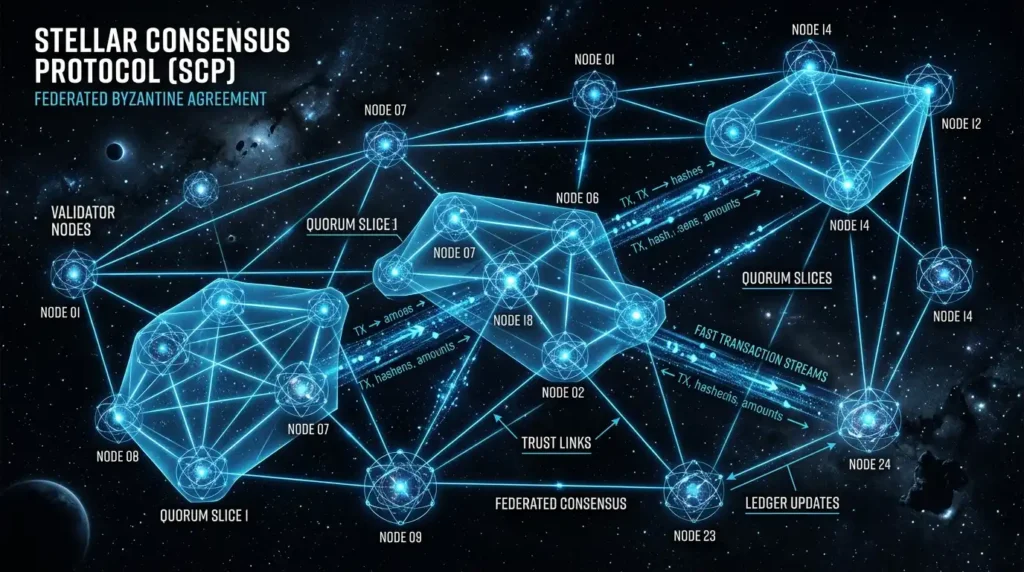
The Stellar Consensus Protocol (SCP): Unlike Bitcoin’s energy-intensive Proof of Work or Ethereum’s Proof of Stake, Stellar uses a federated Byzantine agreement system. Network participants (validators) don’t need to trust every other participant — they each define a “quorum slice” of validators they personally trust. Where these slices overlap, consensus emerges organically. The result is fast, cheap, and energy-efficient transaction processing with no mining required.
Transaction Speed and Cost: Stellar processes transactions in 3–5 seconds with fees of roughly 0.00001 XLM — effectively zero. The entire annual transaction costs for most users amount to pennies.
Anchors: These are licensed financial institutions that act as bridges between Stellar and the traditional financial world. An Anchor accepts deposits in fiat currency (say, US dollars), issues equivalent tokens on the Stellar network, and redeems them on the other end. This is how a real-dollar payment sent from the US arrives as local currency in the Philippines without going through a correspondent banking chain.
XLM as Bridge Currency: When two currencies don’t have a direct trading pair on the network, XLM automatically serves as an intermediary. You send USD, Stellar instantly converts it to XLM, then converts XLM to Philippine Pesos on the other end — all in one transaction, in seconds.
Soroban Smart Contracts: In 2023, Stellar launched Soroban, a smart contract platform designed specifically for financial applications. Unlike Ethereum’s general-purpose smart contracts, Soroban is purpose-built for DeFi and real-world asset tokenization with predictable fees and compliance-friendly architecture. The 2026 Protocol 24 upgrade added zero-knowledge (ZK) cryptography — enabling private transactions that can still be audited for regulatory compliance.
Built-in DEX: Stellar has a native decentralized exchange baked into the protocol, allowing any two Stellar-based assets to be swapped without third-party smart contracts. This is part of why Stellar can serve as financial infrastructure rather than just a payment rail.
Stellar Tokenomics: The Numbers
| Metric | Details |
|---|---|
| Current Price (April 2026) | ~$0.15–$0.17 USD |
| Market Cap | ~$5.1 billion |
| CoinMarketCap Ranking | #20 |
| Circulating Supply | ~33.1 billion XLM |
| Maximum Supply | 50 billion XLM |
| Consensus Mechanism | Stellar Consensus Protocol (SCP) |
| Transaction Speed | 3–5 seconds |
| Transaction Fee | ~0.00001 XLM (<$0.001) |
| All-Time High | ~$0.94 (January 4, 2018) |
| Managed By | Stellar Development Foundation (nonprofit) |
Key Tokenomics Details:
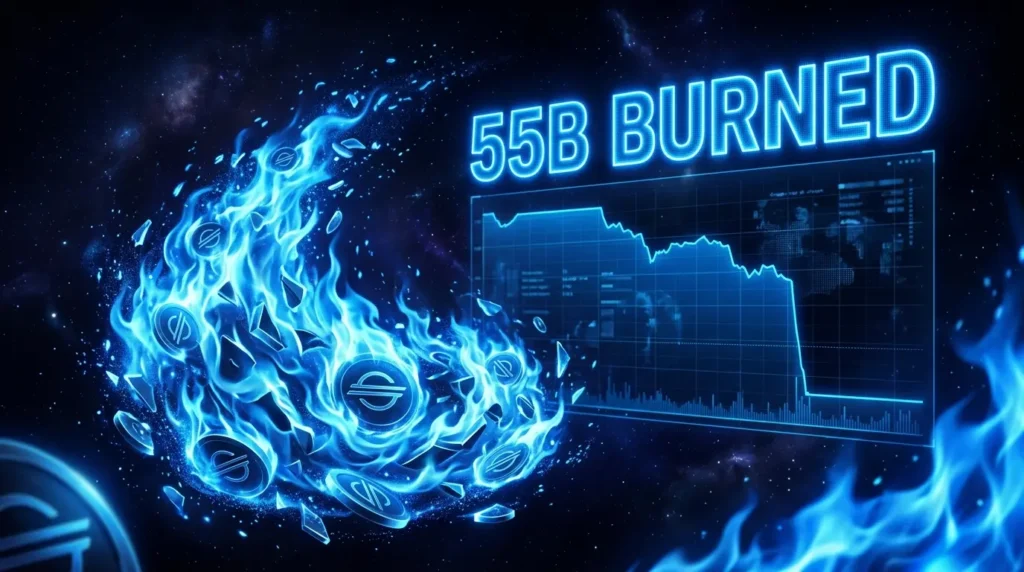
Stellar launched in 2014 with 100 billion XLM and an initial 1% annual inflation rate. In November 2019, the Stellar Development Foundation made a dramatic move: it burned over 55 billion XLM — more than half the total supply — eliminating tokens earmarked for airdrop programs that the SDF determined were not effectively growing adoption. The burn reduced total supply to 50 billion XLM and reduced SDF’s share from ~85% to ~60% of remaining supply.
The SDF controls a significant portion of the XLM supply, which it uses for ecosystem grants, partnerships, and operational expenses. This level of centralization at the foundation level is a point of criticism from some in the crypto community, though Stellar argues it enables more intentional ecosystem development.
Unlike Bitcoin, XLM has no mining and no halving mechanism. New supply enters circulation primarily through SDF grants and ecosystem programs.
Stellar and the ETF / Regulatory Landscape in 2026
March 2026 brought landmark regulatory clarity for Stellar: the SEC officially classified XLM as a digital commodity subject to CFTC oversight rather than a security. This was a critical development — XLM had been operating in a regulatory gray zone since 2014, which created compliance friction for institutions considering Stellar’s infrastructure.
With that uncertainty removed, institutional adoption has accelerated. Key 2026 developments include:
CME Futures Launch: CME Group — the world’s largest derivatives exchange — confirmed the launch of regulated XLM futures contracts in 2026, part of its broader crypto expansion alongside Cardano and Chainlink futures. CME’s crypto trading volume rose 19% year-over-year in March 2026, approaching $8 billion in average daily notional value.
Spot ETF Pathway: With XLM’s commodity designation cleared, spot ETF filings are expected to follow the pattern set by Bitcoin, Ethereum, Litecoin, and HBAR products. No XLM spot ETF has launched as of April 2026, but the regulatory groundwork is now in place.
SWIFT Recognition: A recently circulated SWIFT document positioned Stellar alongside Ripple as core blockchain payment infrastructure being integrated with traditional banking rails — a significant institutional validation signal.
Rakuten Wallet: Japan’s e-commerce giant Rakuten added XLM for spot trading starting April 15, 2026, expanding regulated retail access in a major global market.
Stellar’s Real-World Adoption: The Proof Is in the Partnerships
This is where Stellar genuinely stands apart from most crypto projects. Here’s what’s actually running on the network right now:
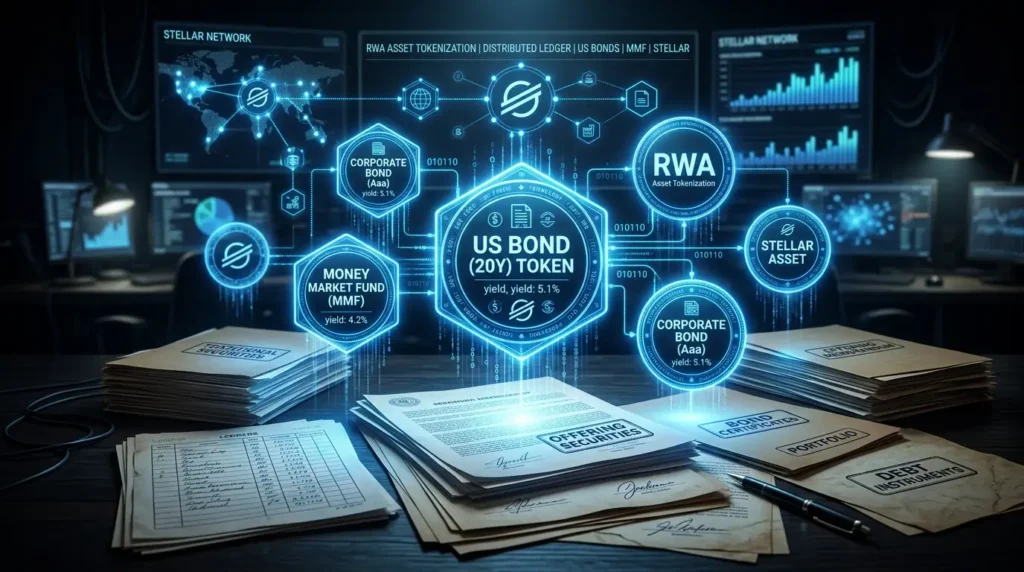
Franklin Templeton: One of the world’s largest asset managers (with $1.68 trillion AUM) tokenized its Franklin OnChain US Government Money Fund (BENJI) on Stellar — the first US-registered money market fund ever recorded on a public blockchain. As of April 2026, BENJI holds over $1 billion in assets, with more than $650 million of that issued on Stellar. This isn’t a pilot or proof of concept. It’s a live, regulated financial product.
Spiko: A French fintech specializing in tokenized treasury solutions manages roughly $597 million in tokenized assets through the Stellar ledger — over 41% of its $1.4+ billion total portfolio.
PayPal: In June 2025, PayPal launched its stablecoin PYUSD on Stellar, choosing the network specifically for its speed and scale capabilities for its “PayFi” ecosystem.
MoneyGram: The global money transfer company integrated Stellar’s network to enable cash-to-crypto-to-cash remittances across its 170-country network — the largest cash access network in the world.
Wirex: In April 2026, Wirex and Ultra Stellar launched native Stellar payment infrastructure targeting millions of users and AI agents.
US Government Data: The US Department of Commerce posts quarterly GDP data on-chain via Stellar.
Humanitarian Aid: Stellar Aid Assist, launched in 2022 with the UNHCR during the Ukraine conflict, enables transparent humanitarian fund delivery in conflict zones without intermediaries.
The pattern is clear: Stellar isn’t chasing retail hype. It’s building the plumbing of the global financial system.
Stellar vs. XRP: The Inevitable Comparison
Since Stellar and XRP share a founder and a mission, this comparison comes up constantly. Here’s the honest breakdown:
What they share: Both target cross-border payments. Both use fast, low-cost consensus. Both were classified as digital commodities by the SEC in March 2026. Both are led by individuals with deep connections to the traditional finance world.
Where they differ:
Ripple is a for-profit company that sells liquidity solutions directly to banks and financial institutions. Its enterprise sales approach has landed massive banking clients globally. XRP has roughly 24x the market cap of XLM, reflecting these deeper institutional banking relationships.
Stellar is a nonprofit foundation that builds open infrastructure and focuses on financial inclusion — particularly in developing markets and for individuals rather than banks. Its approach to adoption is more organic and ecosystem-driven.
Think of it this way: XRP is the institutional payments highway built for Citibank. Stellar is the local road network connecting a rural family in Kenya to the global financial system via their smartphone.
Neither framing is complete. Both have carved out genuine niches. But understanding the distinction helps clarify what you’re actually investing in with each.
Stellar Price History: Lumens Through the Cycles
2014–2016 — The Early Days: XLM launched at essentially zero value, distributed to early community members and developers. The network focused on infrastructure building rather than price speculation.
2017 — The First Bull Run: XLM participated in the broader crypto mania of 2017, rising from under $0.01 to around $0.36 by year-end. A major catalyst was the announcement of partnerships with IBM and Deloitte, validating Stellar’s enterprise potential.
January 2018 — All-Time High: XLM hit its all-time high of approximately $0.94 on January 4, 2018, briefly crossing $0.89–$0.94 during the peak crypto bubble. Market cap briefly exceeded $17 billion.
2018–2019 — The Long Decline: Like virtually everything in crypto, XLM collapsed throughout 2018–2019, eventually trading below $0.05 for extended periods.
2019 — The Great Burn: The November 2019 token burn of 55 billion XLM was a structural positive, though price remained subdued through the bear market.
2020–2021 — Recovery and Retail Surge: XLM recovered with the broader market, briefly touching $0.80 in May 2021. However, it failed to recapture its 2018 highs despite strong fundamental developments.
November 2024 — The Trump Pump: Following the 2024 US election results, XLM surged approximately 470% in a single week — one of the most dramatic short-term moves in its history — as markets priced in more crypto-friendly US regulation.
2025–2026 — Current State: After the post-election rally faded, XLM has traded in the $0.15–$0.40 range. The March 2026 commodity classification and CME futures confirmation have provided fundamental support, though broader altcoin market weakness has kept price suppressed.
What Is XLM Actually Used For?
Transaction Fees: Every operation on the Stellar network requires a small XLM fee — currently around 0.00001 XLM. This creates baseline demand tied directly to network activity.
Bridge Currency: When two currencies on the network lack a direct trading pair, XLM automatically bridges the gap. As cross-border payment volume grows, so does demand for XLM as the universal solvent.
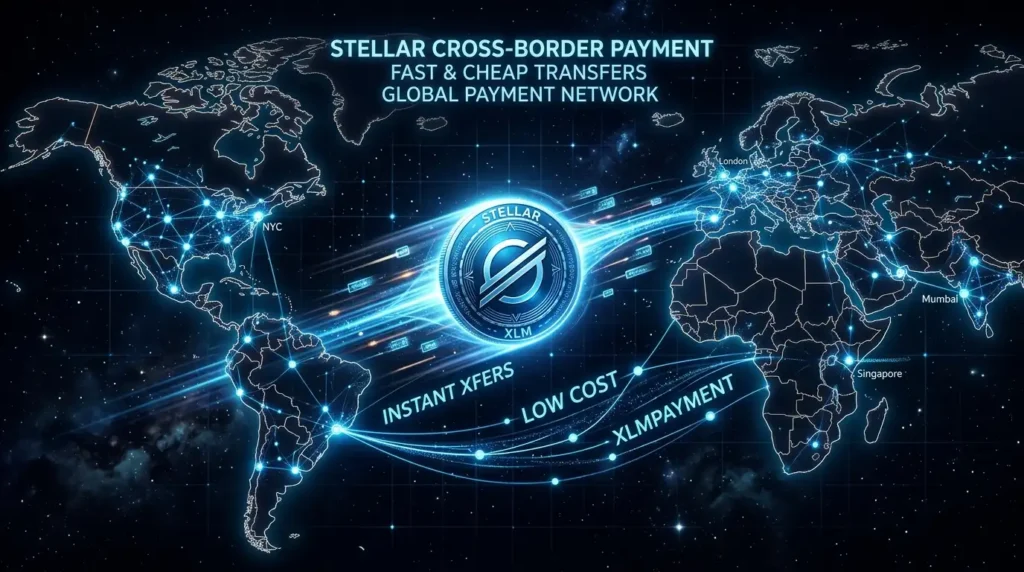
Real-World Asset Settlement: As more tokenized assets trade on Stellar — government bonds, money market funds, stablecoins — XLM powers the settlement layer. Every token transfer touches the XLM fee mechanism.
Spam Prevention: A minimum balance of 1 XLM is required to activate a Stellar wallet. This prevents the network from being flooded with meaningless accounts.
DeFi on Soroban: The Soroban smart contract platform enables XLM as collateral and utility within lending, DEX, and yield protocols — though this use case is still developing relative to Ethereum’s ecosystem.
Stellar Risks: The Honest Assessment
Supply Concentration: The Stellar Development Foundation controls a substantial portion of XLM supply and distributes it through ecosystem programs. This creates real centralization risk — if the SDF’s priorities shift, it could impact the token significantly.
The “XLM Isn’t Needed” Argument: Stellar’s fees are so low that they don’t create meaningful economic pressure on demand. Some argue that XLM’s utility as a fee token doesn’t translate to price appreciation even as network usage grows.
Competition: XRP, Algorand (ALGO), Hedera (HBAR), and increasingly Ethereum Layer 2 solutions all compete for the cross-border payments and RWA tokenization markets. Stellar has a head start in certain niches but no monopoly.
Price Underperformance: Despite its genuine institutional adoption, XLM has consistently underperformed Bitcoin, Ethereum, Solana, and XRP in bull markets. The nonprofit structure means there’s no VC pressure to drive token price — which is philosophically consistent but frustrating for investors.
Market Correlation: Like most altcoins, XLM’s short-term price is heavily correlated with Bitcoin. Strong fundamentals don’t protect against broad market selloffs.
How to Buy Stellar (XLM) in the US
Step 1 — Choose an Exchange
XLM is available on Coinbase, Kraken, Gemini, and Binance.US. Kraken is particularly popular for XLM due to competitive fees and deep liquidity.
Step 2 — Create and Verify Your Account
Sign up, complete KYC verification (government ID required), and enable two-factor authentication. Takes 5–15 minutes.
Step 3 — Add Funds
Link your bank account for free ACH transfers (1–3 business days) or use a debit card for instant purchases (1.5–3.5% fee).
Step 4 — Buy XLM
Search for “Stellar” or “XLM,” enter your amount, and confirm. You can buy fractional amounts — no minimum.
Step 5 — Consider Self-Custody
Hardware wallets including Ledger and Trezor support XLM. The official Solar Wallet and Lobstr are popular software options designed specifically for Stellar.
Important: When creating a Stellar wallet, you need a minimum of 1 XLM as a base reserve to activate it. This is a network requirement, not an exchange fee.
Step 6 — Track for Taxes
Every XLM sale or exchange is a taxable event in the US. Use CoinTracker or Koinly to maintain accurate records.
Key Stellar Terminology for Beginners
Lumens (XLM): The native digital asset of the Stellar network, used for fees and as a bridge currency.
Stellar Development Foundation (SDF): The nonprofit organization that governs and develops the Stellar network.
Stellar Consensus Protocol (SCP): Stellar’s unique consensus mechanism based on federated Byzantine agreement — no mining, no staking, just trusted validator networks.
Anchors: Licensed financial institutions that bridge Stellar to traditional fiat currencies by issuing and redeeming pegged tokens.
Soroban: Stellar’s smart contract platform, launched in 2023, designed for financial applications and real-world asset tokenization.
Real-World Assets (RWA): Traditional financial assets — bonds, equities, money market funds, real estate — represented as tokens on a blockchain.
Base Reserve: The minimum XLM balance (1 XLM) required to keep a Stellar wallet active.
Federated Byzantine Agreement (FBA): The mathematical framework underlying SCP that enables decentralized consensus without requiring all participants to know or trust each other.
Should You Buy Stellar (XLM) in 2026?
Stellar presents a genuinely unusual investment proposition in crypto.
The bull case: Stellar has more institutional adoption and real-world financial infrastructure than almost any other non-Bitcoin/Ethereum asset. Franklin Templeton, PayPal, MoneyGram, and major government agencies have chosen it — not for proof-of-concept demonstrations but for live financial products. The March 2026 commodity classification removed the biggest regulatory overhang. CME futures are coming. A spot ETF pathway exists. And at $5 billion market cap, it’s arguably undervalued relative to the scale of infrastructure it’s supporting.
The bear case: XLM has consistently underperformed its peers in bull markets despite real adoption. The SDF’s supply concentration is a genuine risk. The “fee token that doesn’t need to be valuable” critique has some merit. And Stellar faces serious competition from XRP (which has Ripple’s deep banking relationships) and from institutional-grade Ethereum L2 solutions.
The honest bottom line: If you believe that real-world asset tokenization and cross-border payment rails on blockchain are the future — and the evidence increasingly suggests they are — Stellar is one of the best-positioned projects in that space. But “best positioned” doesn’t automatically translate to “best investment returns.” The two can diverge significantly in crypto.
Invest based on your conviction in the thesis, not on price prediction. And maybe check what Franklin Templeton does next. When a $1.68 trillion asset manager puts $650 million on your blockchain, that’s a signal worth paying attention to.
Quiet revolution. Loud fundamentals. Classic Stellar. 🌟
Disclaimer: This article is for informational purposes only and does not constitute financial advice. Cryptocurrency investments carry significant risk, including the potential loss of all invested capital. Always conduct your own research before making any investment decisions.