There’s one token that virtually every crypto trader uses, but most beginners have never heard of. It’s not Bitcoin. It’s not Ethereum. It’s Tether — and with a market cap of over $184 billion and a daily trading volume that often exceeds Bitcoin’s, it’s arguably the most important piece of infrastructure in the entire crypto ecosystem.
You just might not know it yet.
Tether (USDT) is the world’s largest stablecoin. It’s designed to do something that most cryptocurrencies spectacularly fail at: hold a steady value. While Bitcoin swings 10% in a day and Ethereum does things to your blood pressure that no doctor would recommend, Tether sits calmly at $1.00 — give or take a fraction of a cent.
Understanding USDT is essential for any beginner entering crypto. Let’s break it down completely.
The Quick Answer: What Is Tether (USDT)?
Tether (USDT) is a stablecoin — a type of cryptocurrency designed to maintain a fixed value equal to one US dollar. For every USDT token in circulation, Tether Limited (the company behind it) claims to hold $1 worth of reserve assets.
Think of it this way: USDT is essentially a digital dollar that lives on the blockchain. You can send it anywhere in the world in minutes, use it on any crypto exchange, earn yield on it in DeFi protocols — all while it maintains its $1 value.
This makes it incredibly useful. Volatile markets? Move to USDT and wait. Want to earn yield without crypto price risk? Put USDT in a lending protocol. Need to send money internationally fast and cheap? USDT on the Tron network costs about $1 and settles in seconds.
A Brief History: From “Realcoin” to Reserve Currency of Crypto
Tether was originally launched in 2014 under the name Realcoin by Brock Pierce, Reeve Collins, and Craig Sellars. It was rebranded to Tether shortly after and initially ran on Bitcoin’s Omni Layer protocol — back when that was still a thing people used.
The concept was simple and brilliant: tokenize the US dollar on a blockchain. At the time, moving between crypto and fiat was slow, expensive, and painful. Tether offered a way to stay “in crypto” while holding dollar value.
For years, Tether operated in the background — useful, widely used, but not exactly headline news. That changed when scrutiny of its reserves began to intensify, legal battles erupted, and regulators started paying attention.
Today, USDT has a circulating supply of approximately $184 billion — making Tether one of the largest buyers of US Treasury bills on the planet, placing it alongside sovereign wealth funds in terms of T-bill holdings. That’s a remarkable journey for a token that started as a niche trading tool.
How Does Tether (USDT) Actually Work?
The Peg Mechanism
Tether maintains its $1 peg through a straightforward system:
- A user sends $1,000 to Tether Limited
- Tether issues 1,000 USDT tokens to that user
- Tether holds the $1,000 in reserve assets
- When the user wants their dollars back, they redeem USDT and Tether destroys those tokens
This issuance and redemption mechanism keeps supply aligned with demand. If USDT trades slightly below $1 on exchanges, arbitrageurs buy it cheaply and redeem it with Tether for exactly $1, profiting from the difference and pushing the price back to the peg. If it trades above $1, they buy from Tether and sell on the market. Market forces keep the peg tight.
Multi-Chain Availability
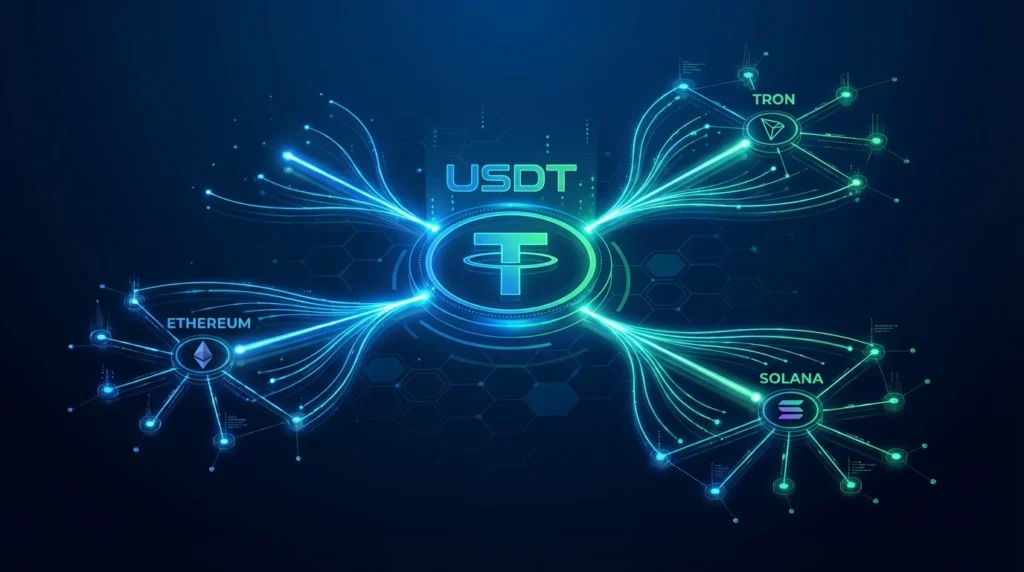
USDT doesn’t live on just one blockchain. As of 2026, it runs natively on 10 major blockchains including:
- Ethereum (ERC-20) — most widely supported, higher fees
- Tron (TRC-20) — most used, very cheap fees (~$1), fastest
- Solana (SPL) — extremely fast, low fees
- Polygon, Avalanche, BNB Chain — various DeFi ecosystems
Over 60% of USDT supply lives on the Tron network, reflecting its dominance for cheap, fast transfers — especially in emerging markets where people use USDT as a dollar substitute for savings and payments.
What Backs USDT? The Reserve Question
This is where things get interesting — and controversial.
According to Tether’s latest reports, reserves consist of:
- ~80% US Treasury Bills — the safest short-term government debt
- ~12% Repo agreements — overnight lending secured by Treasuries
- ~5% Gold — physical gold (~116 tons)
- ~2% Secured loans
- ~1% Bitcoin
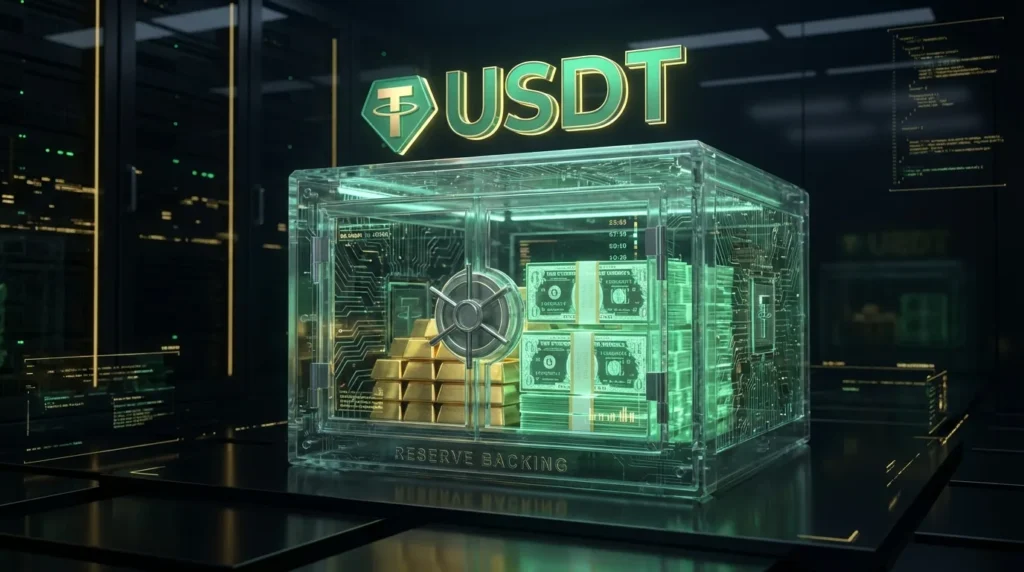
Total reserves reportedly exceed $192 billion against $186 billion in liabilities — a reserve ratio above 100%, meaning Tether claims to be more than fully backed.
But here’s the thing: until very recently, these figures came from attestations — limited snapshots verified by smaller audit firms — not a full independent audit. Critics argued this was not enough transparency for a $184 billion financial entity that functions as the reserve currency of crypto.
The KPMG Audit: A Historic Moment for Tether
In late March 2026, Tether made headlines that sent shockwaves through the industry: the company hired KPMG to conduct a full audit of its $185 billion USDT reserves, and brought in PwC to help prepare its internal systems.
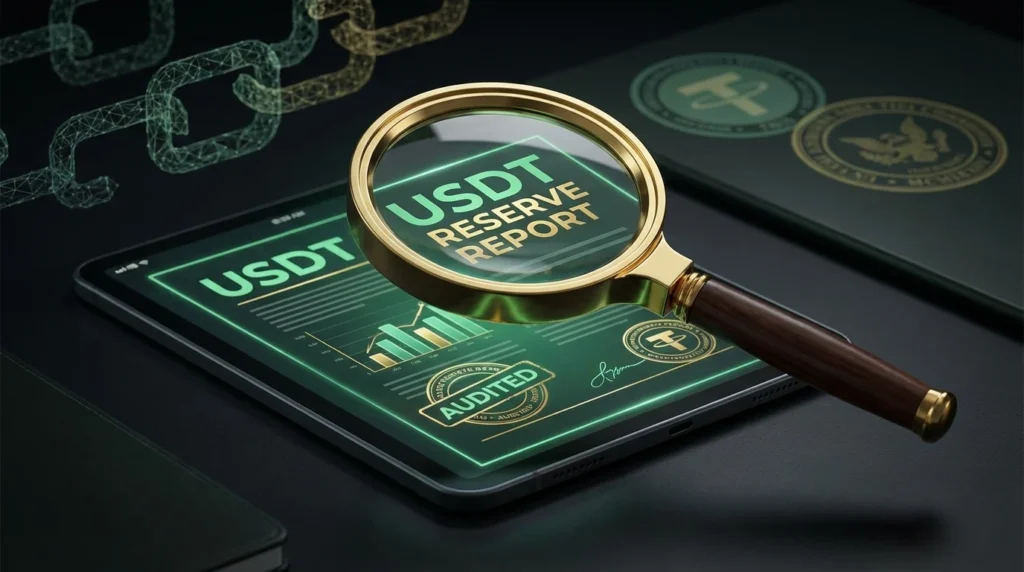
This is a massive deal. A full KPMG audit goes far beyond previous attestations — it examines assets, liabilities, internal controls, and all reporting systems in detail. Tether reported generating more than $10 billion in net profit in 2025 and ended the year with $6.3 billion in excess reserves.
If the audit comes back clean, it would decisively answer years of “Tether is a scam” accusations and establish a new transparency standard for the entire stablecoin industry. The audit push lands at a pivotal moment — USDT functions as the reserve currency of crypto markets and a major buyer of US Treasury bills, linking digital assets to traditional financial systems at scale.
Tether Tokenomics: The Numbers That Matter
| Metric | Data |
|---|---|
| Ticker | USDT |
| Current Price | ~$1.00 (pegged to USD) |
| Market Cap | ~$184 billion |
| Rank | #3 (overall), #1 stablecoin |
| Circulating Supply | ~184 billion USDT |
| Maximum Supply | No cap (issued on demand) |
| Daily Trading Volume | ~$73 billion |
| Blockchains | 10+ (Tron, Ethereum, Solana…) |
| Users worldwide | ~550 million |
| Launched | 2014 |
| Net Profit (2025) | $10+ billion |
How Does Tether Make Money?
Good question. Tether doesn’t charge users to hold or transfer USDT — so where does the profit come from?
Simple: interest on reserves. Tether holds over $122 billion in US Treasury bills. At current interest rates, those T-bills generate substantial yield. Tether keeps all of that interest — it doesn’t pass it on to USDT holders. That’s why Tether generated over $10 billion in profit in 2025 despite being a company that most of its users have never heard of.
This is also why USDC (Tether’s main competitor from Circle) has been gaining ground — USDC is actively working on sharing yield with holders, while USDT does not.
Why Is USDT So Important?
The Reserve Currency of Crypto
Virtually every cryptocurrency trading pair on every major exchange includes USDT. BTC/USDT, ETH/USDT, SOL/USDT — USDT is the intermediary that makes crypto-to-crypto trading smooth. Without stablecoins like USDT, every trade would require converting back to fiat, which is slow and expensive.
DeFi Infrastructure
USDT is a cornerstone of decentralized finance. You can deposit USDT into lending protocols like Aave to earn yield. You can provide liquidity to stablecoin pools on Curve Finance. You can use it as collateral to borrow other assets. The DeFi ecosystem would look very different without it.
Emerging Markets and Dollar Access
In countries with weak or unstable currencies — Argentina, Venezuela, Turkey, Nigeria — USDT has become a lifeline. People who can’t easily access US dollars can hold USDT on their phones as a dollar substitute, protecting their savings from local currency devaluation. This is arguably USDT’s most socially significant use case, and it’s growing rapidly.
Payments and Remittances
Sending $500 from the US to family in Southeast Asia via a bank costs $20–50 and takes days. Sending $500 as USDT on Tron costs about $1 and takes seconds. For the hundreds of millions of people who rely on international remittances, this difference is enormous.
The Controversies: A Balanced View
No article about Tether would be complete without acknowledging the elephant in the room. Tether has had a complicated history.
The reserve controversy: For years, critics questioned whether USDT was truly 100% backed by dollar reserves. In 2019, Tether’s lawyers quietly amended the company’s terms to state that reserves could include “other assets” and “receivables” — not just cash. This raised serious concerns.
The NYAG settlement: In 2021, Tether settled with the New York Attorney General for $18.5 million over claims it had misrepresented its reserves between 2016 and 2019. Tether did not admit wrongdoing, but agreed to enhanced reporting requirements.
The CFTC fine: Also in 2021, Tether paid a $41 million fine to the Commodity Futures Trading Commission for similar misrepresentations.
The depegging incident: During extreme market stress, USDT briefly traded as low as $0.88 — though it recovered quickly.
The transparency gap: Until the KPMG announcement in March 2026, Tether’s attestations were published by BDO Italia — a legitimate firm, but not a Big Four auditor. Critics argued this was insufficient for a $184 billion entity.
In Tether’s defense: the company has maintained its peg through the 2022 crypto collapse (successfully processing $15 billion in redemptions — about 20% of supply at the time), multiple market crises, and years of regulatory pressure. Whatever one thinks of its transparency, the peg has held.
Tether vs USDC: The Main Competitor
The primary competitor to USDT is USDC (USD Coin), issued by Circle. Here’s how they compare:

| Feature | USDT (Tether) | USDC (Circle) |
|---|---|---|
| Market Cap | ~$184 billion | ~$43 billion |
| Market share | ~59% of stablecoins | ~14% of stablecoins |
| Auditor | KPMG (in process) | Deloitte (regular audits) |
| Transparency | Improving | Higher historically |
| US regulation | Launching USAT under GENIUS Act | Fully US-regulated |
| Yield sharing | No | Working on it |
| Primary blockchain | Tron | Ethereum |
USDC is generally considered more transparent and regulatory-friendly. USDT is larger, more liquid, and more widely used globally — especially in non-US markets. Most traders and DeFi users hold both.
How to Use USDT: Practical Guide
Buying USDT:
You can purchase USDT on virtually every major exchange — Coinbase, Kraken, Binance, Bybit. Simply buy it like any other cryptocurrency, using dollars.
Choosing the right network:
This is crucial. When sending or receiving USDT, always confirm which blockchain network you’re using. Sending ERC-20 USDT to a TRC-20 address (or vice versa) can result in permanent loss of funds.
- Sending to an exchange or DeFi on Ethereum? Use ERC-20
- Sending for cheap peer-to-peer transfers or remittances? Use TRC-20 (Tron)
- Using Solana DeFi? Use SPL
Storing USDT:
Any wallet that supports the relevant blockchain works. MetaMask for ERC-20, TronLink for TRC-20, Phantom for SPL. Hardware wallets (Ledger, Trezor) support USDT on Ethereum for maximum security.
Earning yield on USDT:
Multiple platforms offer interest on USDT deposits:
- DeFi protocols: Aave, Compound (variable rates, higher risk)
- Centralized platforms: various exchanges offer savings products
- Note: Always research platforms carefully — yield without risk doesn’t exist in crypto
Is USDT Safe? An Honest Assessment
This is the question every beginner should ask before holding significant amounts of USDT.
Arguments for safety:
- 10+ year track record of maintaining the peg
- Successfully processed billions in redemptions during market crises
- $6.3 billion in excess reserves (more assets than liabilities)
- KPMG audit in progress — biggest transparency step in Tether’s history
- 550 million users worldwide — systemic risk makes regulators very careful
Arguments for caution:
- History of regulatory fines and transparency issues
- Reserves include non-cash assets (gold, Bitcoin, loans) that could be less liquid during a crisis
- As a centralized entity, Tether can freeze individual USDT addresses (and has done so for law enforcement — over $3.29 billion frozen to date)
- “Too big to fail” risk: a Tether collapse would be catastrophic for the entire crypto market
The bottom line: USDT is not risk-free — nothing in crypto is. But for day-to-day trading, short-term holding, and DeFi operations, it’s the most widely used tool in crypto for a reason. For large, long-term holdings, diversifying between USDT and USDC is a reasonable approach.
Key Tether Terminology for Beginners
Stablecoin: A cryptocurrency designed to maintain a fixed value, usually pegged to a fiat currency like the US dollar.
Peg: The target price that USDT tries to maintain ($1.00).
Reserves: The assets held by Tether to back each USDT in circulation.
Attestation: A limited verification of reserve assets at a specific point in time — less comprehensive than a full audit.
TRC-20: The Tron blockchain version of USDT — cheapest to send, most widely used globally.
ERC-20: The Ethereum blockchain version of USDT — most supported by DeFi protocols.
GENIUS Act: The US stablecoin regulatory framework signed into law in mid-2025, under which Tether launched its US-compliant USAT token.
Redemption: The process of exchanging USDT back for actual dollars — Tether destroys the USDT and returns the fiat.
The Bottom Line
Tether USDT is one of the most important and most controversial assets in crypto simultaneously. It’s the lubricant that keeps crypto markets running, the savings account for hundreds of millions in emerging markets, and the trading pair that makes the whole ecosystem function.
It’s also a $184 billion entity that spent years providing limited transparency about its reserves, paid tens of millions in regulatory fines, and whose collapse would be the single most devastating event in crypto history.
The good news: the KPMG audit announced in March 2026 is a genuine step toward the transparency that critics have demanded for years. If it delivers a clean bill of health, Tether’s position as the dominant stablecoin will be stronger than ever.
Until then: use USDT for what it’s designed for — stable value, fast transfers, DeFi operations. Be aware of the risks. Don’t put your life savings in any single stablecoin. And never, ever send USDT on the wrong network.
Disclaimer: This article is for informational purposes only and does not constitute financial advice. Cryptocurrency investments carry significant risk, including the potential loss of all invested capital. Always conduct your own research before making any investment decisions.