If Tether is the scrappy veteran of the stablecoin world — battle-hardened, globally dominant, and perpetually controversial — then USDC is the straight-A student. Audited monthly by a Big Four accounting firm. Backed exclusively by cash and short-term US Treasuries. Issued by a regulated company with a compliance team that probably sleeps very well at night.
USDC might not have Tether’s raw market dominance, but in 2026 it’s making a serious run. In March 2026, USDC surpassed USDT in adjusted transaction volume for the first time in nearly a decade — with $2.2 trillion year-to-date versus USDT’s $1.3 trillion. Goldman Sachs, JPMorgan, Visa, and BlackRock are all partners. Circle’s stock surged 87% in a single month. The regulated stablecoin narrative has found its moment.
As of April 2026, USDC has a circulating supply of approximately $77 billion, trades at exactly $1.00, and is available on 32 blockchain networks. It is the most institutionally trusted stablecoin in existence — and increasingly, the most used.
Let’s break it all down.
The Quick Answer: What Is USDC?
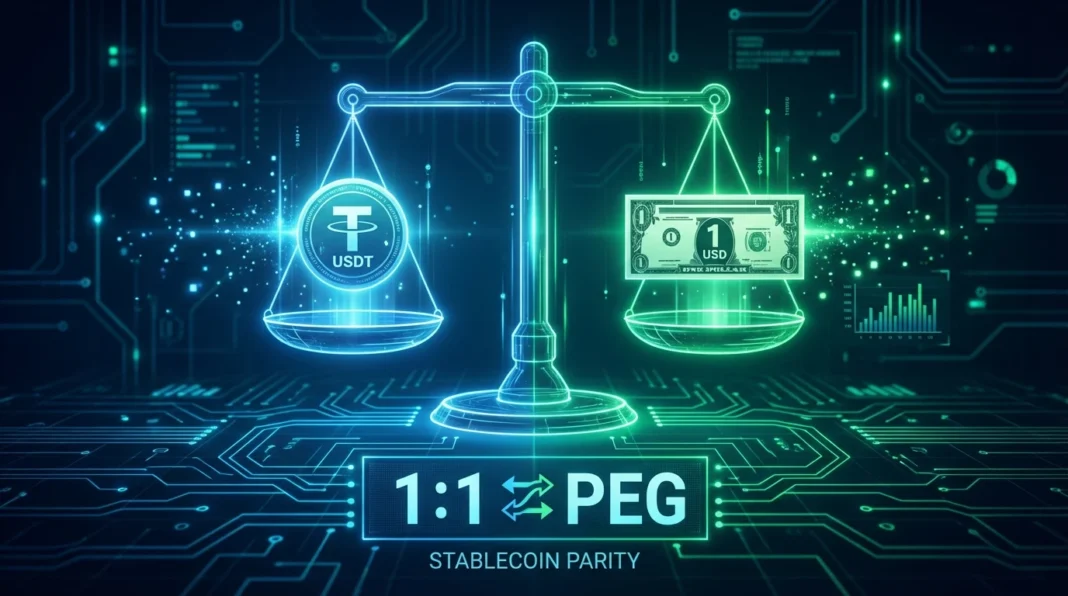
USDC (USD Coin) is a fully reserved stablecoin pegged 1:1 to the US dollar. For every USDC in circulation, there is exactly $1 worth of reserve assets — primarily cash and short-term US Treasury bonds — held in regulated financial institutions.
Think of USDC as a digital dollar that lives on the blockchain. It has all the stability of a US dollar with the programmability and speed of cryptocurrency. You can send USDC anywhere in the world in seconds for fractions of a cent. You can use it in DeFi protocols to earn yield. You can accept it as payment in your business. You can hold it as a stable store of value during crypto market turbulence.
The key difference from other stablecoins: USDC was built from day one with transparency and regulatory compliance as core values, not afterthoughts.
Who Created USDC?
USDC was launched on September 23, 2018 by the Centre Consortium — a joint venture between Circle (a Boston-based fintech company) and Coinbase (the largest US cryptocurrency exchange).
The founding logic was straightforward: if crypto was going to be used by real businesses and institutions, it needed a stable digital dollar that was transparent, regulated, and trustworthy. Tether existed, but its opacity made institutions nervous. USDC was designed to be the answer.
In 2023, Circle took full operational control of USDC, dissolving the Centre Consortium. Coinbase remains a key distribution partner and earns a portion of USDC reserve interest revenue.
Circle — the company behind USDC — is led by CEO Jeremy Allaire and is headquartered in Boston. In 2025, Circle went public on the New York Stock Exchange (CRCL), becoming one of the first major crypto infrastructure companies to achieve a traditional IPO. This move signaled to the market that Circle was playing a long-term, institutional game.
How Does USDC Actually Work?
The Minting and Burning Mechanism
USDC maintains its $1 peg through a straightforward process:
- A user or institution sends $1,000 to Circle (or an authorized partner)
- Circle mints 1,000 new USDC tokens on the requested blockchain
- Circle holds the $1,000 in reserve — cash at regulated banks and short-term US Treasuries
- When the user wants their dollars back, they return 1,000 USDC to Circle
- Circle burns (destroys) those USDC tokens and returns $1,000
This process ensures that USDC in circulation always corresponds exactly to dollars held in reserve. Supply grows when demand increases, shrinks when users redeem.
The Reserve Structure

USDC’s reserves are held in two forms:
Cash — held at regulated US financial institutions including Bank of New York Mellon (BNY Mellon), one of the oldest and largest custodian banks in the world.
Circle Reserve Fund — an SEC-registered government money market fund managed by BlackRock. This fund invests exclusively in short-dated US Treasury securities and overnight repurchase agreements — essentially the safest possible dollar-equivalent assets.
Approximately 98.9% of USDC reserves are held in short-dated US Treasuries and cash equivalents. This is arguably the most conservative reserve structure of any major stablecoin.
Transparency: Monthly Attestations

Circle publishes monthly reserve attestations conducted by Deloitte — one of the Big Four accounting firms. These attestations confirm that USDC reserves equal or exceed the circulating supply. By April 2026, Circle has issued 41 consecutive monthly attestations — a track record of transparency that no competitor can match.
Additionally, Circle publishes weekly disclosures of reserve composition and minting/redemption flows. The data is public, verifiable, and updated constantly.
This level of transparency is why USDC has become the stablecoin of choice for institutions, regulated businesses, and anyone who needs to prove to auditors or regulators what their digital dollar holdings actually consist of.
Cross-Chain Transfer Protocol (CCTP)
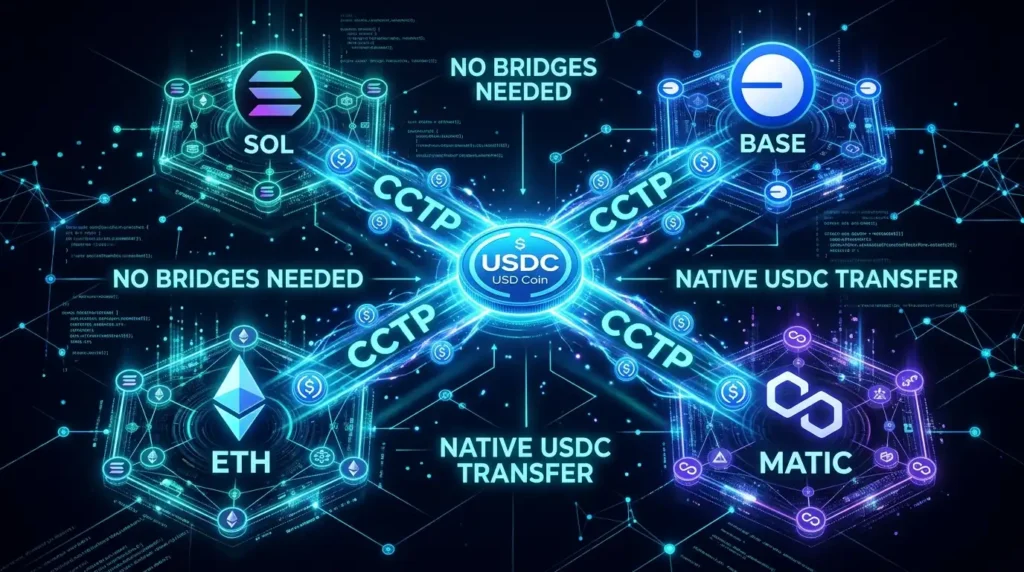
Circle developed the Cross-Chain Transfer Protocol (CCTP) — a native mechanism for moving USDC between blockchains without using third-party bridges. Traditional cross-chain bridges lock tokens on one chain and mint wrapped versions on another — creating security risks and fragmented liquidity. CCTP burns USDC on the source chain and mints native USDC on the destination chain, keeping the token “real” across all networks.
USDC Tokenomics: The Numbers That Matter
| Metric | Data |
|---|---|
| Ticker | USDC |
| Current Price | $1.00 (pegged to USD) |
| Market Cap | ~$77 billion |
| Rank | #6–7 overall, #2 stablecoin |
| Circulating Supply | ~77 billion USDC |
| Maximum Supply | No cap (issued on demand) |
| Supported Blockchains | 32 networks |
| Reserve Composition | ~98.9% US Treasuries + cash |
| Auditor | Deloitte (monthly attestations) |
| Reserve Manager | BlackRock (Circle Reserve Fund) |
| Daily Trading Volume | ~$12–15 billion |
| Countries Available | 195+ |
How Does Circle Make Money?
Like Tether, Circle doesn’t charge users to hold or transfer USDC. The revenue model is based on interest earned on reserve assets.
With billions in US Treasury holdings, Circle earns substantial interest income — especially at current interest rates. Unlike Tether which keeps all interest for itself, Circle shares reserve interest revenue with key partners like Coinbase under their distribution agreement.
This is also why Circle has been lobbying actively around US stablecoin legislation — proposed rules requiring issuers to pass yield to holders could significantly impact the business model.
The March 2026 Milestone: USDC Surpasses USDT
In March 2026, something remarkable happened that would have seemed impossible just years earlier: USDC surpassed USDT in adjusted transaction volume for the first time in nearly a decade.
Year-to-date transaction volumes reached $2.2 trillion for USDC versus $1.3 trillion for USDT. Circle’s stock (CRCL) surged 87% in a month as investors recognized the shift in institutional preference.

The data suggests a fundamental shift in stablecoin usage patterns: as institutions enter crypto in force — Goldman Sachs settling repo trades, JPMorgan piloting tokenized collateral, Visa processing stablecoin settlements — they are overwhelmingly choosing USDC over USDT for its regulatory clarity and audited reserves.
Meanwhile, USDT’s announcement of a KPMG audit (while positive) has not yet closed the transparency gap that Circle has built over years of monthly attestations.
What Is USDC Used For?
DeFi: The Primary Use Case
USDC is the dominant stablecoin in regulated DeFi. Lending protocols like Aave and Compound use USDC as a core asset. Decentralized exchanges use USDC pairs for stable trading. Yield strategies deposit USDC to earn interest on lending markets.
In 2025, Ethereum alone processed over 500 million USDC transactions. The token is present on virtually every major DeFi protocol across every major blockchain.
Institutional Settlement
This is USDC’s fastest-growing use case in 2026:
- Goldman Sachs and JPMorgan joined pilots using USDC to settle repo and tokenized collateral trades in Q1 2025
- BlackRock manages USDC reserves and uses USDC to settle tokenized fund transactions
- Visa processes USDC settlements in 30+ countries — over $225 million in stablecoin settlement volume by mid-2025
- Coinbase Commerce reports 65% of crypto B2B settlements on its platform are denominated in USDC
E-Commerce and Business Payments
Shopify merchants processed more than $800 million in USDC-denominated orders during the 2024 holiday season. USDC has become a genuine business payment tool — faster than wire transfers, cheaper than payment processors, and stable unlike Bitcoin or Ethereum.
Cross-Border Remittances
Like USDT, USDC serves as a digital dollar substitute in countries with weak or unstable currencies. Unlike USDT, USDC’s regulatory compliance makes it easier for licensed money service businesses and banks to integrate into their products.
Education and Innovation
A coalition of universities including MIT, Stanford, and Oxford are piloting USDC smart contracts for tuition payments, with volumes already in the tens of millions of dollars. This represents an entirely new use case — programmable institutional payments using stablecoins.
USDC’s Multi-Chain Presence
USDC is available natively on 32 blockchain networks as of 2026. The major ones by usage share:
| Blockchain | USDC Usage Share |
|---|---|
| Ethereum | 23.3% |
| BNB Chain | 21.6% |
| Solana | 15.0% |
| Arbitrum (L2) | 9.5% |
| Polygon | 8.5% |
| Base (Coinbase L2) | 6.1% |
| Optimism | 1.5% |
| Others | 14.5% |
Notable 2026 expansion: Circle launched USDCx on Cardano — a privacy-enhanced version using Zero Knowledge Proof technology, providing transaction privacy not available in standard USDC deployments.
USDC vs USDT: The Definitive Comparison
This is the most common question about USDC. Let’s be direct:
| Feature | USDC | USDT |
|---|---|---|
| Market Cap | ~$77 billion | ~$184 billion |
| Market share | ~24% of stablecoins | ~59% of stablecoins |
| Auditor | Deloitte (monthly) | KPMG (in process) |
| Reserve transparency | Weekly disclosures | Quarterly attestations |
| Reserve quality | 98.9% US Treasuries + cash | Mix including gold, Bitcoin, loans |
| Regulatory standing | SEC confirmed not a security | Resolved similar classification |
| Issuer | Circle (public company, NYSE: CRCL) | Tether (private company) |
| Primary blockchain | Ethereum / multi-chain | Tron / multi-chain |
| Institutional preference | Higher | Lower |
| Global liquidity | High | Higher |
| History of issues | None significant | Regulatory fines, transparency disputes |
The bottom line: USDC wins on transparency, regulatory clarity, and institutional trust. USDT wins on raw size, global liquidity, and emerging market penetration.
Most sophisticated users and institutions in 2026 hold both — USDT for maximum liquidity and trading, USDC for compliance-sensitive operations and DeFi.
Circle’s IPO: A New Chapter

In 2025, Circle went public on the New York Stock Exchange under the ticker CRCL — becoming one of the first major crypto infrastructure companies to achieve a traditional IPO.
This was a significant milestone for the entire crypto industry. A public listing means:
- Full financial disclosure requirements (quarterly earnings, SEC filings)
- Institutional investors can hold Circle stock in traditional portfolios
- Circle has access to public markets for capital raising
- Regulatory accountability increases dramatically
Circle’s IPO essentially made USDC the most regulated, most transparent stablecoin product in existence — backed by a publicly traded company with all the reporting obligations that entails.
USDC Risks: The Honest Version
Centralization: Like USDT, USDC is controlled by a private company (Circle). Circle can freeze individual USDC addresses — and has done so cooperating with law enforcement. This is a feature for regulators, a risk for those who prioritize censorship resistance.
Regulatory risk: Proposed US legislation under the Clarity Act may prohibit passive yield rewards on stablecoins. Rules affecting how USDC reserves are managed could impact Circle’s business model and potentially USDC’s stability.
Depegging risk: USDC briefly depegged to $0.87 in March 2023 when it was revealed that Circle had $3.3 billion in deposits at Silicon Valley Bank, which collapsed that weekend. The peg recovered quickly, but the incident showed that even well-managed stablecoins carry custodial risk.
Interest rate sensitivity: Circle’s revenue model depends heavily on interest rates earned on Treasury holdings. A significant rate cut would reduce Circle’s income, though it wouldn’t affect USDC’s peg.
Competition: New entrants — including bank-issued stablecoins enabled by the GENIUS Act — could compete with USDC in the institutional market that Circle is targeting.
How to Get and Use USDC: Practical Guide
Buying USDC:
Available on virtually every major exchange — Coinbase (preferred, given Circle’s partnership), Kraken, Gemini, and most others. You can also mint USDC directly through Circle Mint if you’re an institutional user.
Choosing your network:
- Ethereum (ERC-20) — most widely supported by DeFi protocols and institutions
- Solana (SPL) — fastest, cheapest for everyday transfers
- Base — Coinbase’s L2, excellent for low-cost DeFi
- Polygon — popular for gaming and retail applications
Always verify which network you’re using before sending. Sending USDC to the wrong network address can result in loss of funds.
Earning yield on USDC:
- Aave — leading DeFi lending protocol, deposit USDC and earn variable APY
- Compound — similar to Aave, established lending protocol
- Coinbase — offers USDC rewards directly in the app (simplified, regulated)
- Various other platforms — always research carefully before depositing
Storing USDC:
Any Ethereum-compatible wallet works for ERC-20 USDC (MetaMask, Ledger, Trezor). For Solana USDC, Phantom or Backpack wallets are recommended.
Key USDC Terminology for Beginners
Circle: The US-based fintech company that issues and manages USDC. Listed on NYSE as CRCL.
Centre Consortium: The original joint venture between Circle and Coinbase that created USDC. Dissolved in 2023 with Circle taking full control.
Attestation: A formal verification by an independent accounting firm (Deloitte) that USDC reserves equal or exceed circulating supply. Circle does this monthly.
Circle Reserve Fund: The BlackRock-managed, SEC-registered money market fund that holds the majority of USDC reserves in short-term US Treasuries.
CCTP: Cross-Chain Transfer Protocol — Circle’s native system for moving USDC between blockchains without third-party bridges.
BNY Mellon: Bank of New York Mellon — one of the world’s largest custodian banks, which holds USDC cash reserves.
USDCx: Circle’s privacy-enhanced USDC variant launched on Cardano in 2026, using Zero Knowledge Proofs for transaction privacy.
GENIUS Act: The US stablecoin regulatory framework that established federal rules for stablecoin issuers — USDC is fully compliant.
Should You Use USDC in 2026?
We are not financial advisors. But we will say this plainly: for most legitimate financial use cases in crypto — DeFi, payments, institutional settlement, saving in digital dollars — USDC is the most trustworthy option available.
Its reserves are transparent, audited, and invested in the safest possible assets. Its issuer is a publicly traded company with full regulatory accountability. Its peg has been maintained through market crises, exchange collapses, and even its own brief depegging incident in 2023. And its institutional adoption in 2026 has reached a scale that was unimaginable even two years ago.
The question isn’t really “should you use USDC” — it’s “should you use USDC or USDT?” And the honest answer is: for compliance-sensitive operations, institutional use, and DeFi on regulated platforms, USDC. For maximum global liquidity and trading on non-US platforms, USDT. Many users sensibly choose both.
What USDC is not: an investment. It’s not designed to go up in value. It’s designed to stay at exactly $1 while giving you the speed, programmability, and borderlessness of cryptocurrency. If that’s what you need — USDC delivers it better than anyone else in 2026.
Disclaimer: This article is for informational purposes only and does not constitute financial advice. Cryptocurrency investments carry significant risk, including the potential loss of all invested capital. Always conduct your own research before making any investment decisions.