Imagine a city with a well-established road system. Everyone knows the rules: drive on the right, obey traffic lights, stop signs mean stop. The system works.
Now imagine the city needs to add new rules — say, a dedicated lane for electric vehicles. One approach: simply repaint the existing lanes (old cars can still use the road, nothing breaks). Another approach: rebuild the entire road infrastructure from scratch for the new system (old cars literally can’t use it anymore).
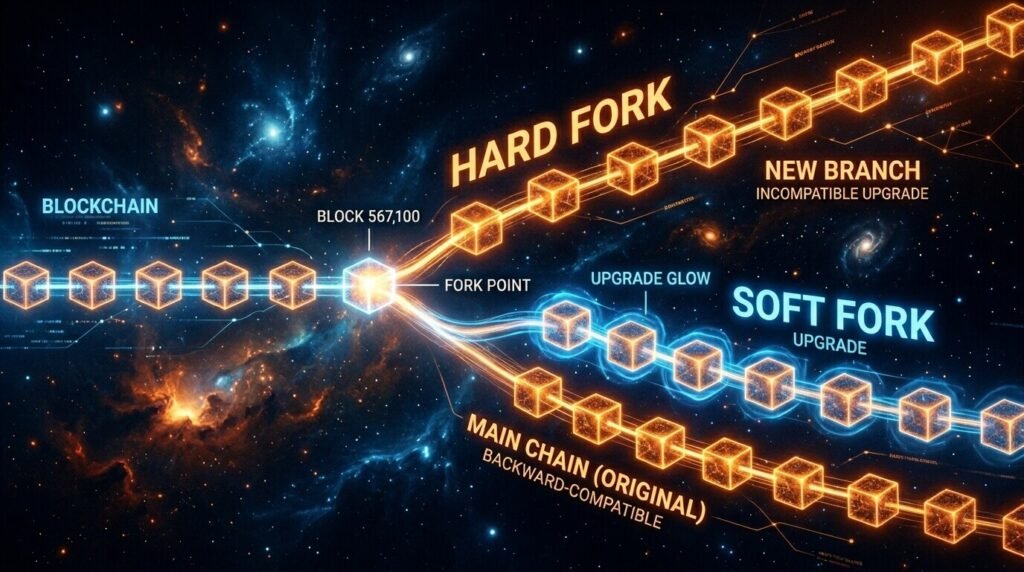
The first approach is a soft fork. The second is a hard fork.
In blockchain, these are the two ways a network upgrades its rules — and the choice between them has produced some of the most dramatic events in crypto history, including the creation of Bitcoin Cash, Ethereum Classic, and dozens of other cryptocurrencies.
The Quick Answer
Soft fork: A backward-compatible upgrade to a blockchain. Nodes that haven’t updated can still participate in the network. No chain split occurs.
Hard fork: A non-backward-compatible upgrade. Nodes that don’t upgrade are incompatible with the new rules. If part of the community refuses to upgrade, the blockchain permanently splits into two separate chains — often creating a new cryptocurrency.
The key word is backward compatibility — and understanding it unlocks everything else.
What Is a Soft Fork?
A soft fork tightens or modifies the existing rules of a blockchain in a way that old nodes can still accept.
Think of it like changing the rules of a card game to be more restrictive. Players with the old rulebook can still play — they just might not understand some of the new moves. But the game continues, nobody gets kicked out, and the table doesn’t split in two.
Technical reality: After a soft fork, transactions created under the new rules are still valid to old nodes (they just look like a specific type of old transaction). New nodes understand the full picture. Old and new nodes can coexist on the same network.
Result: The blockchain remains unified. No chain split. No new cryptocurrency.
When are soft forks used?
- Minor protocol improvements
- Bug fixes
- Security patches
- Adding new transaction types in a compatible way
- Increasing efficiency without breaking existing rules
Famous Soft Forks
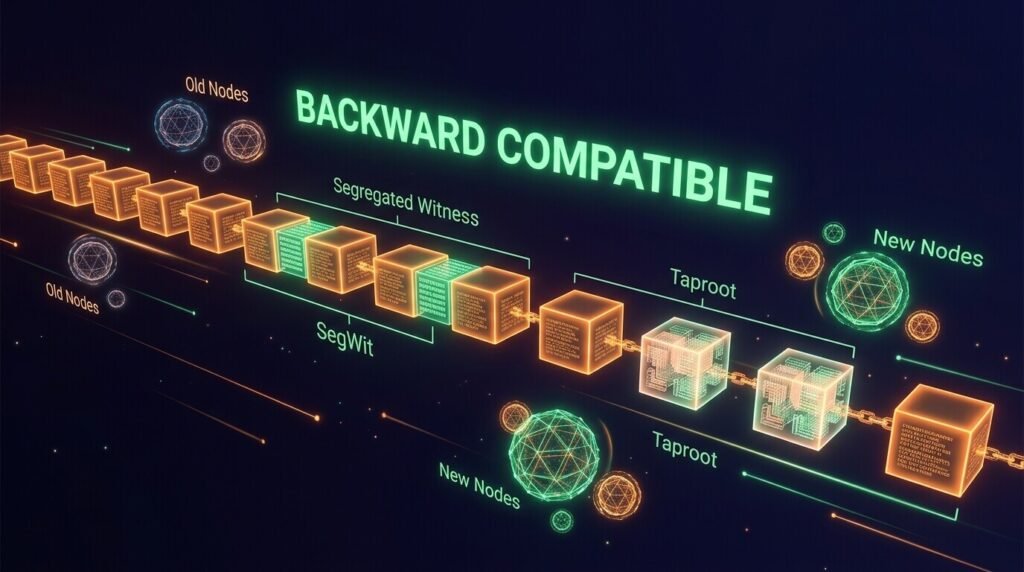
SegWit (Segregated Witness) — Bitcoin, 2017
The most significant soft fork in Bitcoin’s history. SegWit solved Bitcoin’s scaling problem by restructuring how transaction data is stored — separating (“segregating”) the signature data (“witness”) from the transaction data itself. This effectively increased Bitcoin’s block capacity without increasing the block size limit (which would have required a hard fork).
SegWit also fixed a longstanding bug called “transaction malleability” and laid the groundwork for the Lightning Network — Bitcoin’s Layer 2 payment channel system.
Taproot — Bitcoin, November 2021
Bitcoin’s biggest upgrade since SegWit. Taproot improved privacy (making complex multi-signature transactions look identical to simple ones on-chain), improved efficiency, and expanded Bitcoin’s smart contract capabilities. It was activated with overwhelming community support.
Because both SegWit and Taproot were soft forks — backward-compatible — they didn’t split the Bitcoin network or create new coins. They simply improved the existing system.
What Is a Hard Fork?
A hard fork changes the rules in a way that old nodes cannot accept. It’s not backward compatible — the new and old rules are fundamentally incompatible.
What happens when not everyone agrees to upgrade?
If the entire community upgrades simultaneously (a “planned hard fork”), the transition is seamless — everyone moves to the new chain together. But if part of the community refuses to upgrade — because they disagree with the change, have ideological objections, or simply want to preserve the original chain — the blockchain permanently splits into two.
Both chains share all history up to the moment of the split. After that moment, they diverge completely and run independently forever.
The result of a contentious hard fork: Two blockchains. Two communities. Two cryptocurrencies.
The Two Most Famous Hard Forks in History
1. Bitcoin → Bitcoin Cash (August 2017): The Blocksize Wars
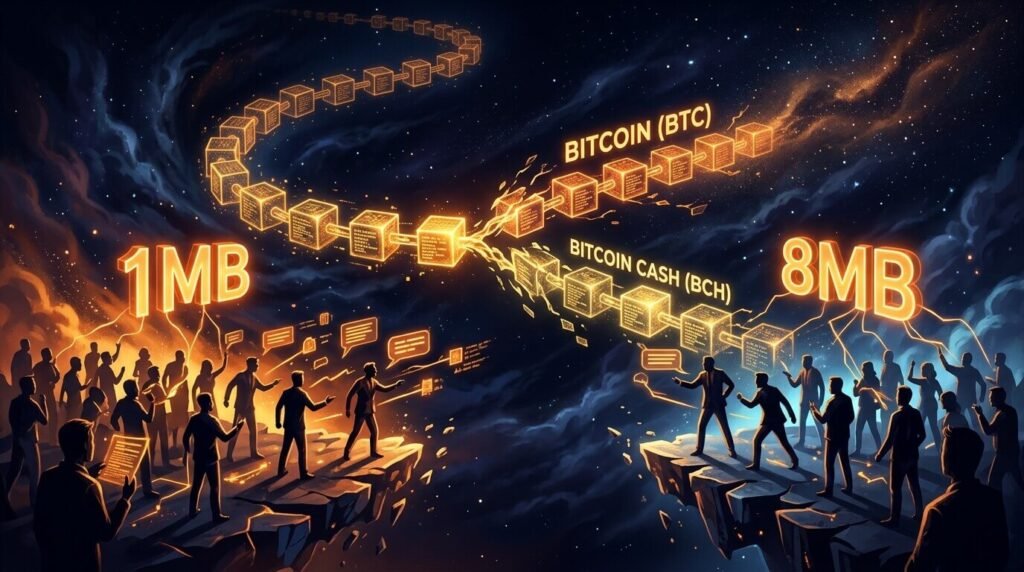
Bitcoin has one significant limitation by design: its block size is capped at 1MB (effectively ~1.7MB with SegWit). This limits how many transactions can be processed per block (~3–7 transactions per second), which causes congestion and higher fees during busy periods.
In 2017, this limitation sparked a fierce community debate — later called “The Blocksize Wars.”
One side: Increase the block size to 8MB (and eventually 32MB) to allow more transactions per block, lower fees, and make Bitcoin more practical for everyday payments.
The other side: Larger blocks would require more expensive hardware to run a node, potentially centralizing Bitcoin by pricing out smaller participants. Keep the 1MB limit, scale with Layer 2 solutions like Lightning Network instead.
The debate was intense — years of arguments, accusations, and political maneuvering. Both sides believed they were protecting the true vision of Bitcoin.
On August 1, 2017, the impasse broke. Supporters of larger blocks hard-forked Bitcoin to create Bitcoin Cash (BCH) — starting with an 8MB block size.
Every Bitcoin holder at the time of the fork automatically received an equal amount of Bitcoin Cash — like a surprise airdrop. The original Bitcoin chain continued unchanged. Bitcoin Cash ran as a separate chain with its own miners, nodes, and community.
Bitcoin Cash itself later split again in November 2018, when disagreements within the BCH community created Bitcoin Cash ABC (the dominant chain, which kept the BCH ticker) and Bitcoin SV (BSV) — a “hash war” where both sides spent enormous resources trying to out-mine the other.
Where are they now? The original Bitcoin remains dominant by every measure. Bitcoin Cash trades as a legitimate altcoin with a smaller community. Bitcoin SV has marginal relevance.
2. Ethereum → Ethereum Classic (July 2016): The DAO Hack
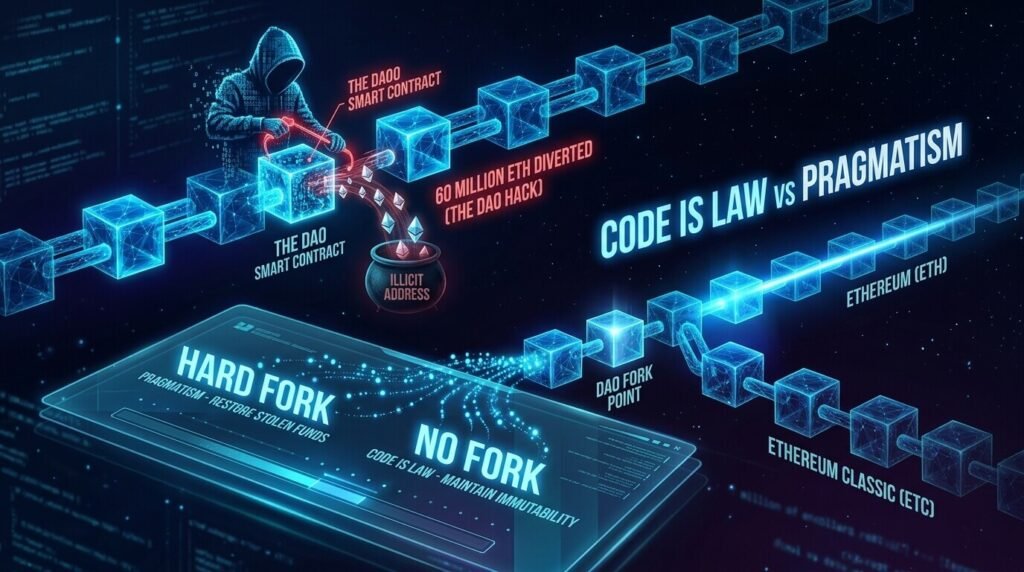
In 2016, a project called “The DAO” (Decentralized Autonomous Organization) was one of the first major experiments in decentralized governance on Ethereum. It raised approximately $150 million in ETH from thousands of contributors — one of the largest crowdfunding events in history at the time.
In June 2016, an attacker exploited a vulnerability in The DAO’s smart contract code and drained approximately $60 million worth of ETH — about a third of all funds raised.
The Ethereum community faced an unprecedented crisis and a profound philosophical question:
Option A: Hard Fork
Rewrite the blockchain’s history to move the stolen ETH back to its original owners. The blockchain would be altered to act as if the hack never happened.
Option B: Do Nothing
Accept that “code is law” — the attacker found and exploited a legal loophole in the smart contract. The blockchain is immutable. Reversing transactions violates the fundamental principle of an unchangeable ledger.
The majority of the community chose Option A — the hard fork. The Ethereum blockchain was rolled back to just before the hack, the stolen funds were effectively returned to their owners, and the chain continued as Ethereum (ETH).
But a minority of the community refused. They believed immutability was sacred — that altering blockchain history, even to correct a theft, set a dangerous precedent. They continued mining the original, unaltered chain.
That original chain is now called Ethereum Classic (ETC).
The debate continues to this day: did the Ethereum community do the right thing by prioritizing people over principle? Or did they fatally compromise the most important property of a blockchain — its immutability?
There’s no consensus answer. Both chains still exist. ETH became the dominant platform for DeFi, NFTs, and smart contracts. ETC survived as a smaller, ideologically pure alternative.
Soft Fork vs Hard Fork: The Complete Comparison
| Feature | Soft Fork | Hard Fork |
|---|---|---|
| Backward compatible? | Yes | No |
| Requires everyone to upgrade? | No — old nodes still work | Yes — or chain splits |
| Risk of chain split? | Very low | High if community disagrees |
| Creates new cryptocurrency? | No | Sometimes (if community splits) |
| Typical use case | Improvements, bug fixes, new features | Major protocol changes, ideological splits |
| Community consensus needed | Majority (miners/validators) | Universal, or split occurs |
| Examples | SegWit, Taproot | Bitcoin Cash, Ethereum Classic |
| Impact on existing holders | None | May receive new coins if chain splits |
What Happens to Your Crypto During a Fork?
This is what most holders actually want to know.
During a soft fork: Nothing changes for you. Your wallet still works. Your balance is unaffected. You don’t need to do anything.
During a hard fork that doesn’t split: Same — if everyone upgrades together, your experience is seamless.
During a contentious hard fork that creates a new coin:
- Your existing coins stay on the original chain
- You automatically receive an equal number of coins on the new chain
- Both balances reflect whatever holdings you had at the moment of the fork
For example: if you held 1 BTC when Bitcoin Cash was created, you automatically held 1 BTC and 1 BCH. If you held 10 ETH when Ethereum Classic was created, you automatically held 10 ETH and 10 ETC.
The catch: To access the new coins, you typically need to use a wallet or exchange that supports the new chain. Exchanges usually handle this automatically, but if your crypto was in a self-custody wallet, you may need to take extra steps — and must be careful about “replay attacks” (where a transaction on one chain can be duplicated on the other).
Why Forks Happen: The Real Reasons
Technical improvements: Most planned forks are just software upgrades — adding features, fixing bugs, improving performance. Like any software, blockchains need periodic updates.
Scaling disagreements: The Bitcoin Blocksize Wars are the most famous example. How do you make a blockchain handle more transactions? Different camps have genuinely different technical philosophies.
Philosophical disputes: Should a blockchain ever reverse transactions, even to correct theft? The Ethereum/ETC split turned on this question. Some believe immutability is sacred; others believe the community has the right to correct obvious wrongs.
Security emergencies: Sometimes a fork is the only way to neutralize a critical vulnerability. The Ethereum community faced exactly this with the DAO hack.
Power struggles: Blockchains have politics. Developers, miners, large holders, and businesses all have different interests. When those interests collide and can’t be reconciled, forks are the ultimate democratic mechanism — the community votes with their feet (and their hash rate).
Key Terminology
Fork: Any change to a blockchain’s underlying protocol rules.
Soft Fork: A backward-compatible protocol upgrade that doesn’t require all nodes to update and doesn’t split the chain.
Hard Fork: A non-backward-compatible protocol change that requires all nodes to upgrade; can create a chain split if part of the community refuses.
Chain Split: When a hard fork results in two separate, permanently diverging blockchains.
Backward Compatible: The new rules are a superset of the old rules — blocks valid under the new rules are also valid under the old rules (soft fork).
SegWit (Segregated Witness): Bitcoin’s 2017 soft fork that separated transaction signature data, increasing capacity and enabling the Lightning Network.
Taproot: Bitcoin’s 2021 soft fork that improved privacy, efficiency, and smart contract capabilities.
The Blocksize Wars: The 2015–2017 dispute within the Bitcoin community over block size limits that resulted in the creation of Bitcoin Cash.
The DAO Hack: The 2016 exploit that drained $60 million from an Ethereum-based smart contract, leading to the Ethereum/Ethereum Classic split.
Replay Attack: A risk during hard forks where a valid transaction on one chain can be copied and broadcast on the other, potentially causing unintended transfers.
The Bottom Line
Forks are how blockchains evolve — and how they reveal their true nature.
When a blockchain community agrees on an improvement, soft forks let them upgrade cleanly and quietly. When they disagree fundamentally — about values, about philosophy, about what the technology is even for — hard forks let them go their separate ways, taking the shared history with them but building different futures.
The Blocksize Wars revealed that Bitcoin’s community values decentralization above all — including speed and low fees. The DAO fork revealed that the Ethereum community values pragmatism — they’re willing to bend the rules of immutability to protect real people from real losses.
Neither answer is obviously correct. Both answers produced blockchains that still exist today, still have communities, still have value.
That’s the beauty and the messiness of decentralized governance: nobody can force a resolution. The community decides — by upgrading their software, one node at a time.
When the blockchain forks, it’s democracy at the protocol level. 🍴
Disclaimer: This article is for informational purposes only and does not constitute financial advice. Cryptocurrency investments carry significant risk, including the potential loss of all invested capital. Always conduct your own research before making any investment decisions.