Ethereum is the world’s most active smart contract platform — but it has a scaling problem. At peak demand, gas fees can reach tens or hundreds of dollars per transaction, and the network processes only around 15–30 transactions per second.
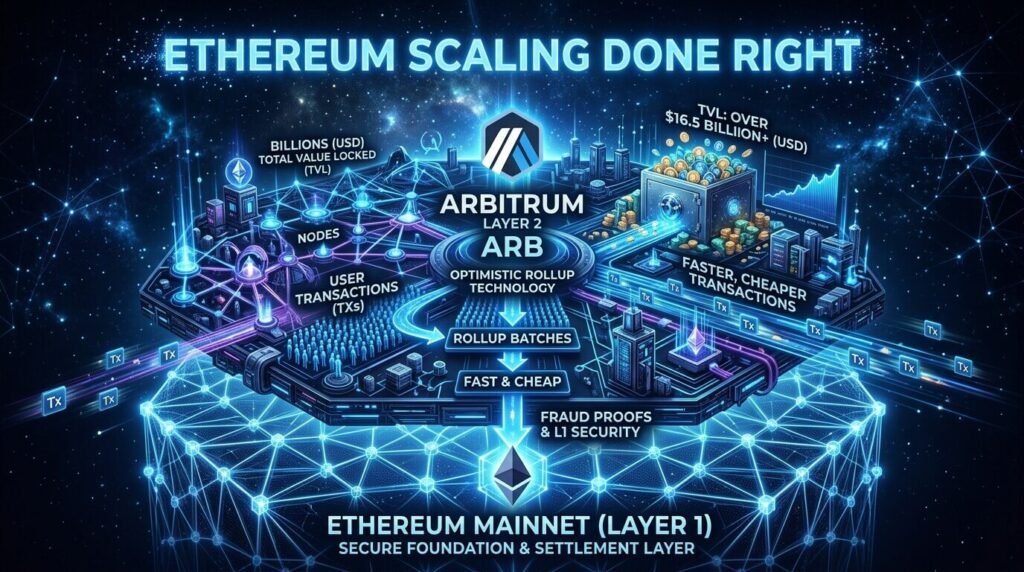
Arbitrum is the leading solution to this problem. As Ethereum’s largest Layer 2 network, Arbitrum processes transactions off-chain, batches them together, and settles on Ethereum — inheriting Ethereum’s security while offering dramatically lower fees and higher throughput.
In April 2026, Arbitrum holds approximately $1.8–2 billion in Total Value Locked, leads the Ethereum Layer 2 ecosystem in DeFi activity, and hosts some of DeFi’s most active protocols including GMX, Aave V3, Camelot, and Uniswap V3.
What Problem Does Arbitrum Solve?
Ethereum’s base layer is deliberately constrained — limited throughput and high fees are a consequence of prioritizing decentralization and security over speed. This is the scalability trilemma: decentralization + security + scalability are difficult to achieve simultaneously.
Layer 2 solutions like Arbitrum solve this by moving the heavy computational work off Ethereum’s main chain. Transactions are processed on Arbitrum fast and cheap, results are settled on Ethereum securely, and users get Ethereum-level security at a fraction of the cost.
How Arbitrum Works: Optimistic Rollups
Arbitrum uses Optimistic Rollups — assume all transactions are valid, post them to Ethereum in batches, and only run verification if someone challenges a transaction.
Step by step:
- Users submit transactions to Arbitrum
- A sequencer orders and processes them off-chain
- Compressed transaction data is posted to Ethereum
- Anyone can challenge suspicious transactions during a ~7-day fraud proof window
- Challenged transactions are re-executed on Ethereum to determine validity
- Valid transactions finalize; invalid ones are rejected
Key performance:
- Gas fees: $0.01–$0.50 vs. $5–50+ on Ethereum mainnet
- Throughput: thousands of TPS vs. ~15–30 on Ethereum
- EVM compatibility: 100% — any Ethereum smart contract works without modification
- Withdrawal to Ethereum: ~7 days due to the fraud proof window
Optimistic Rollups vs. ZK Rollups: The Fundamental Debate
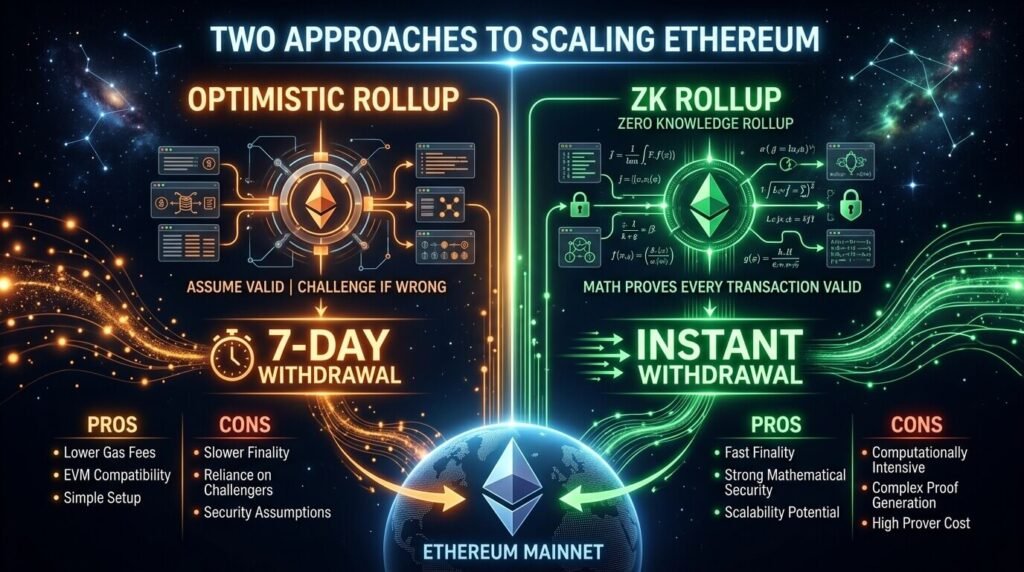
Layer 2 scaling has two competing philosophies. Understanding both is essential for evaluating Arbitrum’s long-term position.
Optimistic Rollups (Arbitrum, Optimism, Base)
Trust transactions by default. Use fraud proofs — if someone thinks a transaction is invalid, they challenge it and it’s re-executed on Ethereum.
Advantages:
- Full EVM compatibility — existing Ethereum contracts deploy without modification
- Technically simpler, lower development costs
- Currently larger and more mature DeFi ecosystems
- Proven at scale with billions in TVL
Disadvantages:
- ~7-day withdrawal delay to Ethereum (challenge window)
- Security relies on at least one honest participant actively monitoring
- Withdrawal delay creates capital inefficiency for bridges
ZK Rollups (zkSync, StarkNet, Polygon zkEVM, Scroll, Linea)
Use cryptographic zero-knowledge proofs to mathematically verify every transaction before submitting to Ethereum. No trust required — validity is mathematically guaranteed.
Advantages:
- Instant finality — withdrawals in minutes to hours, not 7 days
- Stronger security model — invalid proofs are immediately rejected
- No need for fraud monitors — mathematics does the verification
- Better long-term privacy potential
Disadvantages:
- Generating ZK proofs is computationally expensive
- Full EVM compatibility is technically harder to achieve
- Ecosystems are less mature — fewer protocols, less liquidity
- Developer tooling is more complex
Which Approach Will Win?
The optimistic camp argues: Current EVM compatibility and ecosystem depth are decisive. The 7-day withdrawal is solvable with fast bridge solutions (Hop Protocol, Across). Optimistic rollups have proven product-market fit with billions in TVL.
The ZK camp argues: Cryptographic finality is fundamentally superior. As ZK proof generation becomes cheaper through hardware acceleration and algorithmic improvements, ZK rollups will offer better security AND comparable performance. Current disadvantages are engineering challenges being actively solved.
The honest 2026 assessment: Both coexist. Optimistic rollups dominate by TVL and activity today. ZK rollups are growing rapidly with technically superior security. The next 3–5 years will likely see both serving different use cases rather than one definitively winning. Arbitrum’s response: the Orbit framework allows ZK-based L3 chains to settle on Arbitrum, partially bridging both approaches.
The ARB Airdrop: One of Crypto’s Most Celebrated
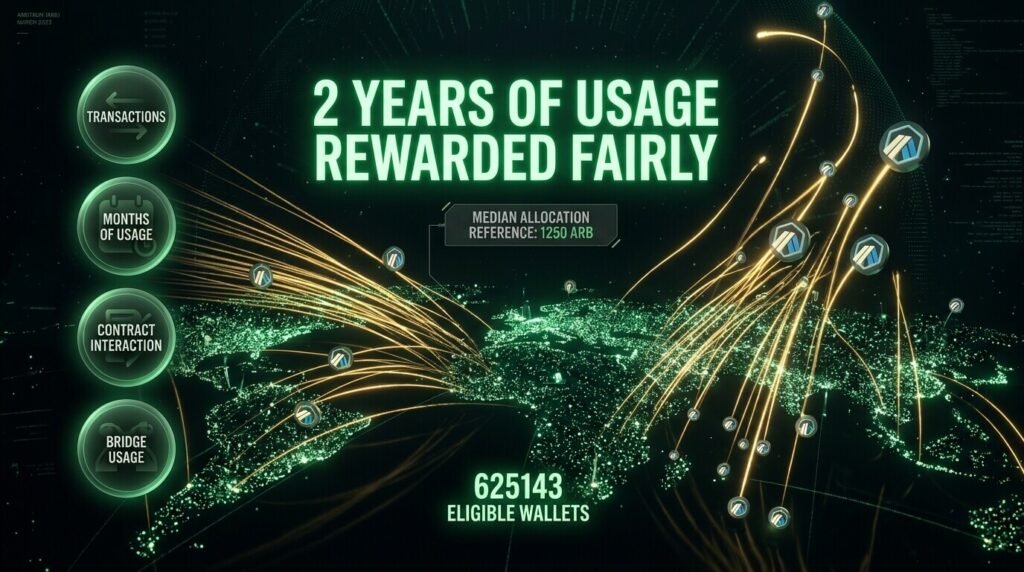
The ARB airdrop on March 23, 2023 is widely regarded as one of the fairest and most community-respected token distributions in crypto history.
The Buildup
Arbitrum One launched in August 2021 — without a token. For nearly two years, users transacted on Arbitrum with no guaranteed rewards. Airdrop speculation was constant, but the team remained silent. This extended no-token period filtered out purely mercenary users and built a genuinely engaged community using Arbitrum because it was the best place for DeFi — not to farm a potential airdrop.
The Snapshot and Eligibility
On February 6, 2023, Arbitrum took a snapshot of all wallet activity. A point-based system determined eligibility:
Points criteria:
- Transactions across multiple distinct months (rewarding consistency, not one-time farming)
- Number of different smart contracts interacted with
- Transaction value in USD across different periods
- Bridging activity to Arbitrum One and Nova
Key rules:
- Minimum 3 points to qualify; maximum 15 points
- Points before Arbitrum’s Nitro upgrade (August 2022) counted twice — rewarding the earliest adopters most generously
- Anti-Sybil: wallets with all transactions within 48 hours, or minimal ETH balance, lost points
The Distribution
1.162 billion ARB were airdropped to individual users (~11.62% of total supply). A total of 625,143 wallet addresses were eligible.
- Minimum per address: 625 ARB
- Maximum per address: 10,250 ARB (~4,400 wallets at maximum)
- Median allocation: 1,250 ARB
Additionally, over $120 million worth of ARB was distributed to 131+ protocols and DAOs that had built on Arbitrum — including GMX, TreasureDAO, Uniswap, Curve, and SushiSwap.
Why the Community Loved It
The ARB airdrop earned exceptional reputation for several reasons:
Fair criteria: Points rewarded genuine, sustained usage — not quick farming. Consistent early users received the most.
Generous to real users: Those who had used Arbitrum since 2021–2022 received thousands of ARB worth thousands of dollars at listing.
Protocol allocations: Distributing tokens to protocols building Arbitrum’s ecosystem was seen as investing in the future, not just extracting value.
No predatory pre-sale dynamics: Early users received tokens at the same time as everyone else — no insiders dumping on retail from a much lower cost basis at launch.
The contrast with airdrops that excluded key users, had opaque criteria, or showed insider favoritism made ARB a benchmark. Community goodwill toward Arbitrum remains notably high compared to many competing Layer 2 projects.
ARB Price History: From First Trade to Today
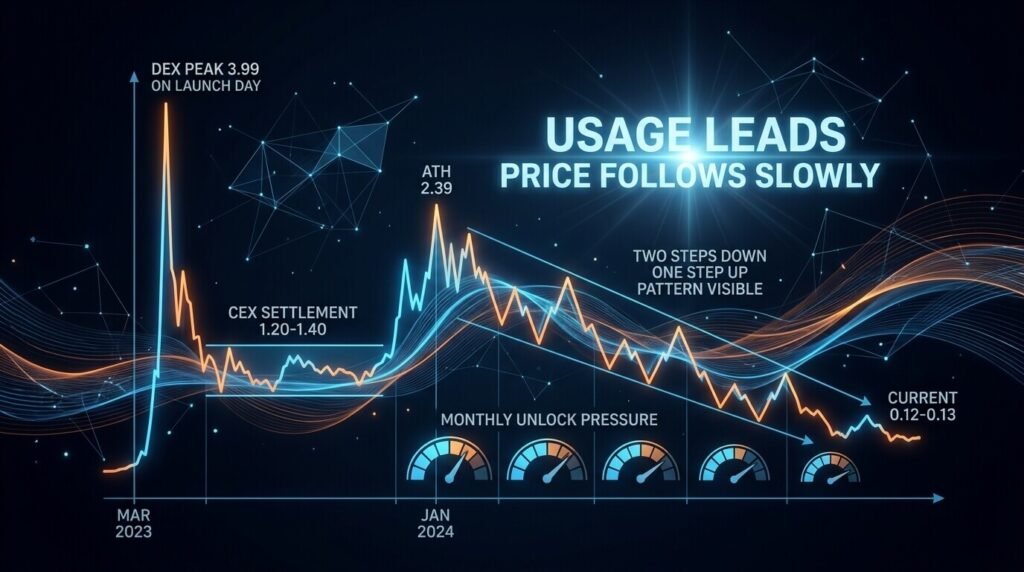
Listing Day: March 23, 2023
The long-awaited ARB token made its market debut trading at $3.99 on Uniswap as volatility spiked on decentralized exchanges. More than 42 million ARB tokens were claimed in the first hour, with some 23,000 individual wallets claiming.
The $3.99 DEX peak was brief — the initial frenzy of buyers quickly gave way to airdrop recipients selling. Within hours, ARB settled around $1.20–1.40 on centralized exchanges. Recipients who received the median 1,250 ARB held approximately $1,500–$1,750 on day one.
The Bull Run Peak: January 2024
ARB reached its all-time high of $2.39 on January 12, 2024 — during a period of broad altcoin optimism driven by Bitcoin’s rally and anticipation of spot Bitcoin ETF approvals. At peak, ARB’s fully diluted market cap approached $20+ billion.
The Decline: Grinding Lower With Resistance
The decline since January 2024 has not been a sudden collapse — it has been a slow, grinding descent characteristic of altcoins navigating a difficult environment:
The pattern: ARB has shown multiple notable bounces — rallying 30–60% during broader market risk-on periods, then giving back gains as unlock pressure resumed. A characteristic “two steps down, one step up” movement rather than a vertical crash. The token has fought — but the headwinds have been persistent.
Why the decline:
- Token unlock pressure: Each month, investor and team allocations unlock. The May 2026 unlock alone releases ~92.65 million ARB. These predictable unlocks create consistent sell pressure that caps recoveries.
- No fee capture: Transaction fees on Arbitrum are paid in ETH — none flow to ARB holders. ARB doesn’t directly benefit when network usage increases.
- Bitcoin dominance: Throughout 2024–2026, institutional capital has flowed predominantly into Bitcoin via ETFs, keeping altcoin performance muted. The expected altcoin season has been delayed.
- Macro environment: The broader crypto market has been characterized by Bitcoin strength and altcoin weakness — a challenging backdrop for L2 governance tokens.
By April 2026, ARB trades around $0.12–0.13 — approximately 95% below its January 2024 ATH. It’s worth noting this is not unique to ARB — many solid altcoins have seen similar or worse performance in the same period.
Who Built Arbitrum and Who Backed It?
Offchain Labs — founded 2018 by Princeton University researchers:
- Ed Felten — former Princeton computer science professor, former U.S. Deputy Chief Technology Officer under President Obama
- Steven Goldfeder — former Princeton cryptography researcher
- Harry Kalodner — Princeton PhD in computer science
Before the DAO transition, Offchain Labs raised significant capital from some of the most respected names in both crypto-native venture capital and Silicon Valley technology investing. The investor list included major institutional funds conducting deep technical due diligence — hundreds of millions in total across multiple rounds. The involvement of top-tier institutional capital was an important signal of team credibility and technical validation, well before the product achieved its current scale.
The Arbitrum Ecosystem: Three Chains
Arbitrum One
The flagship DeFi chain. Home to GMX (perpetual futures DEX), Aave V3, Uniswap V3, Camelot, Pendle, and Gains Network. The deepest liquidity and most active DeFi ecosystem among all Layer 2 networks.
Arbitrum Nova
A second chain optimized for ultra-low-cost, high-volume applications — gaming, social platforms, NFTs. Uses AnyTrust security model for even lower transaction costs. Used by blockchain gaming applications requiring thousands of cheap micro-transactions.
Arbitrum Orbit
Framework for launching custom Layer 3 chains settling to Arbitrum One or Nova. Notable deployments:
- Robinhood Chain: Robinhood’s dedicated blockchain for around-the-clock trading and tokenized stock DeFi integration
- XAI: Gaming-focused L3
The ARB Token
ARB is Arbitrum’s native governance token launched March 23, 2023.
What ARB does: Vote on Arbitrum DAO proposals — protocol upgrades, treasury allocation, grant programs, Security Council elections.
Critical distinction: ARB is a governance token, not a gas fee token. Transaction fees on Arbitrum are paid in ETH.
Tokenomics (April 2026)
| Metric | Data |
|---|---|
| Price | ~$0.12–0.13 |
| Market cap | ~$760–800 million |
| Circulating supply | ~6.1–6.2 billion ARB |
| Max supply | 10 billion ARB |
| FDV | ~$1.2–1.3 billion |
| All-time high | $2.39 (January 12, 2024) |
| DEX listing price (peak) | ~$3.99 |
| CEX listing price | ~$1.20–1.40 |
Distribution
- Arbitrum DAO Treasury: 42.78%
- Offchain Labs team & advisors: 26.94%
- Investors: 17.53%
- Community airdrop: ~11.62%
Key 2026 Developments
KelpDAO Exploit Response (April 2026): Security Council froze 30,766 ETH (~$71M) linked to a $290M+ bridge hack — demonstrating proactive governance while sparking debate about decentralization tradeoffs.
Robinhood Chain: Robinhood’s dedicated blockchain on Arbitrum — tokenized stock trading and DeFi integration. Major institutional validation.
$215M Gaming Catalyst Program: DAO-approved fund to make Arbitrum the primary home for blockchain gaming.
Arbitrum Everywhere Initiative: 2026 strategy expanding through custom chains, institutional partnerships, and consumer apps.
Arbitrum vs. The Competition
| Arbitrum | Optimism/Base | zkSync/StarkNet | |
|---|---|---|---|
| Technology | Optimistic rollups | Optimistic rollups | ZK rollups |
| TVL (2026) | ~$1.8–2B | ~$800M–$3B (Base growing) | ~$200–500M each |
| Withdrawal speed | ~7 days | ~7 days | Minutes to hours |
| EVM compatibility | Full | Full | Improving (near-full) |
| Security model | Fraud proofs (optimistic) | Fraud proofs | Cryptographic proofs (superior) |
| DeFi ecosystem | Deepest L2 DeFi | Base growing fast | Less mature |
| Native token | ARB | OP / Base has no token | Various |
Is There an ARB ETF?
As of April 2026, no ARB-specific ETF exists in the United States or major international markets. ARB is available on Coinbase, Kraken, Binance, and Bybit.
How to Buy ARB
Available on: Coinbase, Kraken, Binance, Bybit
ARB is an ERC-20 token — compatible with MetaMask, Ledger, and Trezor for self-custody.
Key Terminology
Layer 2 (L2): Blockchain built on Ethereum processing transactions off-chain, settling results on Ethereum.
Optimistic Rollup: Batches transactions assuming validity by default — verification only on challenge.
ZK Rollup: Uses cryptographic zero-knowledge proofs to mathematically verify every transaction.
Fraud Proof: Mechanism for challenging invalid transactions in optimistic rollups.
Sequencer: Entity ordering and processing Arbitrum transactions.
ARB: Governance token for voting on Arbitrum DAO proposals — not used for gas fees.
Arbitrum Orbit: Framework for custom L3 chains settling to Arbitrum.
The Bottom Line
Arbitrum is Ethereum scaling’s current leader — proven technology, vibrant DeFi ecosystem, and accelerating institutional adoption with Robinhood Chain as the most visible example.
The ARB airdrop set a community standard. Fair criteria, genuine rewards for real users, no insider favoritism. That goodwill is a real and lasting asset.
The ARB token story is harder. Down ~95% from ATH, facing continuous monthly unlocks and no direct fee-capture mechanism, it embodies the central challenge of L2 governance tokens: how to link protocol success to token value.
The competitive landscape is evolving. Optimistic rollups dominate today. ZK rollups offer technically superior security and faster withdrawals — their ecosystems are growing quickly. Both will likely coexist, serving different use cases as the Ethereum scaling ecosystem matures.
This article is for informational purposes only and does not constitute financial advice. Cryptocurrency investments carry significant risk. Always conduct your own research before investing.