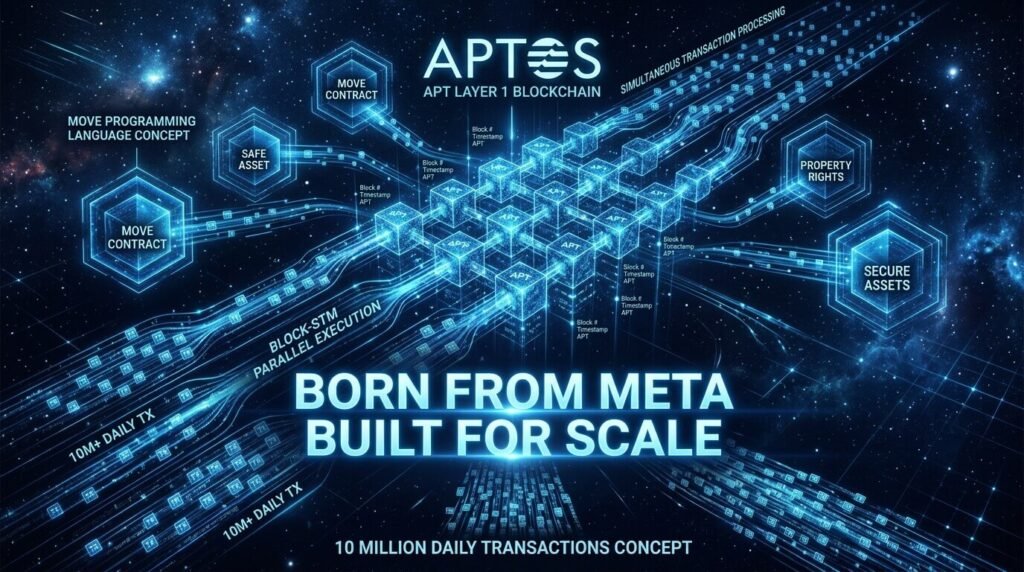
When Meta (Facebook) shut down its ambitious Diem blockchain project in January 2022, it didn’t just kill a product — it freed a team of world-class engineers. Two of them, Mo Shaikh and Avery Ching, immediately founded Aptos Labs with a singular mission: build the blockchain that Diem was supposed to be, but without the constraints of a corporate giant or a skeptical regulator.
The result — the Aptos blockchain — launched its mainnet in October 2022 and quickly established itself as one of the most technically advanced Layer 1 networks in crypto. In May 2026, Aptos processes nearly 10 million daily transactions, holds over $1.66 billion in stablecoin supply, and has attracted partnerships with Microsoft and BlackRock — while its APT token trades around $0.90–1.03, approximately 95% below its January 2023 all-time high of $20.39.
What Problem Does Aptos Solve?
Every major blockchain faces the scalability trilemma — the challenge of simultaneously achieving decentralization, security, and throughput. Ethereum’s approach (favor decentralization and security, sacrifice throughput) created the Layer 2 ecosystem. Solana’s approach (maximize throughput, accept some centralization tradeoffs) created a fast but occasionally unstable network.
Aptos takes a different approach: redesign the fundamental execution engine to achieve high throughput without sacrificing safety — using a new programming language (Move) and a novel parallel execution system (Block-STM) developed from first principles by researchers and engineers who had spent years building Meta’s Diem blockchain.
The Diem / Meta Connection: Where Aptos Came From
To understand Aptos, you need to understand its origin story — and it starts with one of the most ambitious blockchain projects ever attempted.
Meta’s Diem Project
In 2019, Facebook (now Meta) announced Libra — a global stablecoin and payment system that would give billions of unbanked people access to digital payments. Backed by Facebook’s scale and a consortium of major corporations, Libra attracted immediate global attention — and immediate regulatory hostility.
Regulators from the US, EU, and other jurisdictions pushed back hard. The project was renamed from Libra to Diem in 2020 and scaled back significantly. After years of regulatory battles, Diem was effectively shut down in January 2022 when Meta sold its assets.
What Survived Diem: Move and Block-STM
While Diem the payment network failed, it produced two significant technical innovations:
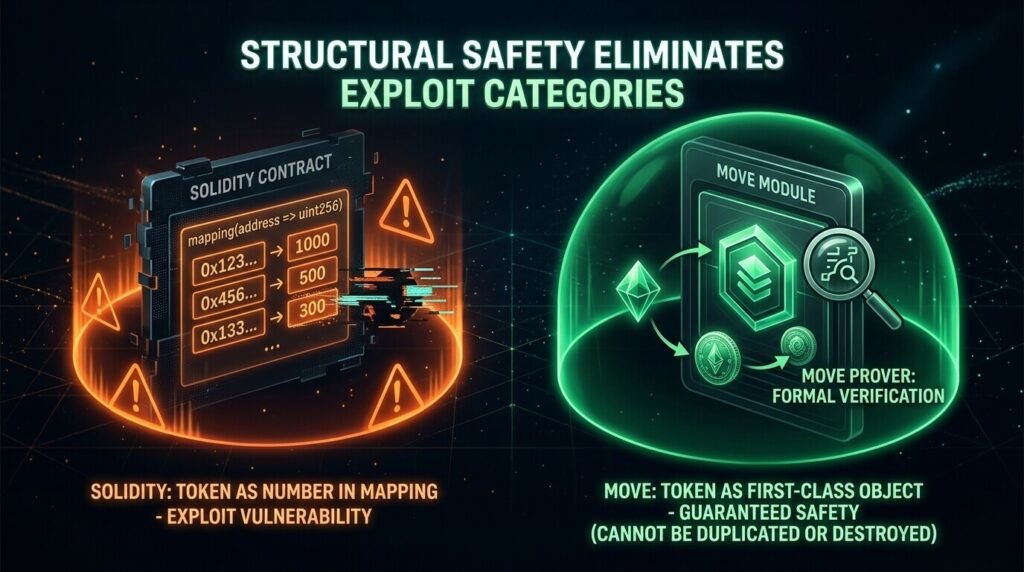
Move: A new smart contract programming language designed from scratch with blockchain safety in mind. Unlike Solidity (Ethereum’s language), Move treats assets as first-class objects that can’t be accidentally duplicated or destroyed — making entire categories of DeFi hacks structurally impossible.
Block-STM: A parallel execution engine that allows blockchain transactions to be processed simultaneously rather than sequentially — dramatically increasing throughput without sacrificing safety.
Both technologies were developed by researchers and engineers who had worked on Diem at Meta. When Mo Shaikh and Avery Ching founded Aptos Labs in 2021, they brought this intellectual property, a team of ex-Meta/Diem engineers, and a determination to deploy these innovations on a public blockchain.
How Aptos Works: The Technical Foundation
The Move Programming Language
Move is the most distinctive technical feature of Aptos — and one of the reasons the project attracted enormous venture capital attention before a single line of production code was deployed.
Why Move matters:
Asset safety by design: In Solidity, tokens are tracked as numbers in a mapping — a technically correct but abstracted representation. Move treats assets as actual objects that can only exist in one place at a time. You can’t accidentally copy a token or destroy it without explicit permission. This structural safety eliminates entire categories of smart contract vulnerabilities.
The Move Prover: A formal verification tool that can mathematically prove that a smart contract behaves as specified — before deployment. This level of pre-deployment verification is unprecedented in mainstream blockchain programming.
Upgradeability: Move contracts can be upgraded without redeployment in many cases — critical for the long-term maintainability of financial applications.
The limitation: Move is not EVM-compatible. Unlike Solidity contracts that can be copied from Ethereum to Arbitrum to Polygon, Move contracts must be written from scratch. This creates a higher barrier for developer adoption — Aptos can’t simply copy Ethereum’s ecosystem.
Block-STM: Parallel Execution
Traditional blockchains execute transactions sequentially — one after another. If Transaction 47 takes a long time, every subsequent transaction waits.
Block-STM (Software Transactional Memory) executes transactions optimistically in parallel — assuming they don’t conflict — and detects conflicts afterward. If a conflict is found, the conflicting transaction is re-executed. This is similar to how modern databases handle concurrent writes.
Performance results:
- Theoretical throughput: 150,000+ TPS (under optimal conditions)
- Real-world performance: 80,000–170,000 TPS in load tests
- Production throughput (April 2026): ~10 million daily transactions
- Transaction finality: Sub-second
For comparison: Ethereum mainnet processes ~15–30 TPS. Solana processes ~2,000–4,000 TPS in real production (well below its theoretical maximum). Aptos’s production numbers, while lower than theoretical maximums, substantially exceed most competitors.
AptosBFT Consensus
Aptos uses a variant of Byzantine Fault Tolerant (BFT) consensus — derived from the HotStuff protocol used by Diem. This consensus mechanism:
- Provides immediate finality (no probabilistic finality like Bitcoin)
- Tolerates up to 1/3 of validators being malicious or offline
- Supports fast validator set rotation
The newest iteration, Raptr consensus (2026), improves sub-second latency and maintains performance even under network attacks.
The APT Airdrop: Early Testnet Reward
Unlike Arbitrum’s celebrated two-year community buildup, Aptos’s airdrop was smaller in scale and more narrowly targeted — but still significant for the early adopters who received it.
The Distribution
On October 19, 2022 — one day after mainnet launch — Aptos announced an airdrop of 20 million APT tokens distributed to early testnet participants.
Who qualified:
- Users who had participated in Aptos’s incentivized testnet (running from late May 2022)
- Users who had connected a qualifying wallet to testnet activities
- Eligible addresses received 150 APT each
The Context
The airdrop was announced with very little advance notice — many testnet participants didn’t know it was coming. The surprise nature meant there was less premeditated farming compared to longer-running airdrop programs.
At mainnet launch prices (~$8–10 range initially), 150 APT represented approximately $1,200–1,500 per eligible address. Those who held through the January 2023 ATH of $20.39 saw their 150 APT reach ~$3,060.
Community Reception
The community reaction was mixed. The 150 APT per address was seen as relatively modest compared to some other high-profile airdrops, and the criteria (testnet participation) were straightforward but not as community-building oriented as some competitors. The surprise timing, however, was appreciated — there was less mercenary farming behavior than in programs with longer advance notice.
Since then, Aptos has continued ecosystem incentive programs and the Shelby testnet (Aptos’s decentralized storage layer) has a potential Season 2 reward distribution expected around October 2026 — tied to active usage performance rather than just participation.
APT Price History: The Dramatic Rise and Painful Fall
Pre-Launch Hype (2022)
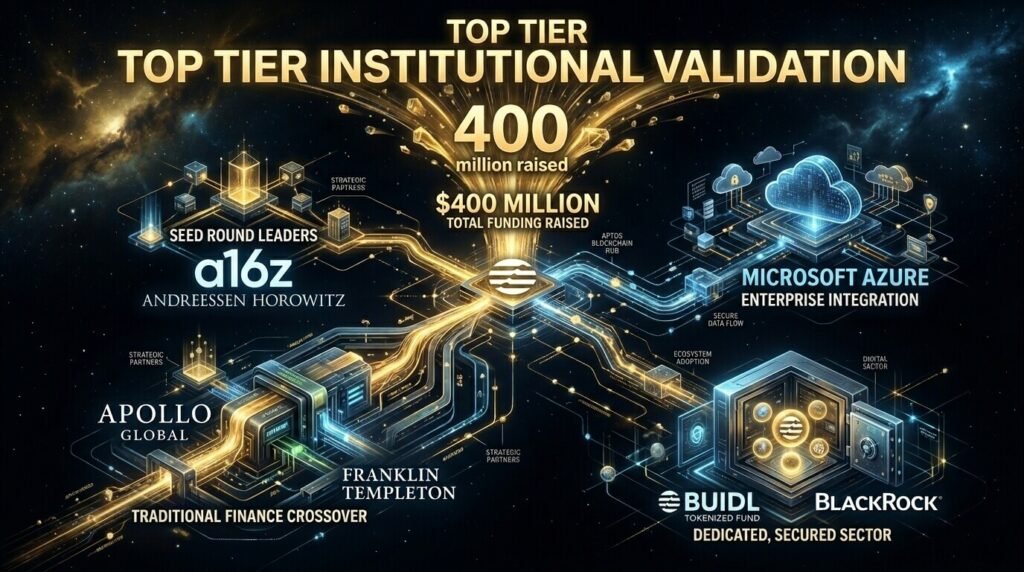
Aptos attracted extraordinary venture capital before its mainnet even launched — raising $400 million in two rounds in 2022. This funding, combined with the Diem pedigree and technical novelty, created significant market anticipation.
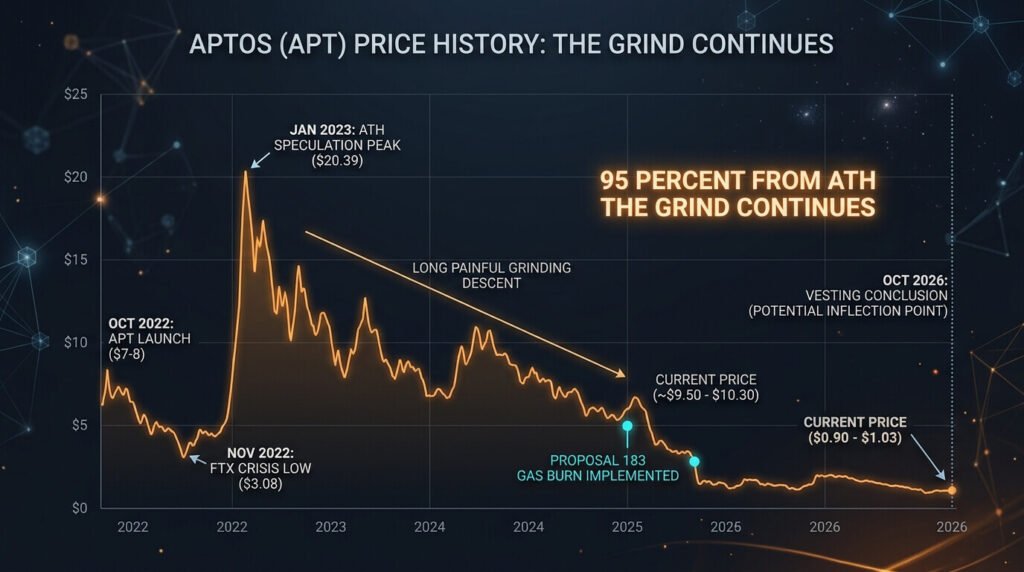
When mainnet launched in October 2022, APT was immediately listed on major exchanges. The initial listing environment was difficult — the broader crypto market was in a bear market following the Terra/LUNA collapse and Three Arrows Capital bankruptcy. APT launched around $7–8 and reached an early low of $3.08 in November 2022 during the FTX collapse.
The All-Time High: January 2023
Despite launching into a bear market, APT staged a remarkable recovery. Through late 2022 and January 2023, APT climbed dramatically as investors speculated on its technical promise and institutional backing.
On January 26, 2023, APT reached its all-time high of $19.92–20.39 — nearly 7x from its November lows in just weeks. At peak, APT’s fully diluted valuation exceeded $20 billion — an extraordinary valuation for a network with limited real-world DeFi activity at the time.
The Long Decline: A Grinding Descent
The ATH proved to be a peak of speculation rather than fundamental value. What followed was one of the more painful price charts in the recent Layer 1 ecosystem:
2023: Following the January peak, APT began a prolonged decline. The token showed multiple attempts to recover — rallying significantly during broader market risk-on periods — but each rally was met with selling. The “two steps down, one step up” pattern was pronounced. By end of 2023, APT traded around $6–8.
2024: Continued weakness despite significant ecosystem development. Partnerships with Microsoft and BlackRock attracted attention but didn’t sustain price. The expected altcoin season never materialized for most non-Bitcoin assets. APT fell below $5, then $3.
2025–2026: The grind continued. APT broke below $2, then struggled to hold $1. By May 2026, APT trades approximately $0.90–1.03 — roughly 95% below its January 2023 all-time high.
Contributing factors:
- Token unlocks: The four-year vesting schedule for early investors concludes in October 2026 — meaning throughout 2022–2026, regular investor unlocks created persistent sell pressure
- Move ecosystem isolation: Not being EVM-compatible means Aptos couldn’t attract capital by simply deploying copies of popular Ethereum DeFi protocols
- Competition intensification: SUI (a competing Move-based blockchain from other ex-Diem developers) launched in 2023 and has surpassed Aptos in market cap ranking
- Developer attrition: A 60% developer attrition rate in late 2025 as talent shifted to AI applications weakened ecosystem momentum
The March 2026 governance shift: Aptos community passed Proposal 183 — introducing a hard supply cap of 2.1 billion APT, permanently burning 100% of gas fees, and reducing staking rewards from 5.19% to ~2.6% APY. This structural deflationary shift, combined with the October 2026 vesting conclusion, could mark a genuine tokenomics turning point — though execution-dependent.
Who Built Aptos and Who Backed It?
The Founders
Mo Shaikh — CEO of Aptos Labs. Former strategy executive with experience at Meta, Blackrock, and others. A business-focused leader who complements the technical depth of the team.
Avery Ching — CTO of Aptos Labs. One of the principal software engineers on Meta’s Diem blockchain. A deeply technical leader who architected significant portions of Aptos’s core technology.
Beyond the founders, Aptos Labs assembled one of the most technically credentialed teams in crypto — dozens of engineers and researchers who had worked directly on Diem, bringing genuine intellectual property and institutional-grade engineering practices.
The Institutional Backers
Aptos raised one of the largest pre-launch funding rounds in crypto history — totaling $400 million across two rounds in 2022:
$200 million seed round (March 2022):
Led by Andreessen Horowitz (a16z) — the most prominent crypto venture fund globally. Participating investors included Tiger Global, Multicoin Capital, and others.
$200 million Series A (July 2022):
Expanded the investor syndicate to include Dragonfly Capital, Apollo Global Management (a major traditional private equity firm), Franklin Templeton (an institutional asset manager), Animoca Brands, Jump Crypto, and Binance Labs (which made a separate strategic investment).
The involvement of a16z specifically is significant — the firm has historically backed some of the most successful crypto projects and its participation serves as a strong technical credibility signal. The presence of Apollo Global and Franklin Templeton alongside crypto-native funds represented unusual institutional crossover validation for a pre-launch project.
The APT Token
APT is Aptos’s native token serving three functions:
Gas fees: Every transaction on Aptos costs APT. The March 2026 governance change means all gas fees are now permanently burned — creating a deflationary pressure proportional to network activity.
Staking: Validators stake APT to participate in consensus and earn staking rewards. Post-Proposal 183, staking APY is approximately 2.6% — lower but more sustainable than the previous 5.19%.
Governance: APT holders vote on protocol upgrades and parameter changes through the Aptos DAO.
APT Tokenomics (May 2026)
| Metric | Data |
|---|---|
| Price | ~$0.90–1.03 |
| Market cap | ~$730M–1.1B |
| Circulating supply | ~806–810 million APT |
| Total supply | ~1.2 billion APT |
| Max supply | 2.1 billion APT (hard cap, post-Proposal 183) |
| All-time high | $20.39 (January 26, 2023) |
| All-time low | ~$3.08 (November 2022) |
| CoinMarketCap ranking | ~#66–85 |
| FDV | ~$1.9–2.1 billion |
Key tokenomics event: The four-year investor vesting schedule concludes in October 2026 — after which the major structural source of sell pressure from early investors ends. Combined with the gas fee burn and hard supply cap, October 2026 represents a potential tokenomics inflection point.
Distribution (at launch)
- Community: 51.02%
- Core contributors (team): 19.00%
- Foundation: 16.50%
- Investors: 13.48%
The Aptos Ecosystem in 2026
DeFi
Aptos DeFi has grown significantly from its early days of near-zero activity:
- On-chain stablecoin supply: $1.66 billion (April 2026)
- Daily transactions: ~10 million
- Key protocols: Liquidswap, Thala, PancakeSwap (Aptos deployment), Echelon
Institutional Integrations
- Microsoft: Integration bringing Aptos to Azure enterprise customers
- BlackRock BUIDL: BlackRock’s tokenized fund available on Aptos — significant institutional validation
- Franklin Templeton: Tokenized fund deployment
Framework-Level CLOB (2026)
Aptos is building a Central Limit Order Book (CLOB) at the protocol level — embedding institutional-grade order book trading directly into the blockchain infrastructure rather than requiring application-layer solutions. This positions Aptos as a potential “Global Trading Engine” for institutional DeFi.
Shelby: Decentralized Storage
Aptos’s Shelby project is building decentralized storage for real-time applications. The testnet is ongoing with a potential Season 2 reward distribution expected October 2026 — tied to actual usage rather than just participation.
Raptr Consensus (2026)
New consensus protocol delivering sub-second finality and robust performance under network attacks — further improving Aptos’s already strong throughput numbers.
Aptos vs. The Competition
Aptos competes at two levels: against other high-performance Layer 1s, and specifically against Sui — which uses the same Move language but different architecture decisions.
| Aptos | Solana | Sui | Ethereum | |
|---|---|---|---|---|
| Language | Move | Rust | Move | Solidity |
| Throughput (production) | ~10M daily TXs | ~2,000–4,000 TPS | Comparable | ~15–30 TPS |
| Finality | Sub-second | Sub-second | Sub-second | ~12 seconds |
| EVM compatibility | No | No | No | Native |
| TVL (2026) | ~$400–600M | ~$8–10B | ~$800M–1.5B | ~$50B+ |
| All-time high | $20.39 | ~$260 | ~$5.35 | ~$4,878 |
| Key advantage | Move safety, Block-STM, institutional | Ecosystem depth, speed | Move, growing DeFi | Security, decentralization |
Aptos vs. Sui: Both use Move but differ in architecture. Sui uses an object-centric model optimized for simple transactions. Aptos uses account-based model with Block-STM. Sui has overtaken Aptos in market cap ranking in 2025-2026 and has seen faster DeFi ecosystem growth — a genuine competitive headwind for APT.
Aptos vs. Solana: Solana has a dramatically larger and more mature DeFi ecosystem. Aptos’s theoretical throughput advantage hasn’t yet translated to user adoption that rivals Solana. However, Aptos’s Move language provides structural safety advantages that Solana’s Rust contracts lack.
Is There an APT ETF?
As of May 2026, no APT-specific ETF exists in the United States or major international markets. However, the March 2026 SEC/CFTC joint classification of APT as a digital commodity provides regulatory clarity that could facilitate future financial products. APT is available on Coinbase, Kraken, Binance, Bybit, and OKX.
How to Buy APT
Available on: Coinbase, Kraken, Binance, Bybit, OKX
APT is the native token of the Aptos blockchain — compatible with the Petra wallet (Aptos’s official wallet), Pontem Wallet, and other Move-compatible wallets.
Key Terminology
Move: Smart contract programming language developed at Meta for Diem — treats assets as first-class objects with safety guarantees structurally preventing many common exploit types.
Block-STM: Aptos’s parallel execution engine — processes transactions simultaneously using software transactional memory, enabling 150,000+ TPS theoretically.
AptosBFT: Byzantine Fault Tolerant consensus mechanism derived from HotStuff protocol.
Raptr: Aptos’s newest consensus protocol (2026) providing sub-second finality under adversarial conditions.
APT: Native token of the Aptos blockchain — used for gas fees (now burned), staking, and governance.
Proposal 183: March 2026 governance proposal that introduced APT’s hard supply cap of 2.1B, permanent gas fee burns, and reduced staking rewards.
Shelby: Aptos’s decentralized storage layer — under testnet development in 2026.
Diem: Meta’s predecessor blockchain project (née Libra) — the technical and organizational origin of the Aptos team.
Disclaimer: This article is for informational and educational purposes only and does not constitute financial advice. Cryptocurrency investments carry significant risk, including the potential loss of all invested capital. Always conduct your own research before making any investment decisions.