
What Is Bitcoin Cash (BCH)? The Complete Guide for Beginners in 2026
Picture this: it’s August 2017, and the Bitcoin community is in a full-on civil war. Developers, miners, and investors are split over a single question — how should Bitcoin scale to handle millions of transactions? The debate was so heated, so irreconcilable, that one faction simply said: “Fine. We’re building our own Bitcoin.”
And that’s exactly what they did.
Bitcoin Cash (BCH) was born from that split — technically called a “hard fork” — and it went on to become one of the most recognizable and controversial cryptocurrencies in the world. Today, it sits in the top 15 by market capitalization, with an $8.5+ billion market value and a clear mission: to be the digital cash that Bitcoin itself was originally supposed to be.
Whether you’re curious about why anyone would fork Bitcoin in the first place, what makes BCH different from BTC, or whether it has any future in 2026 — this guide covers everything you need to know.
The Quick Answer: What Is Bitcoin Cash?
Bitcoin Cash is a cryptocurrency that was created in August 2017 as a direct copy-and-modification of Bitcoin’s code. The people behind it believed that Bitcoin had strayed from Satoshi Nakamoto’s original whitepaper vision of a peer-to-peer electronic cash system — and that it had become too slow and too expensive for everyday payments.
Their solution was simple in theory: increase the block size from Bitcoin’s 1MB limit to a much larger size (initially 8MB, later expanded to 32MB+). More room per block means more transactions per block, which means faster confirmations and lower fees.
In practical terms, Bitcoin Cash today can process thousands of transactions per block compared to Bitcoin’s 1,000–1,500. Transaction fees on BCH are often fractions of a cent. If you want to send $5 to your friend, you won’t pay $3 in fees to do it.
As of April 2026, BCH trades around $430–$445 USD and holds the #13 spot by market cap on CoinMarketCap, with approximately 20 million BCH in circulation out of a capped supply of 21 million.
Who Created Bitcoin Cash? The Fork Heard Around the Crypto World
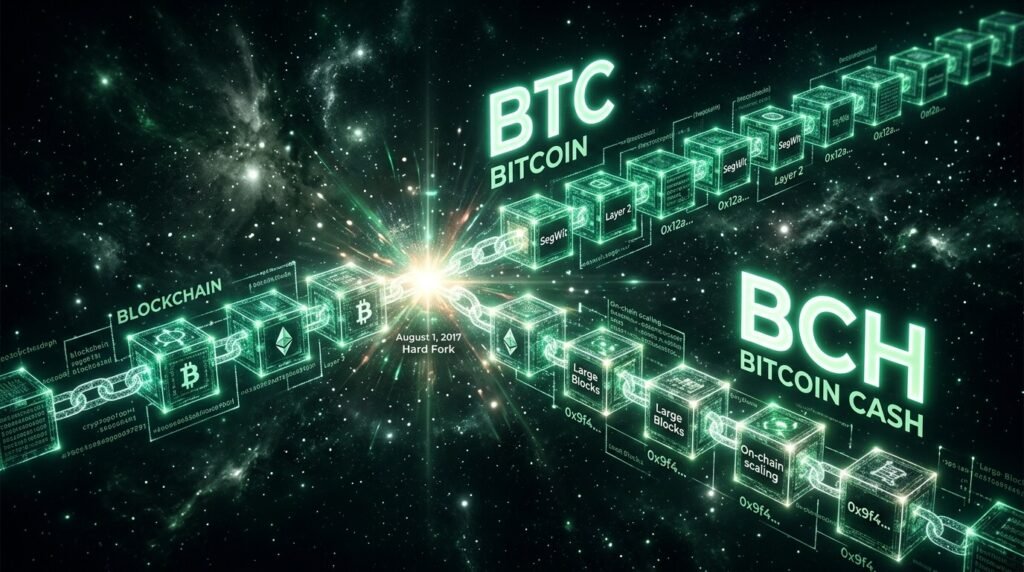
To understand BCH, you need to understand the “block size wars” — one of crypto’s most contentious debates.
Bitcoin was created in 2009 by the pseudonymous Satoshi Nakamoto. By 2015–2017, it was becoming a victim of its own success. Transaction volumes were growing, blocks were filling up, and users were experiencing long wait times and rising fees during peak periods. The question became: how do you fix this?
Two camps emerged. The “small blockers” argued that keeping blocks small was essential for decentralization — bigger blocks would require more storage and bandwidth, potentially pricing out individual node operators and handing control to large corporations. They proposed solutions like SegWit (Segregated Witness) and off-chain payment channels (the Lightning Network).
The “big blockers” disagreed. They said the simplest, most faithful solution to Satoshi’s vision was to just… make the blocks bigger. More data per block, more transactions, problem solved.
The debate dragged on for years with no consensus. In 2017, facing what they saw as an indefinite stalemate, the big-block camp — led by figures including Roger Ver (dubbed “Bitcoin Jesus”), developer Amaury Séchet, Craig Wright, and mining company Bitmain — executed a hard fork on August 1, 2017, at block height 478,559. Every Bitcoin holder at that moment received an equal amount of BCH. Bitcoin Cash was live.
The split didn’t stop there. In November 2018, Bitcoin Cash itself split again, with a faction led by Craig Wright creating Bitcoin SV (Satoshi’s Vision). The original BCH continued under its existing development teams and has evolved independently ever since.
How Does Bitcoin Cash Actually Work?
At its core, Bitcoin Cash uses the same fundamental architecture as Bitcoin:
Proof of Work (PoW) Mining: Transactions are validated by miners who use computing power to solve complex cryptographic puzzles. The first miner to solve the puzzle adds the next block and earns a reward in BCH. This secures the network against attacks — changing history would require redoing all that computational work.
SHA-256 Algorithm: BCH uses the same hashing algorithm as Bitcoin, which means Bitcoin miners can switch to mining BCH if it’s more profitable (and vice versa). This shared hashrate pool is a double-edged sword — it provides security but also means BCH hashrate can fluctuate dramatically.
UTXO Model: Like Bitcoin, BCH tracks coin ownership through Unspent Transaction Outputs rather than account balances. When you “send” BCH, you’re really spending old UTXOs and creating new ones.
Where BCH Differs from Bitcoin:
The most obvious difference is block size. Bitcoin’s blocks are effectively capped at around 1–4MB (with SegWit). Bitcoin Cash blocks can be 32MB or larger, enabling significantly more throughput.
BCH also does not use SegWit, which Bitcoin adopted in 2017. Instead, BCH has pursued scaling directly at the base layer.
More recently, BCH has been adding smart contract capabilities through its CashTokens upgrade (May 2022), which enabled native token creation and NFTs on the BCH chain. The upcoming CashVM / “Layla” upgrade scheduled for May 2026 will bring quantum-resistant cryptography and more advanced smart contract functionality — potentially positioning BCH as a competitive smart contract platform with dramatically lower fees than Ethereum.
Bitcoin Cash Tokenomics: The Numbers That Matter
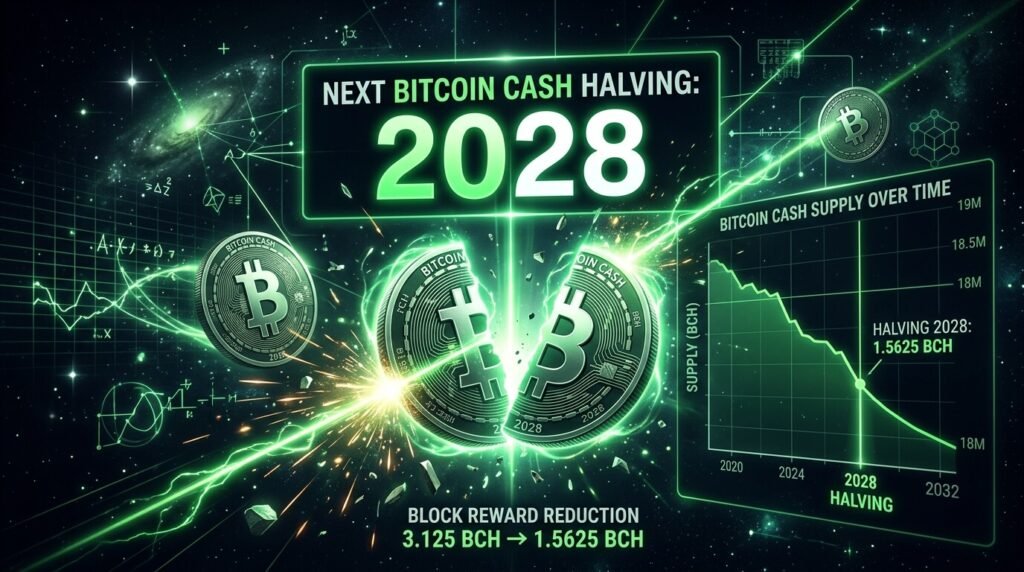
| Metric | Details |
|---|---|
| Current Price (April 2026) | ~$426–$445 USD |
| Market Cap | ~$8.5 billion |
| CoinMarketCap Ranking | #13 |
| Circulating Supply | ~20.02 million BCH |
| Maximum Supply | 21 million BCH (hard cap) |
| Current Block Reward | 3.125 BCH per block |
| Block Time | ~10 minutes |
| Block Size | 32MB+ |
| Consensus | Proof of Work (SHA-256) |
| Last Halving | April 4, 2024 |
| Next Halving | ~2028 |
| All-Time High | ~$4,355 (December 2017) |
Key Tokenomics Details:
Bitcoin Cash shares Bitcoin’s supply model — the same hard cap of 21 million coins and the same halving schedule (every 210,000 blocks, approximately every four years).
The most recent halving occurred on April 4, 2024, cutting the block reward from 6.25 BCH to 3.125 BCH. With approximately 20 million BCH already in circulation, only about 1 million remain to be mined over the coming century.
The halving mechanism creates a deflationary pressure: fewer new coins enter circulation over time. This mirrors the economic model of Bitcoin and was explicitly designed to prevent inflation.
Bitcoin Cash and the ETF Landscape: What’s Happening in 2026?
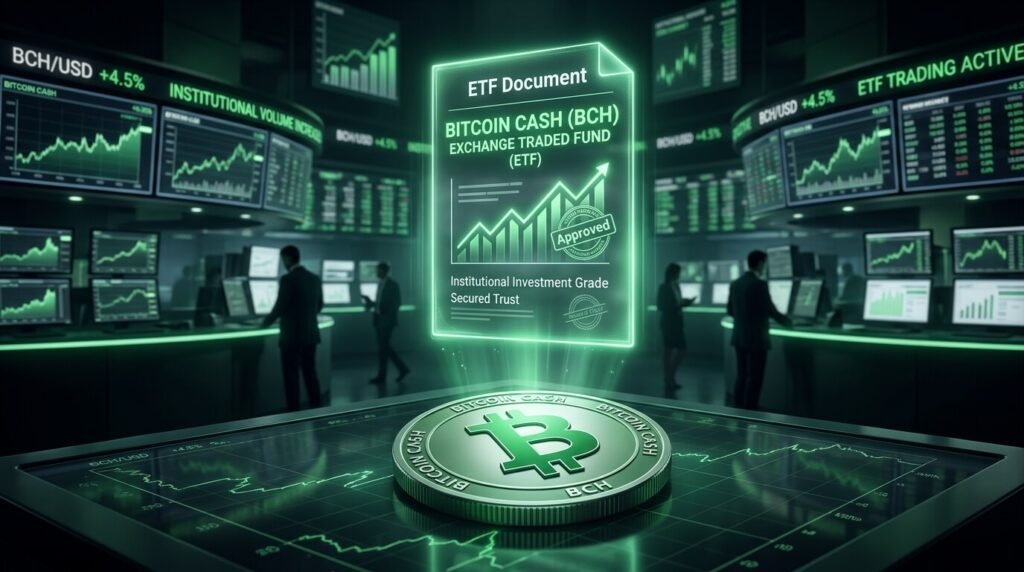
Here’s where things get interesting for institutional investors.
The SEC’s landmark ruling in March 2026 officially classified Bitcoin Cash — along with 17 other cryptocurrencies — as digital commodities subject to CFTC oversight rather than securities. This was a massive regulatory milestone that cleared the legal pathway for BCH-related investment products.
Grayscale filed registration statements in late 2025 to convert its Bitcoin Cash Trust into a spot BCH ETF, planned to list on NYSE Arca with BNY Mellon as administrator and Coinbase as prime broker and custodian. As of April 2026, this product has not yet launched — it awaits final SEC approval under the new Generic Listing Standards framework, which can process applications in as little as 75 days.
BCH was also included among the 10 tokens identified for expedited ETF consideration alongside DOGE, LTC, LINK, XLM, AVAX, SHIB, DOT, SOL, and HBAR. The first BCH spot ETF is widely expected to launch in 2026.
For US beginners: this means that eventually you may be able to gain BCH exposure directly through a regular brokerage account — no crypto exchange required.
Bitcoin Cash Price History: From $1 to $4,355 and Back Again
Bitcoin Cash has had one of the most dramatic price trajectories in crypto history.
2017 — The Big Bang: BCH launched at roughly $200–$300 immediately after the fork, as it inherited Bitcoin’s userbase and attention. By December 2017, it had surged to an all-time high of approximately $4,355 during the infamous crypto bubble — briefly flipping Ethereum in market cap.
2018–2019 — The Long Winter: Like almost everything in crypto, BCH crashed hard in 2018, eventually bottoming near $85. The November 2018 split into BCH and BSV added further confusion and selling pressure.
2020 — The First Halving: BCH’s first halving on April 8, 2020 initially caused some selling (“buy the rumor, sell the news”). The broader crypto bull market that followed lifted BCH significantly, though it never returned to its 2017 highs.
2021 — The Bull Run: BCH climbed to around $1,600 in May 2021 before the broad market correction. Still 63% below its all-time high, it demonstrated that while BCH can participate in bull markets, it tends to underperform Bitcoin and Ethereum during major rallies.
2022–2023 — The Bear Market: The collapse of Terra/Luna and FTX dragged the entire market lower. BCH fell to lows around $80–$100 before recovering.
2024 — Second Halving: The April 2024 halving cut rewards to 3.125 BCH. Price ranged roughly $250–$670 through the year as the broader market recovered.
2025–2026 — Current State: BCH has traded in the $430–$670 range, with the market showing resilience in February 2026 despite a broader crypto downturn. The upcoming Layla upgrade in May 2026 and the anticipated ETF launch have generated renewed developer and investor interest.
What Is Bitcoin Cash Actually Used For?
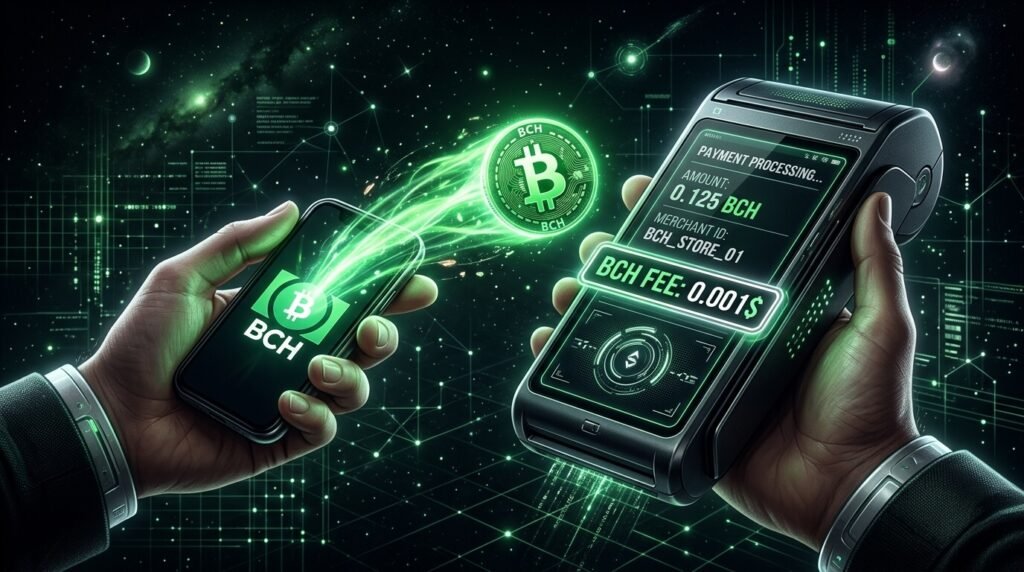
BCH has positioned itself as “digital cash” — a medium of exchange for everyday transactions. Here’s where it actually shows up:
Merchant Payments: Bitcoin Cash has historically had stronger merchant adoption than many altcoins. Platforms like BitPay and Coinbase Commerce support BCH payments, and it ranks 4th for merchant acceptance among cryptocurrencies according to TradingView data.
Remittances and Cross-Border Payments: With fees often under $0.01 and confirmations in roughly 10 minutes, BCH is genuinely useful for international money transfers — particularly in regions where traditional banking is expensive or inaccessible.
Micropayments: Low fees enable tipping, small content payments, and in-app micro-transactions that would be uneconomical on Bitcoin or Ethereum.
CashTokens — Native Tokens and NFTs: The 2022 CashTokens upgrade brought fungible and non-fungible token creation directly to the BCH base layer. Developers can now build token economies without third-party protocols.
DeFi (Emerging): The upcoming CashVM upgrade in May 2026 aims to significantly expand BCH’s smart contract capabilities, potentially enabling more complex DeFi applications — all at BCH’s characteristically low fees.
NEAR Protocol Integration: Since December 2025, BCH has been integrated with NEAR Intents, enabling seamless cross-chain swaps across 25+ blockchains. This interoperability expands BCH’s utility beyond its own ecosystem.
Bitcoin Cash Risks: The Honest Version
No crypto guide worth reading skips the risks. Here’s the unfiltered version:
Lower Security Than Bitcoin: BCH shares Bitcoin’s SHA-256 mining algorithm but has dramatically less hashrate. This means BCH is theoretically more vulnerable to a 51% attack — where a single entity controls enough mining power to rewrite the blockchain history. Bitcoin’s hashrate dwarfs BCH’s, making Bitcoin almost impossibly expensive to attack; BCH is significantly cheaper to target.
The Narrative Challenge: BCH has struggled to define itself beyond “cheaper Bitcoin.” With Bitcoin’s Lightning Network maturing, and Layer 2 solutions improving, the “low fees” argument for BCH becomes less distinctive over time.
Community Fragmentation: The 2018 split into BCH and BSV, ongoing developer disagreements, and the contentious history of the fork have left BCH with a divided community that lacks the unified momentum of Bitcoin or Ethereum.
Volatility: Like all crypto assets, BCH can move dramatically in both directions. It has historically been more volatile than Bitcoin and doesn’t have Bitcoin’s institutional backing or ETF assets (yet).
Regulatory Risk: While the March 2026 SEC commodity classification was positive news, the broader regulatory landscape for crypto continues to evolve globally. Tax treatment, exchange regulations, and cross-border restrictions remain sources of uncertainty.
How to Buy Bitcoin Cash in the US: Step by Step
Buying BCH in the United States is straightforward on any major exchange:
Step 1 — Choose an Exchange
BCH is available on all major US exchanges including Coinbase, Kraken, Gemini, and Binance.US. For beginners, Coinbase offers the simplest interface.
Step 2 — Create and Verify Your Account
Sign up with your email, complete identity verification (government ID required), and enable two-factor authentication. This typically takes 5–15 minutes.
Step 3 — Add Funds
Link your bank account or debit card. Bank transfers (ACH) are usually free but take 1–3 business days. Card purchases are instant but carry a 1.5–3.5% fee.
Step 4 — Buy BCH
Search for “Bitcoin Cash” or “BCH,” enter the dollar amount you want to spend, and confirm the purchase. You can buy fractional amounts — you don’t need to buy a whole BCH.
Step 5 — Consider Self-Custody
If you’re buying a significant amount, consider moving your BCH to a hardware wallet (Ledger or Trezor both support BCH) rather than leaving it on an exchange. “Not your keys, not your coins.”
Step 6 — Keep Records for Taxes
In the US, crypto is treated as property for tax purposes. Every sale or exchange is a taxable event. Use software like CoinTracker or Koinly to track your cost basis.
Key Bitcoin Cash Terminology for Beginners
Hard Fork: A change to a blockchain’s rules that’s incompatible with the previous version, resulting in a permanent split into two separate chains.
Block Size: The maximum amount of data a single block can contain. BCH has a 32MB+ limit vs. Bitcoin’s effective ~1–4MB.
SegWit (Segregated Witness): A Bitcoin upgrade that separates signature data from transaction data, effectively increasing capacity without raising the block size limit. BCH does not use SegWit.
SHA-256: The cryptographic hashing algorithm used by both Bitcoin and Bitcoin Cash for Proof of Work mining.
CashTokens: A native protocol upgrade that allows fungible tokens and NFTs to be issued directly on the BCH blockchain without third-party contracts.
Halving: A pre-programmed event every 210,000 blocks (~4 years) that cuts mining rewards in half, reducing new BCH supply entering circulation.
UTXO (Unspent Transaction Output): The accounting model used by both Bitcoin and BCH, where coin ownership is tracked through unspent outputs rather than account balances.
51% Attack: A theoretical scenario where a miner controlling more than 50% of a network’s hashrate could manipulate the blockchain’s transaction history.
Should You Buy Bitcoin Cash in 2026?
Let’s be balanced about this.
The case for BCH: It’s a battle-tested blockchain with nearly a decade of uptime, a top-15 market cap, genuinely low transaction fees, and real merchant adoption. The upcoming Layla upgrade in May 2026 could materially expand its utility as a smart contract platform. The imminent spot ETF filing from Grayscale — and the broader SEC commodity classification — could bring institutional capital into BCH for the first time. If you believe in the “digital cash” use case, BCH is the most established version of that thesis.
The case for caution: BCH has consistently underperformed Bitcoin during bull markets and faces existential competition from Bitcoin’s Lightning Network for the “cheap payments” narrative. Its hashrate security is significantly lower than Bitcoin’s, and its community has a history of conflict. While the ETF could be a catalyst, it’s not yet approved.
The honest bottom line: Bitcoin Cash occupies a real niche and isn’t going away anytime soon. Whether it’s the right asset for your portfolio depends on your risk tolerance, your conviction in the digital cash thesis, and your broader crypto strategy. Neither “definitely buy it” nor “definitely avoid it” would be honest advice — and that’s exactly the kind of advice this article isn’t in the business of giving.
Do your research. Think about position sizing. And maybe check on that Layla upgrade when May 2026 rolls around.
Much bigger blocks. Very low fees. Such fork drama. Wow. 💸
Disclaimer: This article is for informational purposes only and does not constitute financial advice. Cryptocurrency investments carry significant risk, including the potential loss of all invested capital. Always conduct your own research before making any investment decisions.